Hungarian banks cry out in vain, decree published on doubling free cash withdrawal limit


Despite protests from the Hungarian Banking Association, the change was published in the Hungarian Gazette overnight and will come into effect on 1 February 2026,
raising the monthly limit for free cash withdrawals from 150,000 to 300,000 forints.
As under the current rules, the full amount may still be withdrawn up to twice a month.
Banks must also increase the amount that can be withdrawn from ATMs in a single transaction to HUF 300,000. This is important to prevent banks from circumventing the rule by setting a lower limit per transaction and thus preventing customers from withdrawing cash in one go. However, ATMs may have physical limitations on dispensing such large amounts at once, especially if they cannot dispense notes of a large denomination.
Although the amount withdrawn has been stagnating or growing at a rate below that of inflation, the number of cash withdrawals made using cards has been declining in recent years. This suggests that it cannot be assumed that the majority of society needs the limit increase.

Meanwhile, card payments — currently the strongest alternative to cash — continue to spread rapidly. Qvik payment solutions, which were launched last year, are also becoming increasingly popular in Hungary.
Overall, we can see that 10 years ago, we used our cards more for cash withdrawals. Today, however, the ratio has clearly shifted towards card payments:
we now spend 2.5 times more with cards than we withdraw in cash.

If the dramatic shift is not clear from the above graph, consider this one, which shows why the government's obsession with cash is misguided and goes against the trend.

Banks protest in vain
The Hungarian Banking Association has strongly condemned the planned move. They claim that the root of the problem lies in the 0.9% financial transaction tax charged on all ATM cash withdrawals. In their statement, they warn that, in the current tax environment, the proposal would place an additional burden on banks. You can read our previous detailed article on this topic here. And we have also analysed in depth another government mandate which obliges banks to expand their ATM network.
The advocacy group emphasised that, despite the appearance of free services, there are real costs that customers ultimately bear through other channels. This also affects people who don't withdraw cash.
The transaction fee payable by banks will double from HUF 1,350 to HUF 2,700 per month for a single account,
provided that the customer has taken advantage of the new maximum fee exemption limit for cash withdrawals and continues to do so.
The renaissance of cash
Over the past year or two, the government has made a series of decisions that could lead to a revival of cash use in the era of digital payments:
- the possibility of cash payments has been enshrined in the constitution;
- the central bank (MNB) has introduced regulations for installing ATMs;
- this spring, banks were also obliged to install at least one ATM in every municipality.
The two measures affecting ATMs were not without effect. At the end of the first quarter of 2023, there were 4,769 ATMs in operation in the country. Compared to this, the current situation marks a significant improvement:
in the third quarter of this year, the number of ATMs increased by almost 14% to 5,437 — a new record.

The number of ATMs in county seats totalled 977 at the end of September, down 1.6% compared to 10 years ago, but up 6.1% over end-March 2023. The lowest figure was reached two years ago, when there were only 894 ATMs in county seats at the end of September.

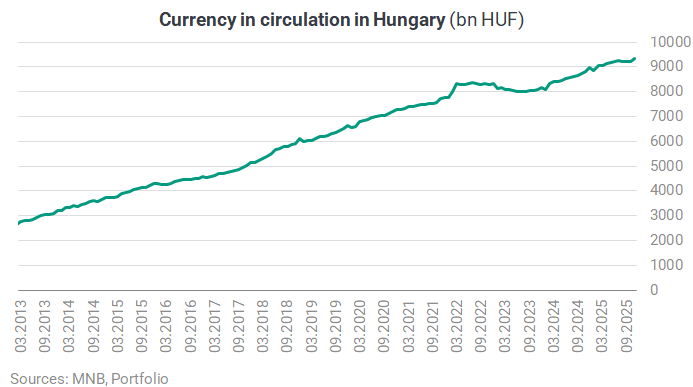
According to data from the central bank, HUF 9,333 billion was in circulation in the domestic currency at the end of November, which is lower than the previous year but still represents an increase of 5.7%, above inflation.
It is reasonable to expect that the new measure will speed up the growth of currency in circulation to some extent.
The world, and salaries within it, is moving towards digitalisation. This means more convenient and faster payments, eliminating the need to count out change at the till, and, looking at the bigger picture, cheaper and more efficient cash flow, as well as reducing the black and grey economies of a country. From this perspective, raising the limit for free cash withdrawals is not a step in the right direction.
At the same time, it is also true that Scandinavian and Western economies, which have become almost completely cashless, have encountered new issues related to the absence of cash that require attention. This has excluded the 'underbanked' group, who do not have bank accounts, from certain services. In addition, cash could serve as a 'last resort' in the event of a total internet outage or power failure. However, if there is no electricity, neither cash registers nor online stores will work, even if we could pay with banknotes and coins. Many Western countries are now rediscovering the value of cash as a refuge. It will be interesting to see what those who are a few years ahead of us in digitalisation achieve. It will probably be worth learning from them.
Cover image (for illustration purposes only): Getty Images