Rating reviews loom over Hungary, with even a downgrade on the cards


Last rating reviews of the year are approaching
Hungary has ticked off most of the major credit rating reviews for 2025, but the last two are still pending. Moody's will publish the outcome of its review on Friday, with Fitch Ratings following a week later. Currently, Hungary has a Baa2 rating from Moody's and a BBB rating from Fitch. The ratings represent the same level;
the only difference is that Moody's has a negative outlook, while Fitch has a stable outlook.
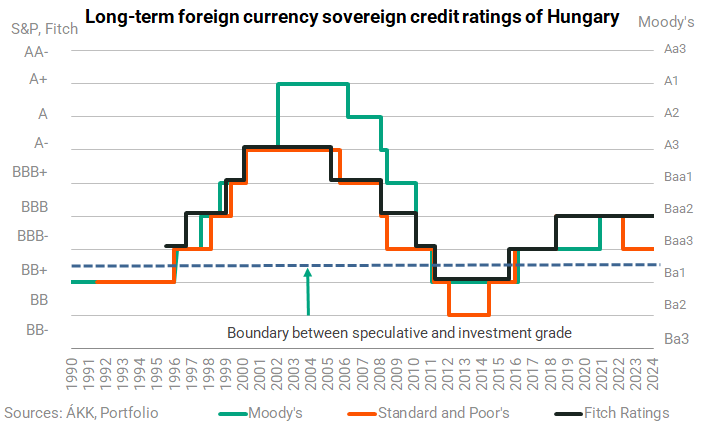
The graph shows that both companies rate Hungary one notch higher than the third major credit rating agency, Standard & Poor's. This means that, unlike with S&P, there is currently no threat of Hungary slipping into non-investment, or 'junk', grade.
Moody’s: one year after the negative outlook
Moving forward chronologically, Moody's decision on Friday will be worth watching. The rating agnecie last reviewed Hungary's rating at the end of May, but did not change it at that time. A year ago, Moody's assigned a negative outlook to the Baa2 rating, which typically suggests
a potential downgrade within the next 6–24 months.
Based on experience, this happens in about two-thirds of cases. This means that Hungary has reason to fear the current decision, as there is a realistic chance of a rating change after one year. Moreover, if we consider the credit rating agency's previous economic forecasts, it is unlikely that the outlook will be revised back to positive.
Last November, Moody's also interpreted the negative outlook as meaning that Hungary's rating was unlikely to be upgraded in the near future. One of the most significant risks to the Hungarian economy was considered to be the permanent loss of a significant portion of EU funds, which are currently frozen.
Thus, they could only consider raising the outlook to 'stable' if there were substantial improvements in relations between the Hungarian government and the EU and if progress were made in meeting the conditions set by Brussels to unblock funds. As there has been no improvement in this area over the past year, fears of a permanent loss of funding appear to be justified for the time being.
Credit rating experts would also view stronger-than-expected GDP growth and more favourable budget and debt trends as positive developments. However, negative developments have also occurred in these areas, with the government officially raising its deficit target to 5% of GDP for this year and next, while economic growth forecasts continue to deteriorate.
A year ago, Moody's experts projected GDP growth of 1.9% by 2025. However, by May, they had revised this down to 1%, and today, even the government would be happy with a growth rate of around 0.5%. The analysts of the rating agency also cut their 2026 growth estimate for Hungary to 2.8% from 3.2% previously.
Based on the above,
it can be practically ruled out that Moody's will upgrade the negative outlook to stable. Based on the considerations outlined when the outlook was lowered, it is possible that Hungary will be downgraded to Baa3 on Friday.
Of the scenarios outlined a year ago, Hungary has moved in a rather negative direction, as no progress has been made in recovering EU funds — in fact, the country has lost a small portion of the funds permanently. Moody's may also view the much weaker than expected GDP growth and the deterioration in the state budget situation negatively.
When the deficit target was last increased, economists at ING Bank in Budapest noted that this move had clearly increased the likelihood of a downgrade to 'Baa3'. This situation may be further complicated by the fact that, in May, Moody's projected that Hungarian public debt could stagnate at 73.5% this year and next — the same level stated by Economy Minister Márton Nagy when he announced the higher deficit targets. Given this, it is possible that the credit rating agency was not entirely taken by surprise by the deterioration in Hungary's overall budgetary situation.
Fitch: back to a negative outlook?
Fitch Ratings caused surprise when it upgraded the outlook on Hungary's BBB debt rating from negative to stable a year ago. Experts interpreted this as meaning that the credit rating agency could no longer justify maintaining the negative outlook that had been in place for two years, and so had to choose between a downgrade and a stable outlook.
We will learn about this year's last rating review by Fitch next Friday. When the outlook was upgraded last November, the main positive factor highlighted was the reduction in macroeconomic imbalances, with inflation falling and the current account balance returning to surplus. Nevertheless, they emphasised that fiscal policy would be uncertain in the run-up to the 2026 parliamentary elections.
In their June review, Fitch experts forecasted economic growth of just 0.7% for Hungary in 2025. This is now broadly in line with market expectations, but can only be described as moderately optimistic. Analysts expect growth to accelerate to 3.1% in 2026.
In June, Fitch estimated Hungary's budget deficit to reach 4.6% of GDP this year and 4.1% in 2026. In comparison, the government's revised deficit target of 5% is significantly higher, particularly for next year. Fitch economists highlighted that lower-than-expected GDP growth and a higher deficit could lead to negative outcomes if the debt trajectory cannot be reduced sustainably. However, it now seems likely that the increased deficit target will cause the debt-to-GDP ratio to stagnate or even rise slightly in the coming years.
In the case of Fitch Ratings' review,
there is perhaps a greater chance that the current rating and stable outlook will be maintained,
as they are not under the same pressure as Moody's, who will soon have to act due to their negative outlook. If there is a change, it will also be negative, meaning a downgrade of the outlook is possible.
Only one question remains
Based on the assessments of the two credit rating agencies to date, the most important question regarding the upcoming reviews is
whether they will take any negative action in the months leading up to the 2026 parliamentary elections.
In theory, this should not be taken into account when making decisions. However, there are already signs in the market that a potential Tisza Party victory is being factored in. This could lead investors to anticipate an improvement in relations between the Hungarian government and the European Commission, as well as access to EU funds that were previously deemed inaccessible. The question is how rating agencies will assess this positive risk.
As we mentioned, the credit rating agencies will not issue a new opinion on Hungary until 2026, after the two upcoming reviews. The schedules for next year are not yet known, but S&P's review is expected to be first, probably in April. This could create an even more 'tense' situation due to the elections, which is also scheduled for April, as it will not yet be clear which party will be able to form a government. Moody's and Fitch are expected to publish their first decisions for 2026 later, around May–June, and they may take the election results into account.
Cover image (for illustration purposes only): Getty Images





