This is how the Hungarian economy failed to grow


The Hungarian economy has been in a state of near stagnation for more than three years. Its output has contracted eight times and grown four times in the last 13 quarters, and was flat in Q3 this year. Overall, industry is being weighed down by weak demand in external markets and the challenges facing the European automotive industry in terms of competitiveness, while the construction industry is being dragged down by weak domestic investment demand, compounded by the adverse impact of unfavourable weather on agriculture. These downward pressures are offset by a few service sectors, which primarily benefit from rising household incomes.
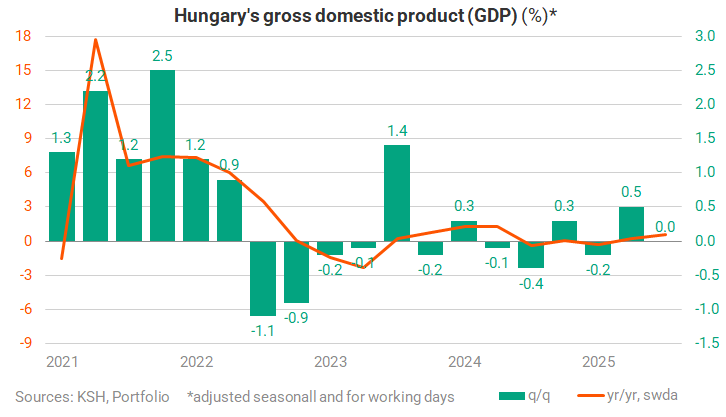
This is how the economy was producing in Q3
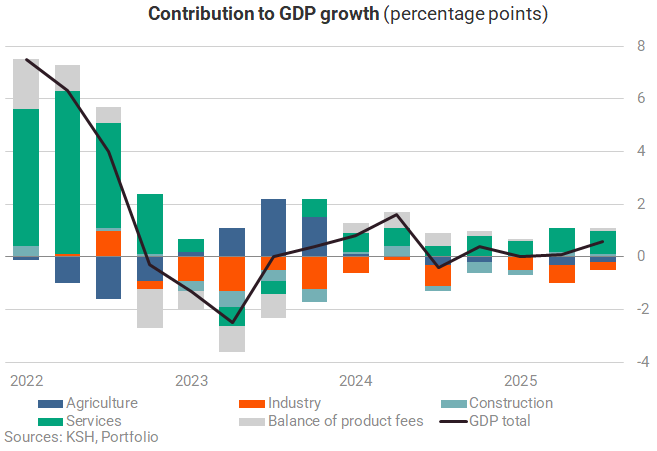
All this means that only the service sector was able to make a meaningful contribution to the 0.6% year-on-year GDP growth in the third quarter. Industry dragged down performance, while the construction industry, which has been on a zigzagging path but carries little weight, contributed by almost nothing. It came as a minor surprise that agriculture ultimately reduced growth by only 0.2 percentage points, which also means that
growth was very modest even after filtering out the impact of bad weather.
A similar picture emerges when the short-term performance of individual sectors is plotted on a heat map. Quarterly growth is primarily evident in the service sectors, such as trade, transport, and financial activities. However, this less-than-bubbly performance was partly due to a decline in GDP in the communications, real estate and entertainment sectors. Surprisingly, industry expanded in terms of added value, while monthly production volumes showed a slight decline. This positive development was crucial in ensuring that the quarterly GDP index remained positive.

Murky picture on the demand side
Examining GDP from the demand side reveals a rather unusual situation. Initially, growth in household incomes appeared to be driving household consumption, which is the driving force behind the economy. However, this was offset by external factors (exports) and the collapse of investment. However, this changed in the third quarter. The contribution of household consumption to growth declined (the Central Statistical Office also retrospectively revised the previous quarter's data downwards) and stockpiling and production for stockpiling became the main growth factors instead.
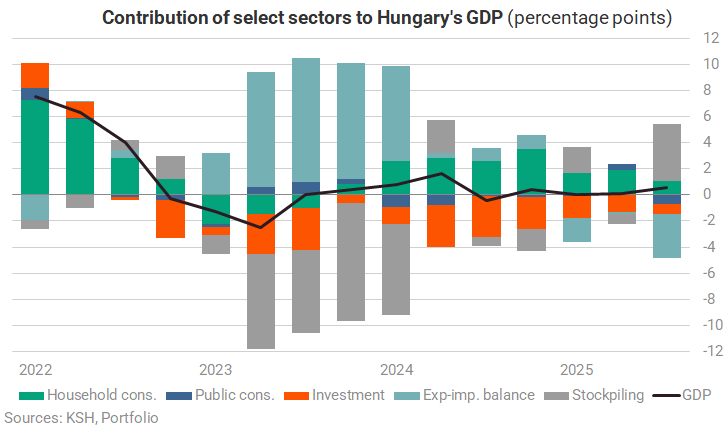
This does not align with our current understanding. The confusion is further compounded by the fact that the Central Statistical Office's October revision brought about drastic changes for 2023 and 2024. As can be seen, the office now believes that exports provided a significant growth impetus due to the depletion of stocks. These substantial gross figures are difficult to interpret. One possible narrative could be that exports, which had faltered during the pandemic, took off when lockdown measures were lifted and accumulated inventories were sold off. However, this is contradicted by the data, which shows that there was no significant stockpiling activity during the pandemic.
Today's release of third-quarter data shows the opposite: it is as if the strength of net exports had vanished, yet industry had continued to produce for stockpiling. However, we consider it much more likely that these interpretations do not make much sense.
Instead, GDP compiled from the supply side (i.e. the value produced by the manufacturing and service sectors) may be poorly matched with demand items (i.e. what was consumed, invested or exported from production). What is missing is the change in inventories. It is highly doubtful that this reveals anything about the structure of Hungarian growth.
What next?
Based on the data from the first three quarters, the key question for 2025 is whether the average annual growth rate will fall below last year's figure of 0.6%. According to our calculations, a significant upturn would be required at the end of the year to avoid this. GDP would need to grow by 1.5% on a quarterly basis. The last time this occurred was during the rebound after the Covid shock, but historically it is considered a rare event.
The upturn may be helped by election handouts, which have increased household income, and by industrial investments starting to bear fruit. However, weak export data in October casts doubt on the extent of the rebound. Currently, growth of around 0.3-0.5% this year seems more likely.

Growth expectations for next year are much more favourable, thanks to rapid wage growth, increased industrial production capacity and a halt in the decline of investment. If 1-1% quarterly growth can be achieved in the coming period, this would result in an average annual GDP growth rate of over 3% by 2026. However, if economic growth remains subdued and quarterly GDP growth rates are around 0.5%, next year's expansion would be less than 2%.
Cover image (for illustration purposes only): Getty Images





