Hungary's public debt and budget deficit have increased - EcoMin

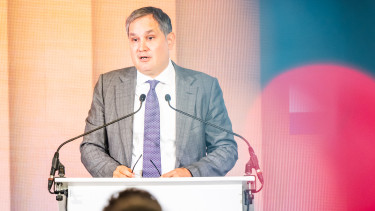
The budget deficit and public debt are deviating from the previously communicated trajectory, Minister of National Economy Márton Nagy acknowledged in an interview with news portal Index. He recalled that the government had previously suggested the debt ratio would plateau in 2025–26, but this is no longer considered sustainable. According to him,
public debt stood at 73.5% of GDP at the end of 2024. In 2025, the accrual-based deficit is expected to be 4.9% of GDP, meaning the debt ratio has risen to around 74.6%.
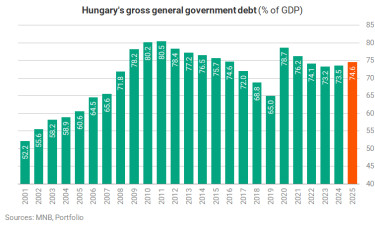
The increase in public debt is not unexpected, given that Portfolio has repeatedly suggested throughout the year that an upward debt trajectory is highly likely. Since 2020, the Hungarian government has had to raise an average of HUF 5,000 billion each year through new debt to finance its spending. With the economy stagnating, it is impossible to grow out of this situation, so it is unsurprising that we are witnessing the highest debt ratio in four years.
The minister also mentioned that the central subsystem of public finances closed with a deficit of HUF 5,738.7 billion, as detailed by Portfolio on Thursday. The 4.9% deficit is interesting because, in September, the government raised its 2025 deficit target from 4.1% to around 4.5%, and its 2026 target from 3.5% to 4%. Notably, in early November, the Economy Minister had already projected a deficit of around 5% for both last year and 2026.
He said that a one-off technical factor had also played a role in the dramatic deterioration of the figures.
At the end of December, the European Commission failed to transfer HUF 248 billion in EU funds by the deadline. This in itself increased the cash flow deficit for 2025.
He emphasised that, although these amounts will be received in early January, they distort the year-end picture. However, this does not affect the accrual-based picture, as the delayed revenue can also be accounted for in 2025. This is why last year's deficit forecast did not increase, with 4.9% being practically in line with the indications given in November.
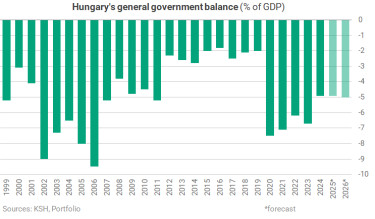
At the same time, Márton Nagy stated that, in European comparison, the accrual-based indicators – the 4.9% deficit and the 74.6% debt ratio – are not excessive, and he believes that they are roughly in line with the EU average. He stressed the importance of maintaining smooth financing and market confidence, even if the budgetary outlook has worsened in the short term.
Márton Nagy argued that the foreign currency bond issue on Wednesday specifically indicates confidence in the country. He stated that demand for issuance totalling EUR 3 billion was three times higher than the offer, with bids exceeding EUR 10 billion. This enabled the ÁKK to achieve a price that was 25–30 basis points more favourable than expected. (It should be noted, however, that demand is a matter of price: even in regional terms, the Hungarian state can borrow at high rates.)
He believes that this demonstrates investors' continued confidence in Hungary's financial viability, despite the surge in the deficit.
The minister emphasised that nearly half of the annual foreign currency resources had already been secured by the beginning of the year, providing substantial financial security, in his opinion.
He claims that the government has sufficient liquidity and reserves, and that it is capable of handling external financial pressure. Negotiations are also underway on the creation of an American financial 'protective shield', which he believes could provide additional security.
Cover photo: Portfolio





