Hungary's inflation retreats in December 2025


In November, the year-on-year CPI retreated to 3.8% from 4.3% in previous months, bringing annual inflation back below 4% after a year. This was a significant development in that it brought the rate of inflation within the MNB's tolerance band, as the central bank targets inflation of 3% +/- 1 percentage point. With the latest figure of 3.3%, the consumer price index moved even closer to the middle of the 2-4% range. There are several reasons for the slowdown in inflation at the end of the year:
- favourable changes in fuel prices;
- the strengthening of the forint exchange rate;
- the reversal of the food price cycle;
- restrained repricing (most likely due to the weak economic situation); and
- the high base at the end of 2024, which is the result of a wave of price increases triggered by the weakening of the forint at that time.

These factors are also evident in the December inflation figures published by the Central Statistical Office (KSH). Monthly inflation stood at just 0.1%, which confirms the low level of repricing activity. The stats office recorded price declines in two key product categories: food and fuel. Global market prices and the value of the forint played a significant role in these declines. Eggs were 3.0% more expensive than in November, as were fruit and vegetable juices (2.2%), non-alcoholic soft drinks (1.4%), snack foods (0.6%), and bread (0.2%). Meanwhile, butter, spreads and cheese were 2.4%, 1.9% and 1.7% cheaper respectively, while milk and cooking oil were 1.1% cheaper.
Price developments were subdued in the case of clothing, while the base effect contributed to the decline in the annual price indices for piped gas and durable consumer goods.
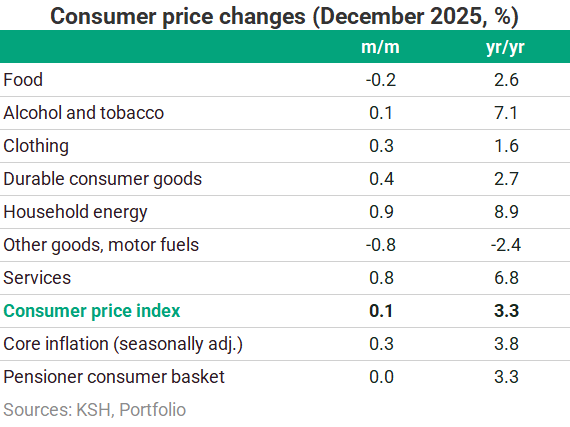
The picture is made more nuanced by the fact that the annual rate of price increases for services accelerated from 6.5% to 6.8%, while the core inflation indicator, which captures more persistent price movements, remained higher at 3.8%. Admittedly, the latter also declined, from 4.1%. The short-term annualised core inflation indicator accelerated slightly but remained below 3%.

This is not how the year started
The resumption of disinflation at the end of the year was particularly favourable, given that 2025 had started out quite differently. Due to various price shocks, tax increases and the weakening of the forint, the inflationary acceleration seen at the end of 2024 continued into 2025. The indicator, which had fallen close to price stability, rose to around 6%. Significant price increases were particularly evident in food, but prices for services, which are sensitive to inflation expectations, also began to rise again.
In March, the government introduced a profit margin cap and urged major service providers to put off price hikes. As price pressures eased, the inflation rate stabilised at around 4.5% by autumn. In the second half of the year, the intensity of repricing noticeably subsided, with hardly any price increases seen on a monthly basis. Consequently, from November to December, as the sharp price surge at the beginning of 2024–25 was removed from the year-on-year price index, the decline in inflation gained new momentum.
Annual average inflation is 4.4%
In 2025, the average annual consumer price level increased by 4.4%, a figure that is worth monitoring in relation to various economic factors that track inflation, such as inflation-linked government retail securities. Despite margin caps, this figure was higher than the 3.7% recorded in 2024.

On average, food prices in 2025 were 5.3% higher than the previous year, with eggs seeing the biggest increase at 20%. The only item to see a greater increase was jewellery (22%). The 17% rise in chocolate, cocoa and coffee prices can primarily be attributed to global trends, with cooking oil and fruit prices rising by the same amount and 15% respectively. The population certainly spent more on gas last year, which was seven times more expensive than in 2024, with the average price of piped gas being 14% higher.
However, the price of products covered by the margin cap fell significantly last year. For instance, margarine prices fell by 22%, while those of dairy products, sugar and pork fell by 4% and 3% respectively.
What to expect in 2026?
The effects seen in the last two months will remain strong at the beginning of the year, as the significant price shock that occurred at the turn of 2024-25 will no longer be reflected in the annual inflation indicator. This effect is amplified by the fact that, in an election year, the government is refraining from raising taxes and regulated prices at the start of the year, while continuing to urge major service providers, primarily in the telecommunications and financial sectors, to exercise restraint.
As a result, inflation is almost certain to fall below 3% in February. If this does not happen, it would be a major disappointment. However, with restrained market repricing, it could fall even further, to around 2%.
However, the indicator will then be subject to a downward pull from the food price cap that was in place in March and April of last year. Consequently, inflation will rise above 3% again. In its latest forecast in December, the National Bank of Hungary (MNB) calculated that the average annual price increase in Hungary this year could be 3.2%, with the price index remaining within the 2–4% tolerance range throughout the year — albeit closer to the upper end in the second half.
In response to the more favourable inflation outlook, the central bank slightly opened the door to monetary easing in December. Prior to today's data release, more optimistic analysts believed that the MNB could potentially cut interest rates as soon as this month. From this perspective, we believe that December's inflation is neutral: it neither strengthens nor weakens the arguments in favour of an early interest rate cut.
According to the more cautious approach, the MNB will wait for the results of the price adjustment period at the start of the year, which is traditionally the most intense seasonally. If February inflation falls significantly below the central bank's target as a result, a convenient solution would be to start cutting interest rates in March, as forecast in the latest inflation report. However, if exchange rates at the beginning of the year prompt the central bank to exercise caution, interest rate cuts may be postponed until the second half of the year.
The main risk this year is that we may experience the opposite of what happened in 2025: encouraging inflationary trends at the beginning of the year, followed by a stronger-than-expected acceleration in the second half. This risk scenario could be supported if:
- changes to the margin cap cause a stronger rebound in food prices;
- tax income policy pushes up prices;
- service providers make up for two years of delayed price increases after the election;
- economic policy implements the necessary fiscal adjustments through price-driving measures, such as regulatory price increases and indirect tax hikes; and
- it is forced to take immediate action due to the deterioration of the external financing environment, meaning a smoother fiscal path cannot be managed.
Cover image (for illustration purposes only): Getty Images





