Cash is back in vogue in Hungary – What is going on here?


Cash in circulation
The amount of cash in Hungarian forints increased by approximately 4.6% last year.
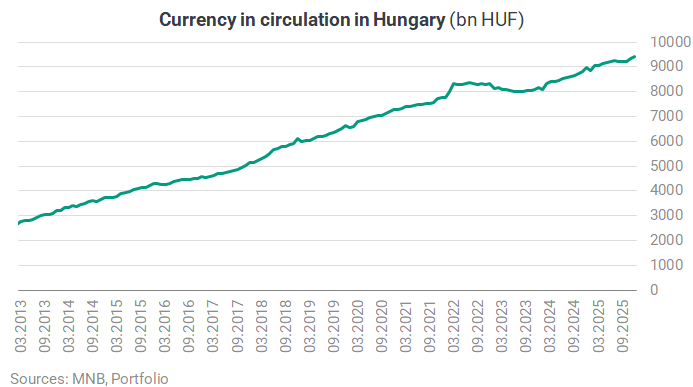
This is slightly higher than the 3.3% year-on-year month inflation rate recorded in December and is roughly equivalent to nominal GDP growth. According to data from the Hungarian Central Statistical Office, annual inflation was 4.4% last year, while real GDP remained largely stagnant.
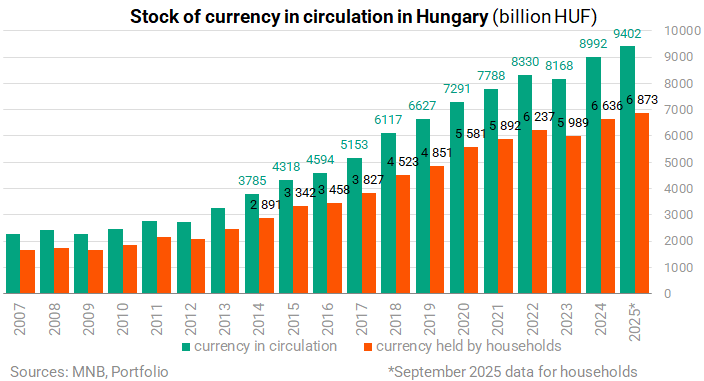
Examining the growth rate, it can be seen that the stock of currency in circulation declined in 2023 for the first time in 14 years, before rising again in 2024.
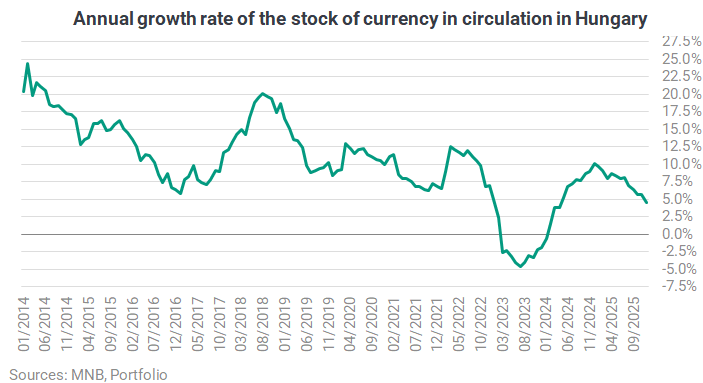
The drivers of changes in cash holdings may have been:
- Roughly three-quarters (73%) of the total cash supply is held by the population, partly for monetary purposes. However, household consumption only increased modestly overall in 2025 (retail sales grew by 2.5% year-on-year in November, which was below the average of 2.8% for the first 11 months).
- The rapid growth of electronic payment methods, such as Qvik and card payments, may further reduce the use of cash in monetary transactions by 2025.
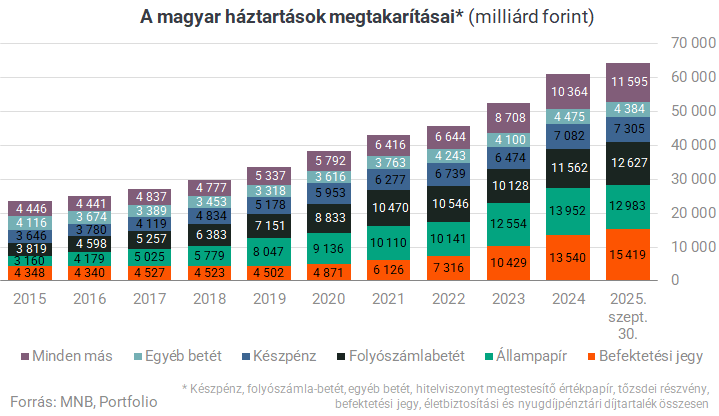
- Over the course of the year, cash holdings for savings purposes continued to lose much of their real value due to the high inflation rate of 4.4%. This may have prompted people to invest in yield-generating assets, thus contributing to the decline in cash holdings. The graph below shows the amount of cash held by the population in dark blue. This data includes foreign currency.
Cash trends abroad and Hungary
Although the use of cash became a constitutional right in Hungary last year, this did not suddenly change how we think about or use cash. This development is probably not related to the increase in cash holdings; financial and practical considerations are likely to be much more important factors.
Although the use of cash is generally declining worldwide, individual countries often follow different paths due to local characteristics, customs and infrastructural legacies. According to the European Central Bank's (ECB) 2024 survey of the euro area,
Cash was the most frequently used payment method at the POS in the euro area and was used in 52% of transactions, against 59% in 2022,
but the share of cash payments has declined.
In terms of value,
- the most important single payment instrument was cards, with a share of 45% (46% in 2022);
- cash had a share of 39% (42%); while
- the share of payments made with mobile devices increased from 4% to 7%; and
- the remaining 9% of transactions are completed using other payment solutions.
On average, consumers consider cards to be faster and easier to use. However, they believe that cash is more effective for managing spending and protecting privacy.
The Norwegian financial information website Finansplassen compiled statistics from the World Bank, Eurostat and other publicly available data to examine which countries are closest to achieving a cashless economy.
With 45 European countries in the rankings, Hungary came 22nd, right in the middle.

Electronic payments
Card transactions still account for the majority of electronic payments. In this area, double-digit growth is typically seen annually in terms of both transaction volume and payment value.

Meanwhile, the number of card-based cash withdrawals has been declining steadily for some time. After a period of slow growth, their value has also begun to decline over the past two years, with the amount withdrawn falling on an annual basis in seven of the last eight quarters.

Overall, people now spend roughly twice as much money in Hungary using cards as they withdraw using them. Payment habits are changing slowly but surely.
Ten years ago, for example, Hungarians withdrew nearly 2.5 times more cash with bank cards than they paid with them.

In addition to cards, Qvik payments based on the domestic Instant Transfer System are becoming increasingly prevalent in various payment scenarios, primarily online but also in some physical stores. One of the first physical stores to adopt this system was CBA, which introduced qvik payments based on the Instant Transfer System in nine of its Prima stores at the end of January this year. Here, we can pay at self-service checkouts using a QR code solution. Praktiker followed suit in December, and the payment method has been available in all 23 of its stores since 11 December last year.

ATMs all over the place, free-of-charge cash withdrawal threshold doubled
Despite protests from banks, a legislative amendment raising the limit for free cash withdrawals to HUF 300,000 per month, available on up to two occasions, was published in the Official Gazette in December, so payment trends in 2026 will likely be influenced by cash. This means that a new era for ATMs will begin on 1 February, when we will theoretically be able to withdraw up to HUF 300,000 instead of HUF 150,000.
Last spring, the government required banks to install at least one ATM in every municipality, with the National Bank of Hungary (MNB) acting as the professional administrator. Banks must comply with this decree in municipalities with a population of 1,000 by the end of 2025, and
those with fewer than 500 inhabitants will be next.
While the banking system can 'work together' and optimise, i.e. relocate ATMs, it would not be possible to meet the requirements without installing hundreds of new ATMs, potentially more than a thousand.
We have examined whether Hungary needs so many ATMs. Spoiler alert: it doesn't!

Cover image (for illustration purposes only): Getty Images





