2025 tourism year comes to an end. Has Hungary finally achieved the much-talked-about "historic record"?


From a tourism perspective, 2025 can be broadly characterised as having strong early and late seasons, a weaker peak season, rapidly growing foreign visitor numbers, modest domestic growth, and overall record annual figures.
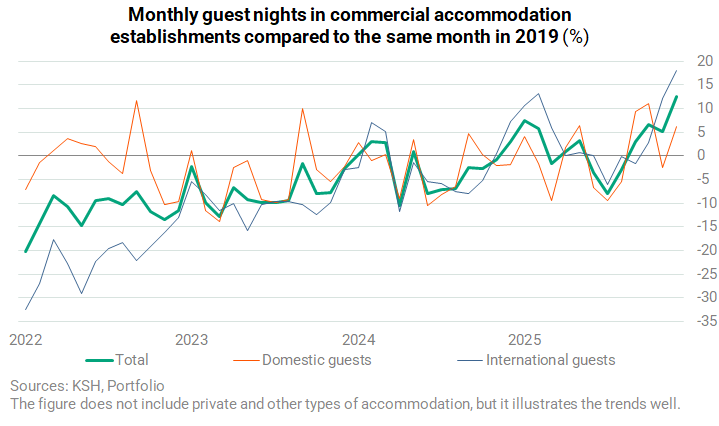
Domestic tourism trends can best be tracked in the graph below.
- According to this, the number of guests staying in commercial accommodation peaked in 2019.
- Then, the pandemic hit domestic tourism very hard and foreign tourism even harder.
- Following the lifting of lockdown measures, a correction began in both areas.
- While this has continued until now for foreigners, the willingness of Hungarians to travel began to decline slowly from 2022 onwards,
- only rising again last year.
- This meant that, from 2024 onwards, foreign guest nights would exceed domestic guest nights.
- In 2025, these trends continued:

As commercial accommodation accounts for 70% of total tourist traffic, it provides a reliable picture of the main trends. Data on other (primarily private) accommodation are only available from 2021 onwards, so it is not possible to provide a comprehensive overview for such a long period. The trends have been similar since this data has been available.

2025 was primarily characterised by increased foreign interest: the number of guest nights spent in commercial accommodation exceeded 16 million for the first time. Meanwhile, guest nights spent in Hungary by locals reached 15.6 million, which is lower than the figures seen in 2018–19. However, practically speaking, we can say that we are approaching the peak.

Examining tourism trends, we can observe an interesting structural change. Compared to the previous record year of 2019, improvement was achieved because there was significant growth outside the peak season, especially in autumn, while summer still lagged behind pre-Covid levels. Overall, it can be said that
we have not yet experienced a summer tourist season as strong as that of 2019.
Pécs-Villány stood out among tourist regions with a 10% increase in traffic, while the capital saw a 6.6% increase and Lake Balaton a 3.7% increase in 2025. As internal tourism trends are not uniform, last year did not only have winners. The number of domestic guest nights in private accommodation establishments fell by 1.7%, which leads us to assume that many smaller rural establishments dependent on domestic tourism may have experienced a decline in turnover (unfortunately, we do not have such a detailed breakdown). In this group, gross accommodation revenue grew by only 6%, which is not much higher than the inflation rate of 4.4%.
The two main indicators in accommodation statistics are the number of guests and the number of guest nights. In our view, the latter is significantly more important in terms of the sector's situation, as it provides a true picture of accommodation occupancy and demand conditions.
Until January, the Hungarian Central Statistical Office (KSH) probably thought so too, as the illustrations and graphs attached to its monthly reports also referred to guest nights. Then, unexpectedly, the situation changed in February, and the same graphs were prepared for the number of guests. This made it more difficult to collect data and update time series, and the KSH's standard graphs now refer to a less authoritative indicator. The reasons for the change are unknown.
It should be noted that as the average length of stay per guest has decreased in recent years, the number of guests provides a better picture of tourism trends than the number of guest nights, which we consider to be the benchmark.
Interestingly, the Hungarian Tourism Agency (MTÜ) and the Ministry of National Economy (NGM) announced in February that 2024 was a record year for tourism, based on the number of guests rather than the number of nights.
The announcement of a record year came as no surprise, as according to the MTÜ, every year has been a record year for the past three years. We have been consistently reporting that this claim will be true in 2025 for the first time, provided that the weaker high season is offset by stronger traffic during the rest of the year. We thought this was likely and it did come true.
Cover photo (for illustration purposes only): Getty Images





