Hungary's Economy Minister makes strong statements

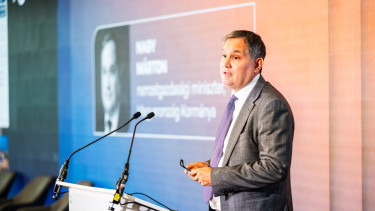
In an opinion piece published in the pro-government daily newspaper Magyar Nemzet, Economy Minister Márton Nagy argues that the centre of gravity of the global electric car market has shifted towards China and Europe, while demand in the United States has fallen since government incentives expired.
He believes that the rise of electric and hybrid vehicles in the EU signals a structural transformation. At the same time, however, Chinese manufacturers are meeting an increasing proportion of the growing demand.
According to recent data, Asian manufacturers account for almost 10% of the total new car market, and around 14% of the pure electric segment.
According to the minister, EU protective tariffs have failed to curb the expansion of Chinese brands, which remain competitive thanks to faster model upgrades, even with higher tariffs. He believes that internal price competition and overcapacity in the Chinese industry are putting downward pressure on export markets, with Europe being an attractive target due to its industrial structure's slower adaptability.
In his article, he explains that European industrial policy responses, such as tariffs and possible minimum prices, can be seen as short-term conflict management. However, no comprehensive strategy has been developed to improve competitiveness. He believes that the German economy is particularly sensitive to the downturn in the automotive and battery manufacturing industries, as well as to supplier layoffs. According to the author, this is a sign of a structural crisis, not a cyclical one.
Márton Nagy believes that the difference in stock market valuations between Chinese and European manufacturers demonstrates that the market considers Asian companies to be the winners of the future.
He claims that the European response has so far focused mainly on regulatory measures, whereas cost levels, the pace of technological development and value for money have lagged persistently behind.
From Hungary's perspective, the minister considers a weakening of the German economy to pose a direct risk.
He emphasises that, due to the country's industrial integration, it is particularly important to strengthen higher-value activities such as engineering, development and innovation, and to diversify export markets geographically. In his view, countries that follow technological trends and develop their own industrial strategy and adaptable value chain position will be successful in the global electric car race.
Cover photo: Portfolio





