Hungary is sliding into a dangerous spiral – is there still a way back?


Debt reduction stalls
The last time Hungary's GDP-to-debt ratio fell was in 2023, when it dropped from 74.1% to 73.2%. Since then, however, our debt has stagnated at best and risen at worst. The figures for 2025 are not yet known, but at the beginning of the year, Minister of National Economy Márton Nagy said that the key indicator could be around 74.6% at the end of the year.

In other words, it appears that
Hungary's public debt ratio rose for the second consecutive year as a percentage of gross domestic product.
Growth is moderate for the time being, but the graph above also shows that, looking at the bigger picture, the government has been unable to return the debt ratio to its previous downward trajectory since the coronavirus pandemic began in 2020. Due to extra spending caused by the pandemic and the economic downturn, the debt ratio jumped from 65% to 78.7% in one year and has barely declined since then.
In theory, the Constitution stipulates that as long as debt exceeds 60% of GDP, it must be reduced year on year. The "trick" is that the law only stipulates that parliament cannot approve a budget that would lead to an increase in the debt ratio. This has not happened in recent years, as the plans always counted on a minimal reduction, but these did not materialize.
There are two main reasons for this: persistently low GDP growth and a lack of fiscal discipline. The economy last saw meaningful growth in 2022, when it was still buoyed by the post-COVID reopening and rebound, but since then, Hungarian GDP has essentially stagnated over the past three years.
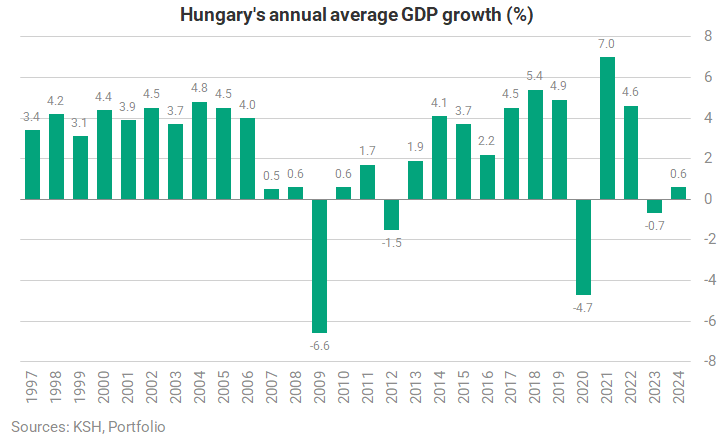
Meanwhile, the budget deficit as a percentage of GDP jumped to more than 7% of GDP during the pandemic and has barely been reduced since then. The government is constantly striving to return to the deficit path of around 3% seen in previous years, but it has had to revise its plans, partly due to lower-than-expected growth. A deficit of 5% is now expected for both 2025 and 2026, meaning that there is still no sign of a rapid reduction in the deficit.

Could the debt trend reverse in 2026?
In the above environment, it is worth examining how the debt ratio might develop in 2026 and whether there is any chance of reversing the unfavorable trend of recent years. This basically depends on two things: the pace of GDP growth and the extent to which the amount of debt increases.
But let's first look at the starting points, i.e., the situation at the end of December 2025. There are no final figures yet, but we can roughly piece together the picture:
- According to our estimates, GDP was approximately HUF 86,700 billion.
- At the beginning of the year, Márton Nagy already mentioned that, according to preliminary data, the debt ratio could rise to 74.6%, which, based on this and the cash flow deficit, would mean that the total debt could reach HUF 64,700 billion by the end of the year.
Of course, we have to make some assumptions for the forecast for 2026 as well:
- The growth of real GDP could be between 2% and 3%, which seems realistic based on expert opinion. In its December inflation report, the National Bank of Hungary (MNB) forecast growth of 2.4%, while the government officially expects growth of 3.1%.
- The GDP deflator could be around 5.5%. This basically means inflation for the whole economy. So, with real growth on top of that, we think nominal GDP could grow by 7.5-8.5%.
- The government has set a cash flow deficit target of HUF 5,445 billion for this year, which we have taken as our starting point, assuming that there will be no further increase in debt above this level. There is a minimal chance that the budget deficit will be below target in the 2026 election year, but based on recent years, overspending is conceivable, so we have included cash flow deficits of HUF 6,000 billion and HUF 6,500 billion in our scenarios.
We therefore expect GDP to rise to between HUF 93,200 billion and HUF 94,100 billion by the end of the year, while nominal debt is likely to be between HUF 70,100 billion and HUF 71,200 billion.

The figure shows that of the nine scenarios plotted based on changes in nominal GDP growth and the deficit, only one shows stagnation in the debt ratio, while in the other cases, debt-to-GDP ratios would rise. In other words,
there is a good chance that the upward trend in debt will continue in 2026.
In fact, in the worst case scenario, with nominal growth of 6.5% and overspending of around HUF 1,000 billion, the debt ratio could rise to over 76%. Therefore, a declining debt path requires the deficit target to be met and a high nominal GDP path (high real growth and/or inflation). If either parameter shifts unfavorably, the debt ratio will rise.
The big question for the coming period will be whether Hungary can reverse this negative trend. This would require stronger growth and/or greater fiscal discipline. It is perhaps more difficult to intervene on the growth side, as global conditions also play a role here, but access to EU funds, for example, could have a beneficial effect. There is no realistic chance of fiscal adjustment before the April elections, but after that, whoever comes to power will probably need to pursue a more disciplined policy in order to keep the long-term deficit path under control. (In the short term, it appears that the first adjustment measures in the second half of the year will still be necessary to meet the deficit target.)
Failure to take these steps could put Hungarian public debt on a permanently upward trajectory.
Credit rating agencies may raise their eyebrows
The rise in the debt ratio is also important because credit rating agencies pay close attention to this indicator, and we were already in a bad position in this regard. In December, Fitch Ratings downgraded Hungary's outlook from stable to negative. In the analysis published at the time, they highlighted that
Hungary's debt ratio of 73.5% was already significantly higher than the median of 61.5% for similar countries with a BBB rating.
The situation is not much better at the other two major credit rating agencies, S&P and Moody’s. In recent years, all three credit rating agencies have emphasized after their decisions that negative changes in fiscal policy and the continuing upward trend in debt
pose a negative risk to ratings and outlooks.
Credit rating agencies will next review Hungary's credit rating after the parliamentary elections in April, with Moody's publishing its latest assessment at the end of May, followed by S&P and Fitch. Of these, S&P's decision may be the most important, as we are only one notch above the junk category with a negative outlook, meaning that a possible downgrade could have painful market consequences, as some conservative investors would have to sell their Hungarian assets. This could primarily result in higher bond yields and a weaker forint. Our rating is one notch higher with the other two agencies, but also with a negative outlook, so there is more room for maneuver there, and a possible downgrade would not result in junk status.
| Planned credit rating reviews for Hungary in 2026 | ||
| First review | Second review | |
| Moody's | May 22 | November 20 |
| Standard & Poor's | May 29 | November 27 |
| Fitch | June 5 | December 4 |
| Source: Portfolio research | ||
Cover photo (for illustration purposes only): Getty Images





