Hungary at the bottom of EU GDP rankings


European growth accelerates sharply in H2 2025
Today's European GDP data came as a pleasant surprise. According to preliminary estimates by Eurostat, the European Union's statistical office, seasonally adjusted GDP rose by 0.3% in the euro area in the fourth quarter of 2025. The same growth was measured across the European Union as a whole compared to the previous quarter.
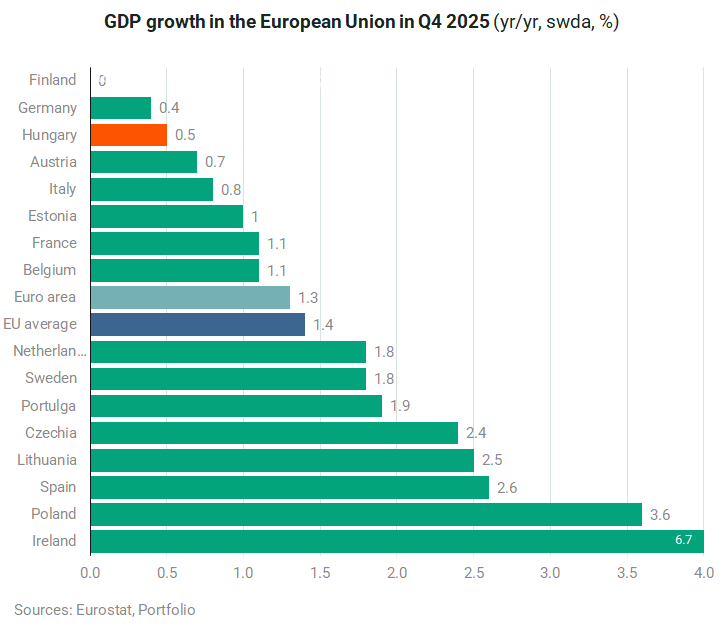
Compared to the same period last year, economic performance increased by 1.3% in the eurozone and by 1.4% in the EU. While this represents a slight slowdown compared to the third quarter, when annual growth was measured at 1.4% and 1.6% respectively,
it still came as a significant positive surprise compared to analysts' expectations.
This positive surprise came from Europe's major economies — Germany, France, Italy, Spain and the Netherlands — as they all published better-than-expected data. These countries have the greatest weight due to their size.
The pace of expansion in the European economy reinforces the narrative that the Old Continent's economy has weathered the trade war and geopolitical risks surprisingly well.
Hungary's growth ranking stinks
Excluding Ireland, whose GDP growth has been distorted by multinational companies, the continent's growth champion has been Poland, with growth of 3.6% over the 12 months to end-2025. The Polish economy is structurally sound and rests on extremely strong foundations. Following Poland in the rankings is Spain, which also has very strong foundations and has performed exceptionally well in recent years.
In terms of growth, Hungary ranks last in 2025, ahead of only Finland, which narrowly avoided recession, and Germany, which is emerging from recession after two years.
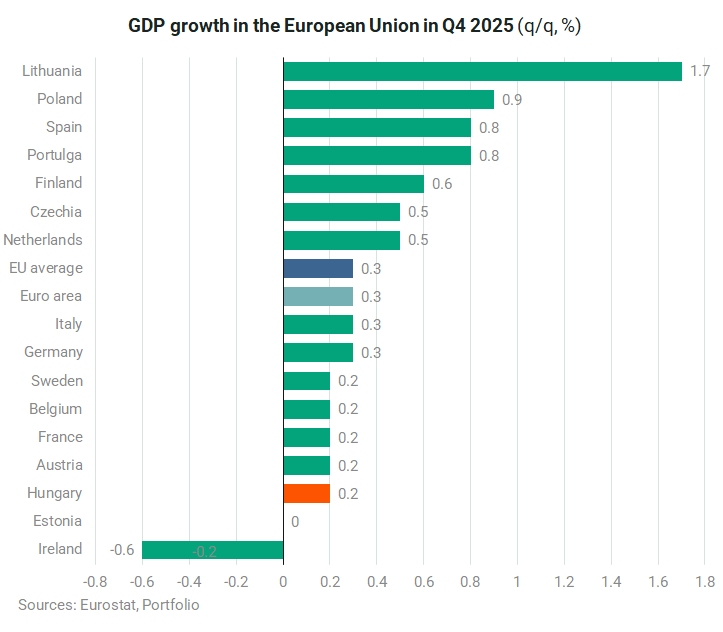
Hungary's position in the quarterly rankings is not rosy either:
in terms of growth over Q3 2025, it has only outperformed Ireland, which recorded a 0.6% contraction due to the accounting practices of multinational companies, and Estonia, which has stagnated. France, Austria, Belgium and Sweden are tied with Hungary for third place from the bottom of the rankings. The largest growth was recorded in the Lithuanian, Polish and Spanish economies in the last three months of 2025.
It took Germany two years to emerge from recession
According to initial estimates by the German Federal Statistical Office (Destatis), the German economy emerged from prolonged stagnation in the fourth quarter of 2025. GDP grew by 0.3% in the last three months of the year compared to the last quarter of 2024 (slightly better than the initial estimate published two weeks ago), with an average growth of 0.3% recorded in 2025 after two years of recession.
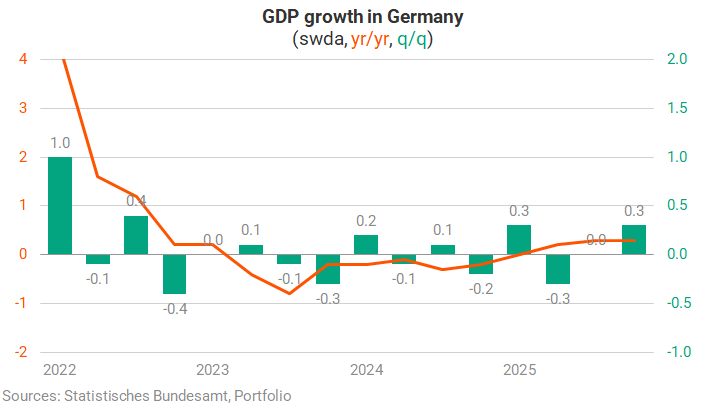
Based on preliminary data from the statistical office and monthly indicators, growth was primarily driven by private consumption and public spending.
While the current performance is still modest, it suggests that the German economy is beginning to recover from its previous slowdown.
However, the German economy continues to face difficulties, both cyclical and structural. Its gross domestic product is only just above 2019 levels, and its potential growth rate is around 0.5%. The necessary investments and reforms were not made during the 2010s, and China's rise has transformed one of the most important export markets into a systemic rival. Consequently, the export-oriented German business model has come under sustained pressure, resulting in virtual stagnation of the economy.
Nevertheless, the short-term outlook is encouraging.
The growing order book and falling inventories suggest a moderate industrial turnaround is underway. The infrastructure and defence investments that have already been announced are expected to contribute significantly to growth this year. If defence capabilities can be expanded quickly, a significant proportion of the additional spending is likely to be utilised in the domestic economy. The government is also planning to reduce energy costs, which could improve competitiveness. However, the strengthening euro and possible US tariff measures could easily disrupt the recovery's momentum.
The problems behind weak growth are deeply rooted. Action is required to reduce bureaucracy, introduce e-government on a large scale, address unfavourable demographic trends and ease the tax burden. It is up to Friedrich Merz's government to transform the current signs of recovery into a sustainable growth path. The biggest domestic risk is that complacency will suddenly replace national pessimism before structural reforms are implemented.
France remained resilient amid the storms of 2025
According to ING Bank's assessment, France's economy entered 2026 relatively calmly, following a turbulent 2025. In the last quarter, GDP grew by 0.2% compared to the previous quarter, bringing the year-on-year growth rate to 1.1%.
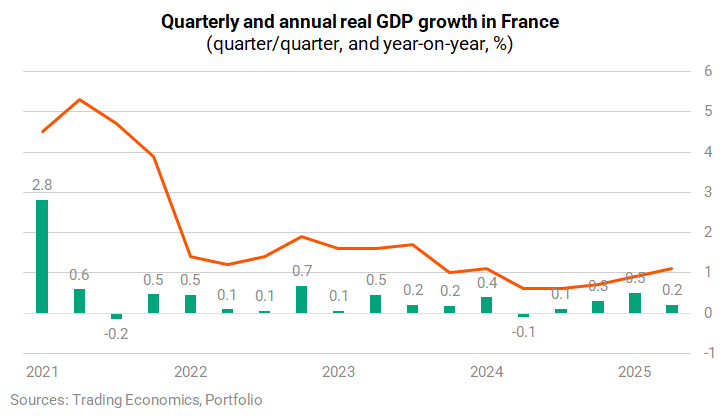
GDP growth stood at 0.2% quarter‑on‑quarter in the fourth quarter, an expected slowdown after the strong +0.5% surprise in the previous quarter.
For the year as a whole, GDP growth averaged 0.9%, below the +1.1% recorded in 2024 but still stronger than anticipated at the beginning of last year.
The prolonged budget saga and the US trade war weighed on activity in 2025, particularly on household consumption, which increased by only 0.4% over the year,
and investment, which grew by a modest 0.2% in 2025," ING Bank said in a research note on Friday. Despite easing inflation and rising real wages, households accumulated record savings in mid‑2025, before reducing them slightly at year-end. This helped consumption regain some momentum in the final months of the year.
At the end of January 2026, budget uncertainty finally eased with the adoption, via Article 49.3, of a compromise bill designed to avoid a no‑confidence vote. The budget includes tax increases, especially for large companies, with the tax burden set to rise to 43.9% of GDP in 2026 (43.6% in 2025).
Although the clarification of the budgetary situation has had a positive effect on economic sentiment, the analysts warn that the normalisation of the market situation is not expected to result in an immediate, strong recovery.
The budget remains unfavourable to businesses, and higher taxes could weigh on investment and job creation,
they warn.
"With no structural challenges being addressed, the 2027 budget looks set to be even more complex – a factor likely to raise uncertainty again, push long‑term rates higher, and continue to constrain economic activity."
Defence spending will continue to support the sector, and aeronautical exports should remain a key growth engine, provided production capacity keeps pace, according to ING Bank. However, if it continues, the recent appreciation of the euro could weigh on exports and thus on French activity, they warn.
High tax pressure may also act as a brake, and recent business surveys show investment intentions remain very weak.
Overall, the 2026 outlook is moderately positive, with GDP growth expected to reach around 1%, and edge up to 1.1% in 2027, but political and fiscal risks remain elevated. Industrial firms report better activity prospects and improving order books. Business sentiment is improving, particularly in industry, supported by the broader European rebound and the German stimulus plan. Overall, persistent uncertainty will likely keep French growth slightly below the European average, they concluded.
Cover image (for illustration purposes only): Getty Images





