Hungary's debt grew a little further in 2025


By the end of 2025, Hungary's general government debt reached 74.9% of GDP. This was an increase of 1.4 percentage points compared to the previous year, and represented the second consecutive year in which the debt ratio had failed to decline.

In January, Economy Minister Márton Nagy projected a figure of 74.6%, meaning that the public debt was slightly higher than expected at the end of the year.
The increase is primarily due to the high deficit, but the denominator effect also played a role, as the stagnating economy has hindered debt growth.
The last time Hungary's year-end debt ratio was higher than this was in 2021.
According to preliminary financial accounts data from the central bank (MNB), general government net lending was equal to -4.7% (HUF -4,050 billion) of Hungary’s GDP in the four quarters to 2025 Q4.
Although this indicator does not fully correspond to the official ESA deficit indicator, in practice, the two indicators usually produce the same result. This means that last year's deficit fell from 5.1% in 2024. Márton Nagy had previously predicted a deficit of 4.9%, meaning that, in terms of the general government balance, the outcome was the opposite of that seen with public debt.
Nevertheless, this data does not alter the fact that budgetary adjustments will undoubtedly be required during the second half of the year to achieve this year's deficit target of 5%. Taking a broader view of public finances, we can see that the typical budget deficit of 7% between 2000 and 2023 has fallen to 5% for 2024–25. This is also the official deficit target for this year. Rather surprisingly, Prime Minister Viktor Orbán has predicted that the deficit will remain at this level until 2027.
The statistics also show that households' net financing capacity, or their willingness to save, declined last year. At 4.3% of GDP, this figure is significantly lower than the level of around 7% seen two years ago.
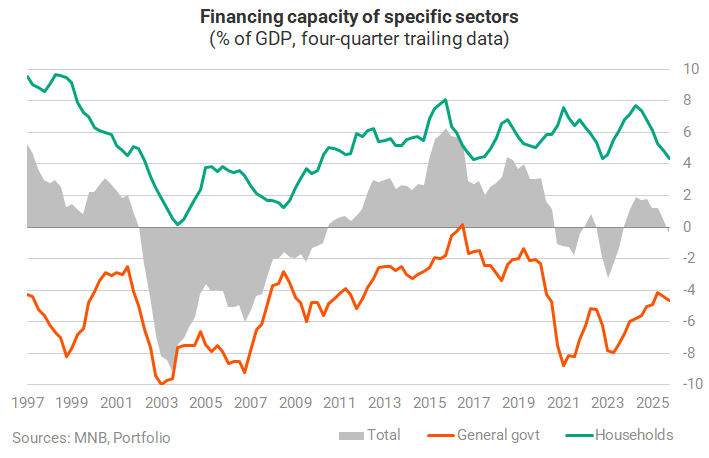
This also means that the combined GDP-proportionate financing capacity of the two largest economic sectors, the general government (the state) and households (the population), has turned slightly negative at -0.4%, the first time this has happened in two years. However, this does not currently threaten the country's external balance position, as the third major sector — the corporate sector — does not have any financing needs due to its investment slowdown. However, the external balance could deteriorate significantly if a revival in household consumption were to be accompanied by a spectacular rise in companies' willingness to invest.
Cover image (for illustration purposes only): Portfolio





