Hungary has become one of the EU's most seriously ill patients; only drastic budgetary measures can ensure its recovery


In recent years, European public finances have faced the challenges of crisis management, persistently high interest rates, rising security policy expenditure and structural pressures resulting from ageing populations. During the second half of the 2010s, a period characterised by low interest rates and rapid economic growth, many countries automatically reduced their debt ratios. However, their fiscal space is much more limited today.
However, this period of grace is coming to an end. Without painful budgetary decisions, the situation will become unmanageable. This is essentially the main conclusion of the European Commission's 2025 Debt Sustainability Monitor (DSM) report.
This annual document is one of the most important analyses related to excessive deficit procedures. It provides a comprehensive, multi-year assessment of the public debt trajectories of EU Member States. Rather than forecasting the most likely economic scenario, the report shows the direction in which debt ratios are likely to move in the short, medium and long term, given the current fiscal and macroeconomic parameters and in the absence of new budgetary measures.
We spend more, on more things, faster, but from less and less.
Even before the report was published, it was clear that it would show a deterioration in debt sustainability across almost the entire European Union. This was due to the energy crisis and increased defence spending resulting from the rearmament fever, which had also burdened the budgets of member states.
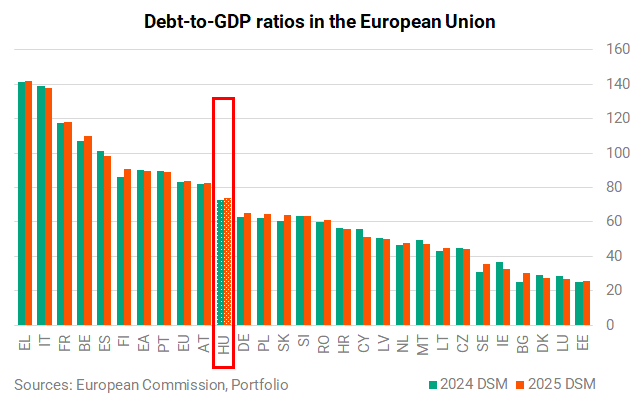
The average GDP-to-debt ratio of EU member states increased from 82% in 2024 to 83% in 2025, while the baseline scenario projects it to reach 100% by 2036. According to the report, the main drivers of this growth are the surge in defence spending in 2026, the gradual increase in costs associated with an ageing population, and the increasing proportion of interest payments in GDP. The dynamics of interest rate growth, or the 'snowball effect', are becoming increasingly unfavourable: the difference between nominal GDP growth and the implicit interest rate could lead to debt growth for several countries by the end of the period.
In the baseline scenario, Italy will have a debt ratio of 149.1%, France 144.0%, and Belgium 137.4%, all of which are high initial debt levels.
Greece is one of the few exceptions, with a predicted decline from 147.6% to 123.5%, although this remains an exceptionally high ratio.
At the other end of the ranking, Denmark will see a decline to 13.8%, Ireland to 20.3%, Cyprus to 20.1%, and Luxembourg to 20.1% by 2036.
Methodology
The report's baseline scenario assumes that there will be no policy changes from 2027 onwards. The structural primary balance expected for 2026 will remain unchanged and the debt path will mainly be shaped by the interest-growth differential, ageing-related expenditure and the structure of debt renewal.
The DSM assesses three horizons: in the short term, financing and market risks (GFN, spreads, ratings), in the medium term between 2025 and 2036, the evolution of the debt ratio and the crossing of the 90% threshold, and in the long term, using the S1–S2 indicators, the size of the permanent adjustment needed to achieve a sustainable path.
Under this system, Hungary has been placed in the high-risk category: the Commission's preliminary estimate for 2025 was a debt ratio of 73.7%. However, we already know that the reality is worse than this, with data from the Hungarian National Bank showing a debt ratio of 74.9%.
In the case of Hungary, the debt level could rise to 102.5% by 2036 according to the baseline scenario. According to the European Commission's assessment, this increase alone is sufficient for a high risk rating, with the threshold being a debt level of 90%.
Several other Member States show a similar trend: Germany (from 63.5% to 91.0%), Austria (from 81.4% to 102.0%), Poland (from 59.5% to 106.8%), Slovakia (from 61.9% to 101.2%) and Finland (from 88.1% to 113.9%).
Financing becoming increasingly difficult
The short-term section highlights other financing risk concerns: gross financing needs above 16 per cent are considered high risk. Belgium, Spain, France, Italy and Finland will fall into this category in 2025. Hungary's GFN indicator is 14.9% in 2025, rising to 15.2% in 2026 and falling to 14.3% in 2027. While this remains below the threshold, the volume of financing needs is significant.
The structure of the Hungarian general government finance deficit (GFN) in 2025 will be as follows: a primary deficit of 0.6% of GDP, interest expenditure of 4.0%, short-term debt renewal of 4.5%, long-term maturing debt of 5.4%, and a stock-flow adjustment of 0.5%. Therefore, most of the financing requirement stems from the renewal of maturing debt and interest payments.
Yield spreads are another indicator of short-term risk. According to the report, spreads relative to German government bonds declined overall in the EU in 2025, though they remained highest in Hungary and Romania. Monetary policy environments also differ: while several European central banks eased policy, Hungary's central bank base rate remained at 6.5% due to inflationary risks. Higher interest rates gradually increase the average cost of financing as older, lower-yielding bonds mature.
When assessing medium-term trajectories, the European Commission considers both the endpoint and the uncertainty of the distribution. Stochastic simulations calculate the possible distribution of the debt ratio based on 10,000 macroeconomic shocks. In Hungary's case, there is an 81% probability that the debt ratio will be higher in 2030 than in 2025. The difference between the 10th and 90th percentiles for 2030 is 25.4 percentage points, indicating a relatively wide uncertainty band.
Even if this is a marathon, we have a big problem
This is complemented by a long-term sustainability assessment based on indicators S1 and S2. The latter indicator shows the immediate structural primary balance adjustment required to stabilise debt in the long term, taking age-related expenditure into account.
At the EU level, the long-term sustainability risk is considered moderate overall based on the S1 and S2 indicators, but there are significant differences between countries. Taking into account age-related expenditure, the EU average S2 value is 2.3, meaning an immediate and sustained improvement to the structural primary balance of 2.3% of GDP would be needed to achieve long-term debt stabilisation. The EU average for S1 is 3.1%, which would require permanent adjustments equivalent to 3.1% of GDP to reduce the debt ratio to 60% by 2070.
While most Member States fall into the low or medium risk category, several countries, including Belgium, Luxembourg, Malta, Slovenia, Slovakia and Hungary, show high long-term risk. This is typically due to a significant increase in ageing-related expenditure and their starting fiscal position.
Based on the S2 indicator, Hungary would need to improve its structural primary balance by 6.7% of GDP immediately and sustainably from 2027 onwards in order to stabilise public debt at the 60% level required by the Stability and Growth Pact by 2036.

This calculation also takes into account the additional costs arising from ageing over the next decade. The S1 indicator is 5.3, meaning a permanent structural adjustment equivalent to 5.3% of GDP would be required to reduce the debt ratio to 60% by 2070.
The report also examines fiscal space in isolation, demonstrating the extent of historical feasibility based on previous structural primary balances. In Hungary's case, this indicator stands at 57%, which is considered a medium value. There have been examples of a stricter fiscal position than the current one, but Hungary is not among the countries with the greatest fiscal space.
Compared to the countries with the highest debt, Hungary's trajectory is not particularly striking in the overall picture of the EU, but the trend is clearly upward.
While the report's conclusion is not normative, it is numerical: under the current parameters, debt will not stabilise automatically and its sustainability will depend on future fiscal decisions.
The report's main conclusion is that the European Union's biggest fiscal challenge is that debt trajectories are no longer stabilising automatically in the current macroeconomic environment, unlike during the favourable period from the mid-2010s until the start of the pandemic. Interest expenditure as a percentage of GDP is increasing, defence spending is set to remain at a persistently high level and the cost of an ageing population is putting gradual but structural pressure on budgets.
The Commission's analysis does not predict an immediate crisis, but rather a gradual narrowing of fiscal space. This is a worrying sign given the current period of crises. If another external shock were to occur, the situation could deteriorate dramatically.
Cover image: EU





