Hungary's Mol shows robust 2025 performance


Highlights
As we mentioned in our preliminary analysis, Mol was operating in a mixed industry environment in the fourth quarter of last year. The factors that had the greatest impact on the oil company's performance in the recently closed period are outlined below:
- Despite low product sales, the performance of the Downstream business significantly improved due to refining margins and the jump in the Brent-Ural spread.
- However, the Upstream business performed poorly due to falling oil and gas prices, though extremely high production improved the situation.
- Consumer Services (supported by one-off items as well as organic growth) and Circular Economy Services (supported by seasonality, favorable external effects and internal efficiency efforts) also exceeded expectations by a large margin.
Overall, it can be said that
Mol exceeded analysts' expectations and closed a strong quarter compared to previous periods.
Here are Mol's key figures:
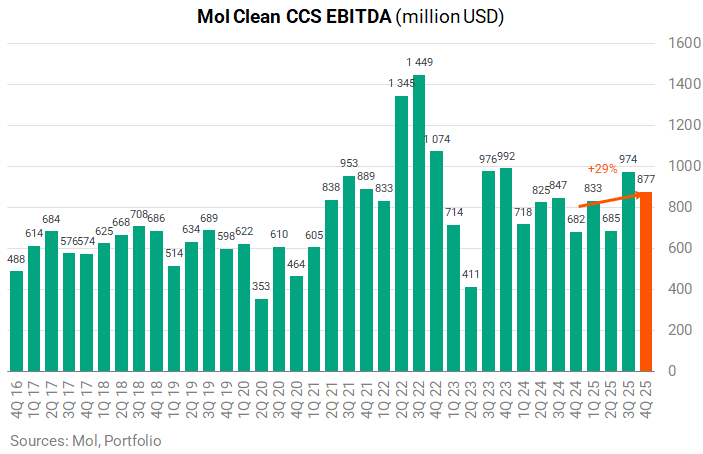
- Group Clean CCS EBITDA: USD 877 million, versus USD 820 million consensus estimate (i.e. +7%). Although this result is lower than that achieved in 2022 when energy prices were exceptionally high, it is still a particularly strong performance when viewed in the context of the longer term.
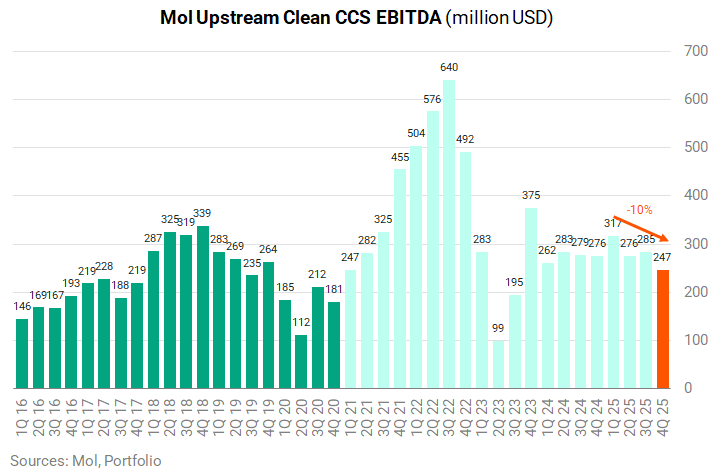
- Upstream EBITDA: USD 247 million, 1% lower than the consensus estimate of USD 249 mn, and a 10% drop over the Q4 2024 figure.
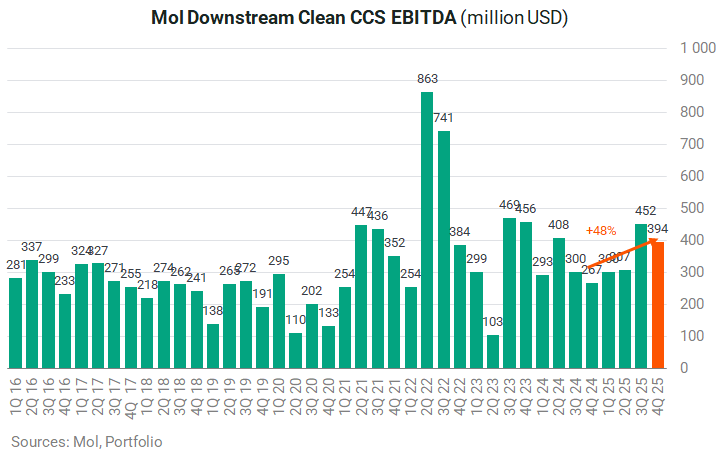
- Downstream Clean CCS EBITDA: USD 394 million, 4% under the USD 408 mn forecast, but 48% up yr/yr. An important piece of information about the business is that
the Fire-damaged CDU in Danube refinery expected to be rebuilt by Q3 2026, and
the reconstruction expected to result in around USD 50 mn extra CAPEX. - Consumer Services EBITDA: USD 205 million, 10% higher than forecasted (USD 187 mn), and 32% higher than in the same period of 2024.
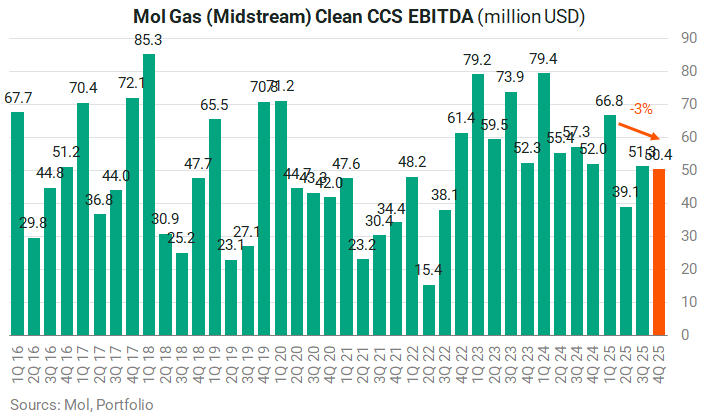
- Gas Clean EBITDA: USD 50 million, undershooting the USD 56.3 mn consensus forecast, and 3% down yr/yr.
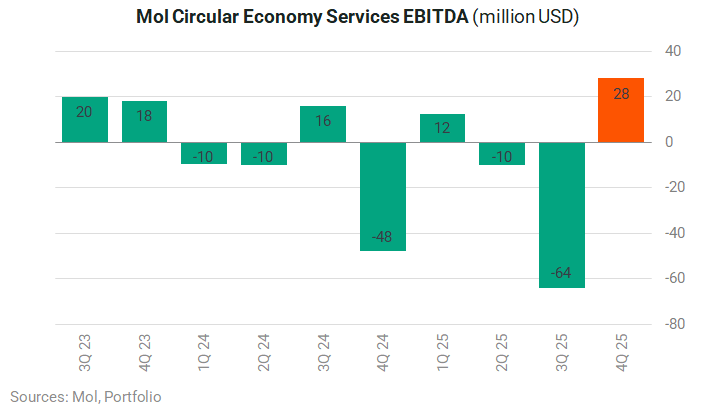
- Circular Economy Services EBITDA: This was the only area that caught analysts off guard. The USD 28 mn EBITDA compares with an estimate of a USD 10 million loss.
Taking tax rates and the results of financial transactions into account,
the total after-tax profit was USD 35 million, compared to an expected USD 242 million.
In its presentation, Mol indicated that DD&A (depreciation, depletion and amortisation) was driven higher than usual to USD 400-450 mn by goodwill impairment on ACG and asset impairment on Polish operation of Consumer Services.

As for the whole year
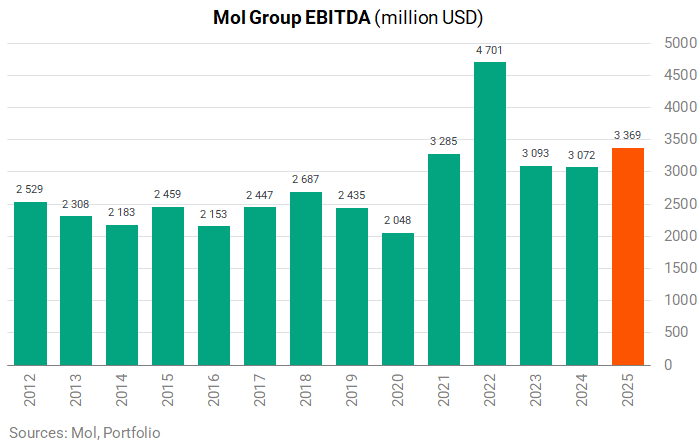
2025 was the second strongest year in Mol's history, with the oil company generating a total EBITDA of $3,369 million.
Brent-Ural spread
Although it is true that Mol pays higher costs compared to international comparable prices for oil from Ukraine via the Druzhba pipeline and from Croatia via the Adria pipeline, it can still be said that
the Hungarian company has access to relatively cheap Russian oil.
In any case, the arrival of Russian oil may have resulted in relatively high margins for Mol in the fourth quarter.
In its investor presentation accompanying the flash report, Mol illustrates how the margin has developed in this respect.

With regard to the Upstream segment, management emphasised that the decline in oil and gas prices had offset the upward trend in production compared with the previous quarter. Higher production levels were supported by increased output in Central and Eastern Europe, as well as in the Kurdistan region of Iraq. Total hydrocarbon production exceeded 99.4 mboepd in Q4 of 2025. Average production for the full year was 94.7 mboepd, which exceeded the annual guidance of 92–94 mboepd.
Further production growth is expected in 2026, reaching a level of 95–97 mboepd.

Overall, it can be said that the upstream segment, which is involved in exploration and production,
delivered an average performance due to falling oil and gas prices and rising production.
Mol noted in relation to the Downstream segment that better refining margin environment outweighed the effects of lower volumes and worse petchem performance. R&M processed volumes were lower due to fire incident at the Danube Refinery in October.
The Downstream segment performed particularly well overall,
achieving earnings of USD 452 million and becoming Mol's best-performing business unit.
Taking seasonality into account, the Consumer Services business unit performed particularly well, ultimately generating a profit of USD 205 million. According to Mol's presentation, the results were driven by one-off effects and growth in both the fuel and non-fuel segments. Overall, fuel margins strengthened, mainly due to strong performance in Croatia and Romania, while non-fuel margins positively impacted the results for the fourth quarter of 2025. These results were further supported by favourable currency effects due to the strengthening of the Hungarian forint.
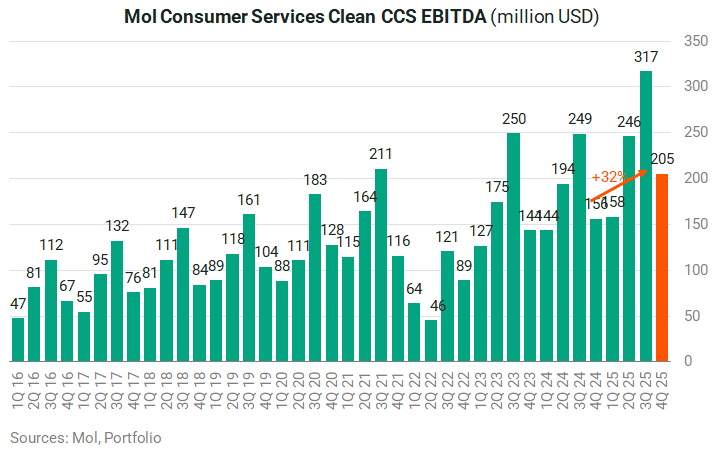
Non-fuel turnover grew by ~5.4%. Fresh Corner unit count reached 1,409 units at the end of Q4 2025, up 2.7% q/q and 6% yr/yr. Non-fuel margin rose by about 5.8% yr/yr, and non-fuel margin represented 35.6% of the total margin in Q4 2025.

The Gas Midstream business unit's EBITDA was $51 million, which was slightly below analysts' expectations.
According to Mol, higher demand for transportation was offset by lower regulated tariff levels. Although external conditions were less favourable than a year earlier, transmitted volumes remained strong throughout the period.
While analysts had expected a loss of $9.6 million, circular economy services generated a profit of $28 million in the fourth quarter.
Mol noted that Circular Economy Services EBITDA was supported by seasonality and the impact of internal efficiency measures. The Deposit Return System (DRS) is close to being fully seet up, with rollout completed. Redemption is already available at nearly 5,300 location. Beverage packaging return ratio reached 88.8% in its first complete year of operation with three billion bottles collected at an average rate of 8.3 million per day. Preparations for waste incinerator are ongoing, and a decision is possible by the end of 2026.
Management comment
Chairman and CEO Zsolt Hernádi commented the results:
"I am very pleased to see the further improvement of our internal efficiency, especially in the Circular Economy business. In the last quarter of 2025, we also reached several important milestones: we decided to transition to a holding structure, further strengthened our renewable portfolio in Hungary, and our hydrocarbon production neared 100 mboepd, reflecting the resilience of our integrated business model.
At the same time, the fire at the Danube Refinery and the serial outages of the Druzhba pipeline once again highlighted the challenges of energy supply in landlocked countries.
"Recent events highlighted again that our energy sovereignty depends on the diversity of our crude resources, at least two commercially viable transportation routes and on the cooperation with Governments who understand the interest of the region.
"We are even more determined to stand up for the interests of the region and we will do everything to keep all our options open to maximize our freedom of choice. And this is for maintaining the region's security of supply ecosystem.”
Guidance
Mol has outlined its expectations for the 2026 financial year:
-
EBITDA is expected to be significantly lower than in 2025, at USD 3 trillion;
- oil production may see significant growth, but
- refinery output may be lower than in 2025.

Cover photo: Portfolio





