The average gross wage rose above HUF 700,000 in Hungary last year


In December 2025, the gross average earnings of full-time employees were HUF 789,200, while net average earnings were HUF 548,900. Gross average earnings increased by 8.5% compared to the previous year, while net average earnings increased by 9.8% and real earnings by 6.3%.
The higher increase in net average earnings compared to gross average earnings was due to the increased family allowance introduced on 1 July 2025 and the personal income tax exemption for mothers raising three children introduced on 1 October 2025. Meanwhile, the median gross earnings were HUF 607,700 and the median net earnings were HUF 427,500, representing increases of 9.4% and 10.8% respectively compared to the same period the previous year.
The nominal figures at the end of the year are boosted by bonuses and one-off payments, which are traditionally paid during this period. This is why gross average earnings approached HUF 800,000 in December. By contrast,
average regular (ex-bonus) earnings in 2025 were HUF 656,000.
The net median wage, i.e., the after-tax income of the person 'in the middle', compared to whom half of those employed earn less and half earn more, averaged HUF 391,000 in 2025. By the end of the year, this figure had crept up to HUF 423,000 in December.

The average annual net real wage growth rate, which was 4.3% in November, rose to 6.3% in December. This was due to tax breaks introduced in July and October, as well as slower inflation.
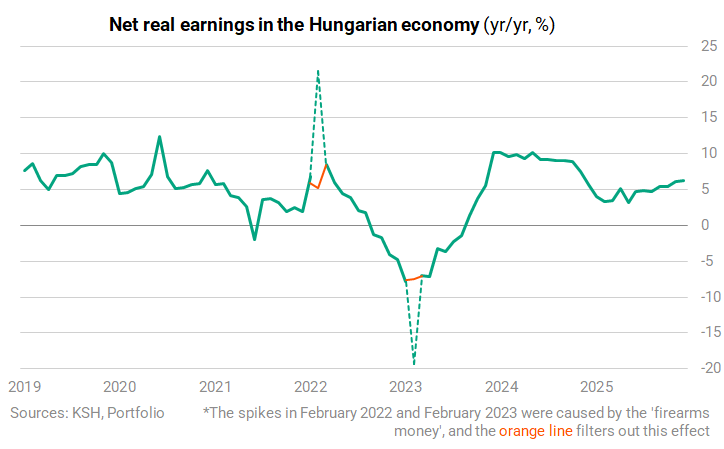
The outlook for this year will be shaped by several factors.
- Given the increase in public wage growth before the election,
- the expansion of tax breaks,
- the expected decline in inflation and
- the 11% increase in the minimum wage and 7% increase in the guaranteed minimum wage,
we can expect real wage growth to be higher in 2026 than last year.
Cover photo: Shutterstock





