Analysts forecast a decision not seen in Hungary for nearly a year and a half


Everything in place for an interest rate cut
In recent months, the MNB has been moving step by step towards an interest rate cut, as December saw a slight shift in communication when it was announced that from then on, decisions would be made on a meeting-by-meeting basis, depending on the data received. Since then, December's inflation rate still warranted caution, but
in January, the rate of price increases fell more than expected to 2.1%, paving the way for the central bank to take action.

The current rate of price increases has fallen to an eight-year low, meaning that even with the previously estimated 1-1.5 percentage point impact of margin caps, inflation is still within the central bank's target range (3 plus or minus 1 percentage point). In fact, it is approaching the lower end of the range, which could provide a solid basis for an interest rate cut.
Furthermore, the stability and further strengthening of the forint are also favorable in this regard. Some analysts had previously feared that the approaching elections would lead to further significant government spending, which could make the Hungarian currency vulnerable. However, these fears have not materialized so far, and as a result, the forint has been hitting multi-year highs in recent weeks.

In other words, everything seems to be in place for the Hungarian base rate to start falling again after nearly a year and a half, following September 2024. This could only be torpedoed by the international mood in the coming days, as a US attack on Iran is on the table. If this triggers serious risk aversion in the market, the Monetary Council may remain cautious, but based on current information, they have every reason to cut the base rate.

It is no coincidence that analysts surveyed by Portfolio almost unanimously expect the benchmark rate to fall by 25 basis points to 6.25%. Only the experts at Equilor and Századvég Economic Research believe that decision-makers may still maintain a cautious approach.

Now is the time to call bingo
If monetary policy were a game of bingo, I think now would be the time to shout "bingo!" In my opinion, every single factor that could lead to an interest rate cut is present, and we can check off every single condition,
emphasized Péter Virovácz. According to the ING Bank analyst, January's inflation data can no longer be an obstacle to an interest rate cut. What's more, the forint has strengthened since the last interest rate decision meeting, and it has done so while the market has already priced in a cycle of interest rate cuts for this year.
Following lower-than-expected inflation figures in January, it has become virtually certain that interest rates will start to fall in February,
confirmed Péter Kiss, investment director at Amundi.
There are plenty of risk factors that the central bank must take into account, and indeed does take into account. Perhaps the most important one at present is the country's oil supply, which poses a significant risk to the exchange rate – so far, this has had little or no impact on the exchange rate.
Even if supplies can be secured via the Croatian pipeline, it will still be a more expensive solution, which will worsen the current account balance and thus weaken the forint, as well as increasing inflation in itself, added Gábor Regős of Gránit Fund Management. He sees the inflationary effect of fiscal easing related to the elections as another risk factor. This represents a demand shock in the economy, which could increase inflation. At the same time, despite the above risks, he also believes that with lower-than-expected inflation data for January, there is room for interest rate cuts.
From the central bank's point of view, it may be favorable that companies' inflation expectations have largely returned to pre-COVID levels. Caution is advised, as the effects of the strong forint have so far only had a moderate impact on consumer prices, and household expectations remain high. In any case, all things considered, the balance sheet may now point towards taking the first cautious step, agrees Orsolya Nyeste, analyst at Erste Bank, with the majority.
Thanks to the high base effect in February and the extension of margin restrictions from March onwards, inflation could develop extremely favorably for the central bank in the coming months, thereby postponing the rise in inflation and providing scope for interest rate cuts, according to Tamás Isépy. Nevertheless, the Századvég Economic Research analyst believes that
the central bank will wait to cut interest rates in February due to the continuing upside inflation risks.
Zoltán Varga, analyst at Equilor, expects something similar, saying that given the increasing geopolitical risks, the MNB will not act on the first data received, but will take a cautious and patient approach. In their view, the risks associated with maintaining interest rates are much smaller than those associated with premature interest rate cuts. At the same time, they expect that after the current meeting, there will be a clear indication of the easing expected in March.
Although volatility has increased slightly on global markets, the external environment remains supportive, Mariann Trippon pointed out before the decision. However, according to the CIB Bank analyst, the tone of the announcement is likely to remain cautious, with the MNB emphasizing data dependency and not committing to any future interest rate path.
Could there be a string of cuts?
The interest rate path following February may depend on market developments in addition to incoming data, emphasized Mariann Trippon. In her view, if the market situation remains stable in March, another 25 basis point easing step may be taken in parallel with the publication of the latest Inflation Report.
If my predictions are correct and the forint remains stable over the next month and February inflation falls to around 1.5 percent, then Tuesday's interest rate cut could be followed by another in March, agrees Péter Virovácz. After that, he believes that the foreign exchange market's reaction to the election results could determine the interest rate path. Increased foreign exchange market volatility could deter the Monetary Council from making another cut and cause decision-makers to wait and see. At the same time, there could be another 25 basis point easing step.
The dilemma may arise if the cycle of interest rate cuts begins, causing interest rates to fall during the year while monthly inflation rates rise, added Éva Palócz, CEO of Kopint-Tárki.
If, at the end of the summer, it appears likely that the rise in inflation at the end of 2026 will only be temporary, the MNB may lower the base rate again in the last months of the year, and interest rate cuts may resume in September, according to Zoltán Árokszállási, head of the MBH Bank Analysis Center. He believes that further interest rate cuts expected overseas will also increase the scope for the MNB, so they expect a base rate of 5.50% by the end of this year.
According to Árokszállási, interest rate cuts may continue in 2027, but the extent of this is uncertain at present. If, due to the expected rise in inflationary pressure towards the end of the year and this year's low base, we see inflation rise again at the beginning of 2027, accompanied by high inflation expectations, it is not certain that the MNB will proceed with quarterly interest rate cuts next year. Thus, by the end of 2027, he believes that the base rate in Hungary could be between 4.5% and 5%.
What does this mean for the forint?
If the interest rate cut does indeed happen, the next question is how it will affect the forint exchange rate. Until now, the 6.5% base rate has been the most important support for the Hungarian currency. However, last year, developed central banks (ECB, Fed) and, in the region, the Polish and Czech central banks also cut interest rates, thereby improving the relative position of the forint. In addition, the market has now priced in the easing, which the Hungarian currency weathered without any serious shocks.
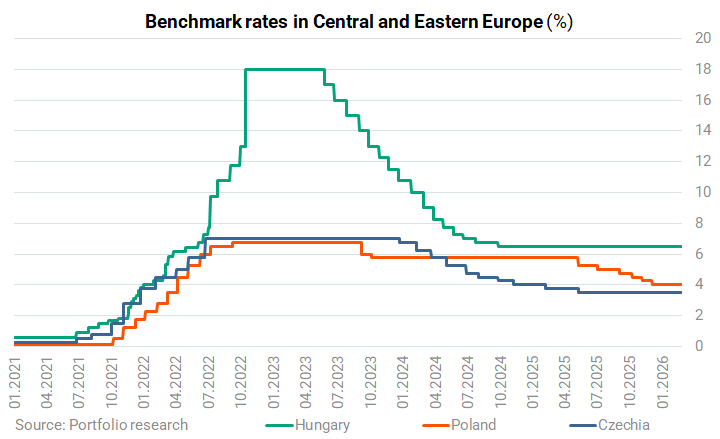
After a 25 basis point easing, Hungarian interest rates still significantly exceed the regional average, it is still worth bringing money here, and carry trade can still maintain the exchange rate, according to Gábor Regős.
Looking ahead, the start of the base rate cut will increase the attractiveness of domestic government securities, but one of the factors that has supported the forint so far will weaken as a result. The central bank must therefore tread carefully in order to maintain market stability, Péter Kiss emphasized.
Based on interest rate market pricing, a 25 basis point cut would come as no surprise, so it could be neutral for the forint itself – the market impact would be determined more by the central bank's guidance following the decision, according to Sándor Jobbágy, macro analyst at Concorde.
A cautious interest rate cut may follow, which means that the forint should not react strongly, emphasized Zsolt Becsey, analyst at UniCredit Bank. In his opinion, the outcome of the elections could cause turbulence in the financial markets, which may prompt the exchange rate-sensitive central bank to wait and see.
The forint has clearly outperformed since the beginning of the year, even with interest rate expectations falling significantly (i.e., expectations of interest rate cuts strengthening). The forint has also performed much stronger than other regional currencies in recent weeks, so it can easily withstand interest rate cuts, Zoltán Árokszállási pointed out.
Cover photo (for illustration purposes only): Shutterstock





