Hungary wants to save HUF 1.6 trillion in EU funds by exploiting a legal loophole

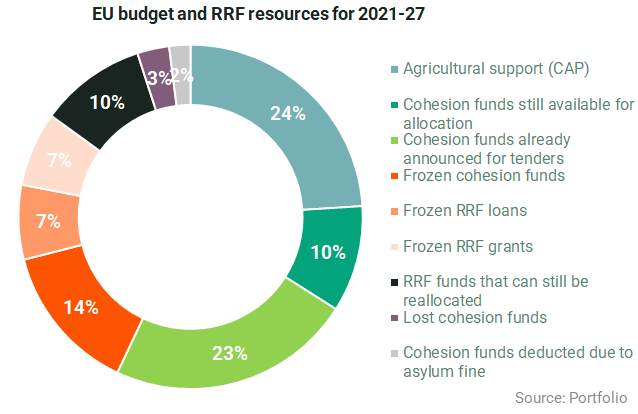
The Hungarian government is attempting to use a legal manoeuvre to release the frozen funds from the recovery fund, as it continues to be denied access to RRF funds due to its failure to meet super milestones relating to transparency and anti-corruption reforms. According to a joint analysis by K-Monitor, the Hungarian Helsinki Committee, Amnesty International Hungary, TASZ, and Transparency International Hungary, the cabinet is working on a plan that would essentially "fulfill" the operational logic of the RRF in one fell swoop:
it would transfer the delayed projects to the Recovery Plan and reallocate around €4 billion to increase the Hungarian Development Bank's capital.
The significance of the amount is demonstrated by the fact that the reallocated item would account for over half of the amended Recovery Plan (approximately 2,731 billion HUF).
The EU would consider the mechanism a completed project, as the money would leave the budget and go to a state development bank. The cabinet expects this to enable it to demonstrate "results" that Brussels will approve before the August 2026 deadline.
This method is not without precedent, with the European Commission recommending this approach to an increasing number of member states. Poland was the first to exploit this loophole, using a similar trick this year to request that nearly €6 billion of its recovery fund be placed in a new defence fund managed by a dedicated body of the Polish Development Bank.
The Commission finally approved the plan because, like Hungary, Poland had been unable to access RRF funds for years. However, after Prime Minister Donald Tusk took office, the government implemented a series of reforms to meet EU conditions. The Commission was also more flexible because it was deemed unlikely that the projects would meet their milestones, which would have resulted in the loss of roughly half of their budget of €59.8 billion, or €28.6 billion.
The essence of the Hungarian and Polish legal tricks is the same: if expenditure is incurred before the deadline, the investment is 'closed' to the EU, even if the projects are implemented much later.
According to the civil society organisations' recently published analysis, the Hungarian model would be somewhat more radical. The MFB would receive a capital injection of HUF 1.6 trillion at the stroke of a pen, accounting for more than half of the modified Recovery and Resilience Plan.
According to the draft amendment, several investments of the original plan would be reduced to zero (mainly in the fields of water management, sustainable green transport, energy, the transition to a circular economy as well as investments in the RePowerEU programme), while a disproportionately large share of the RRF allocation would be redirected to a capital injection for the state-owned MFB Bank (Hungarian Development Bank).
This proposed restructuring disregards the reform priorities identified in the European Semester recommendations. Rather than constituting a credible reform effort, the planned amendment appears primarily aimed at reallocating funds in the face of impending implementation deadlines,
the authors of the analysis said.
The logic is that if a project is not completed on time, the EU will not pay for it and the money will be lost. However, if the entire amount is accounted for as a capital injection, it becomes eligible for reimbursement, even if the funds are returned to the economy years later in the form of preferential loans.
An important condition is that the European Commission approves the amendment to Hungary's Recovery and Resilience Plan.
In principle, if this happens, the MFB would spend the reallocated funds on housing, energy efficiency and green transition objectives over a period of five to ten years — well beyond the official deadlines set by Brussels.
However, it is questionable how the European Commission will respond, given that it is not the technical implementation of the projects to which it objects, but rather Hungary's substantial failure to implement reforms in the areas of the rule of law and anti-corruption.
According to the analysis, out of the 27 super milestones (which all would have been due by the end of 2022), 1 has not been achieved, 9 have been achieved only partly, and only 17 can be considered as fully achieved to date. This shows a regression compared to November 2024.
As regards anti-corruption measures, the implementation of the commitments is far from being carried out at the right pace and with the ambition to achieve real results in the fight against corruption in Hungary. The implementation of many of the measures will at best only formally meet the milestones, and the implementation of the substantive commitments is seriously delayed.
This is the area where the Government’s “ticking-the-box” approach is the most striking, seriously undermining the effectiveness and long-term sustainability of the remedial measures.
According to recurring criticism from Brussels, which is also reflected in country-specific recommendations, there is still a lack of transparency in public procurement, a high proportion of single-bidder tenders, and restrictions on access to public interest data prevent both journalists and civil society from effectively monitoring the workings of public authorities.
Another significant aspect of the rule of law conditions would be the restoration of judicial independence. While the European Commission had deemed this temporarily acceptable at the end of 2023, subsequent developments have cast doubt on the credibility of the reform. These include the Curia's new uniformity complaint proceedings on the primacy of EU law, changes to the appointment of judges, and political decisions made after 2024, such as making salary increases conditional. They argue that the system has once again become vulnerable to the demands of the executive branch, a problem that is increasingly being recognised in Brussels.
In a wider context, [...] new and old systemic deficiencies continue to jeopardise the independence of the Hungarian judiciary.
The situation is further complicated by the fact that, in the summer of 2025, the government introduced legislative changes indicating that the cabinet did not expect RRF funds to become available. Two subsequent decrees introduced a completely new regulatory structure for the use of funds. One of these enables the authorities to suspend the evaluation of applications and the conclusion of grant agreements if related payment requests cannot be sent to Brussels. This essentially affects the entire RRF programme, given that Hungary has not reported any completed milestones or submitted any payment requests by May 2025.
The other new regulatory element sends an even clearer signal: the government has incorporated the category of 'impossible projects' into the legal system. If an investment is to be implemented in a more developed region (e.g. Budapest) and financed from a currently blocked source due to EU proceedings, the authority can terminate the application.
Essentially, the cabinet has acknowledged that the completion of numerous projects has become infeasible due to the EU's continued withholding of payments, either because of unmet horizontal enabling conditions or due to concerns regarding the rule of law. This means that the government has enshrined in its own legal system the fact that it cannot rely on the blocked funds in the short term.
The reallocation to the MFB that is now taking shape is therefore not an independent technical idea, but rather the second step in a strategy. The first message was that the cabinet is not waiting for Brussels to lift the freeze. The second message is that the cabinet would rather 'save' the funds through a banking arrangement. The question is whether the European Commission will accept this Hungarian approach, given that civil society organisations' analysis suggests the government has made no real progress in addressing corruption or rule of law issues.
So far, Brussels has followed a very clear logic: it will only provide funding once reforms linked to super milestones have been completed. While the Polish example may open up new technical room for manoeuvre, the essence of the Hungarian case remains the unresolved concerns about the rule of law.
Cover photo: EU