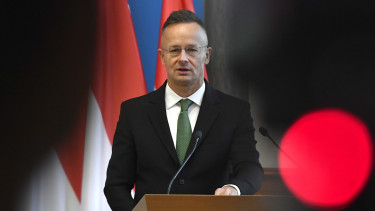
Orbán says Hungary is "the safest country in Europe" - Is it really?

"What lies to the west of here is different from our world. It is a mixture of something, a jumble of something, something uncertain, something soulless, something that is bubbling up and no one knows what will come of it," Orbán said on Saturday.
We have order and security. Hungary is the safest country in Europe. [Applause.] Confident calm, a Hungarian world that suits us, where we feel at home.
The question of what constitutes safety is a tricky one, and when it comes to an election campaign, we should not even hope for an accurate definition. So, let's explore where this sense of safety and 'confident calm', this feeling of being at home, could come from, and whether it is merited. You'll have to be the judge of that.
The number of crimes committed in Hungary totalled 233,470 in 2024, according to Central Statistical Office (KSH) data.

Between 2010 and 2021, the number of crimes dropped 66%, while it grew by 52% between 2021 and 2024.

But what about the satisfaction of knowing that, once the culprits are in the clutches of justice, they will get what they deserve? This is another complex issue, but we can at least calculate the percentage of definitive sentences for crimes committed, which should provide an insight into the judicial system.
The long-term statistics does not bode well, showing that the rate dropped from over 60% in the mid-1960s to around 20% by the 2000s. (The lowest point around 14% was reached during the change of regime in 1989-1990, which is kind of understandable.)

After the Orbán government came into power in 2010, the ratio first dipped and then kept on rising - until 2019 that is. The improvement was impressive, but the turnaround resulted in a 40% decline by 2024. In other words: there were more crimes and fewer convictions.


Crimes in more detail
The following graphs depict the number of various crimes registered in Hungary between 2009 and 2024. Each graph is preceded by two percentages: the first shows the change between 2010 and 2024, and the second shows the change between 2021 and 2024.
The total number of crimes registered jumped 31% year-on-year in 2024 to 233,470. The figure marks a 47.8% decline over 2010 but a 51.6% increase over 2021.
Homicides:
- 2024/2010: -58.9%
- 2024/2021: -6.9%

Attempted homicides:
- 2024/2010: -29.6%
- 2024/2021: +61.3%

Involuntary manslaughter:
- 2024/2010: +46.2%
- 2024/2021: +216.7%

Battery:
- 2024/2010: -56.3%
- 2024/2021: -6.5%

DUI:
- 2024/2010: +11.6%
- 2024/2021: -11.0%

The above figures are a mixed bag, but the next ones... they show dramatic changes indeed. The comparison to 2010 is not possbile here, because the KSH has data only from 2013. And the increases are staggering.
Sexual violence:
- 2024/2013: +433%
- 2024/2021: -2.3%

Sexual exploitation:
- 2024/2013: +352%
- 2024/2021: +30.1%

Domestic violence:
- 2024/2013: +4,030%
- 2024/2021: +9.1%

There should be a more detailed database operated by the Ministry of the Interior offering a breakdown of victims by type of crime, sex and age, but, conveniently, it does not work. Wherever you click to filter the results, you get an error message saying, "Failed report operation. We cannot find the server required to load the workbook data model."
The KSH offers statistics for registered victims and victimisation incidents, though. The data show improvement between 2009 and 2021 and an increase in the number of victims from then onward.

Is Hungary the safest country in Europe?
To answer this question, we used data from Eurostat, the European Union's statistical office. Buckle up, because even with the caveat of Orbán's extremely vague use of the adjective 'safe', Hungary is NOT the safest country in the bloc.
This time, we will not even bother you with the exact number of crimes; we will just give you the number per 100,000 inhabitants. This makes comparison much easier, too.
Some sets of figures offer an age breakdown. In some cases, we have selected the under-18 age group. Others do not provide this breakdown, but they still allow for a European comparison. Wherever data were available, we have plotted the changes for Hungary between 2010 and 2024. Unfortunately, the latest figures are from 2023, meaning the Hungarian statistics are one year more up to date.


When we talk about a safe country, we often consider how safe the most vulnerable groups, particularly women and children, feel there. Sadly, Hungary is by no means the safest place for these groups in the European Union, and some of the country's recent trends are appalling.
Sexual explotation

The number of victims of sexual explotation under the age of 18 per 100,000 inhabitants more than doubled in Hungary between 2016 and 2023. The number of female victims went up 37% and the number of female victims under the age of 18 doubled during this period.
Hungary's ranking in these categories is far from the best in the EU.


Killed by a family member or intimate partner
Between 2015 and 2023, the number of female homicide victims killed by a family member or intimate partner per 100,000 inhabitants in Hungary dropped by almost 60%. However, the country was still ranked fifth in the EU in 2023, with several member states missing due to a lack of data.

The situation for Hungarian women killed by their intimate partner per 100,000 inhabitants got infinitely worse between 2015 and 2023. This dramatic change earned Hungary a position in the top3 in the EU two years ago.

In summary, we are unsure which safety aspect Orbán was referring to, but we have found no evidence that Hungary is the safest country in the European Union.
Cover image (for illustration purposes only): Getty Images