Slovakia to tax cheap Russian oil, bad news for Hungary's Mol


In recent weeks, the price spread between European Brent crude oil and Russian Ural crude has widened considerably: while in peacetime the spread was $1-4 (Ural was typically cheaper), the spread has been above $30 for weeks, and Russian oil is currently nearly $36 a barrel cheaper.

The price differential has emerged because Western oil companies, in response to Vladimir Putin's invasion of Ukraine, have stopped buying Russian oil as a kind of voluntary sanction, or have significantly cut their purchases, so falling demand is putting pressure on prices. However, the beneficiary of the situation is Mol, which continues to buy Russian oil and process it at its refineries in Százalombatta and Bratislava, making massive profits, with the relatively cheap oil pushing up the company's refining margins to unprecedented levels, to almost $35 a barrel in March.
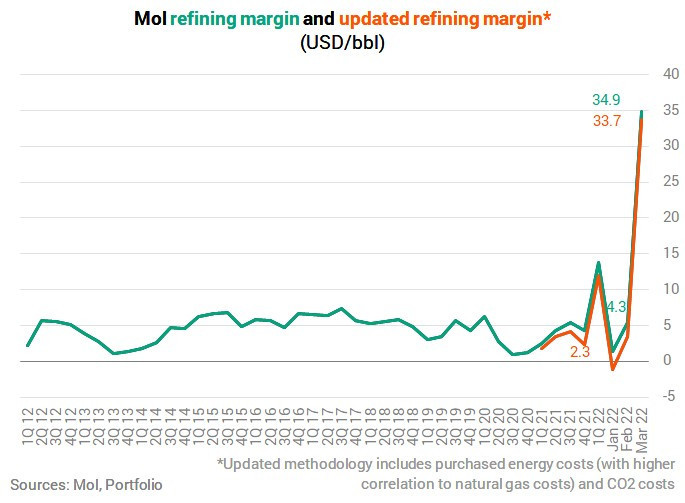
The cheap Russian oil and its distorting effect on competition has been a cause of concern for many, with Poland, for example, proposing a tax on Russian oil to ensure that those who no longer process Russian oil, such as Poland's PKN Orlen, are not put at a competitive disadvantage.
With no decision yet in the European Union on the Russian oil embargo, partly because of opposition from the Hungarian government, US Treasury officials are considering another way to marginalise Russian oil as much as possible: making imports more expensive through tariffs, which could also be used to finance Ukraine's reconstruction. US Treasury officials said on Tuesday, according to a report by Reuters, that a proposal to impose tariffs on Russian oil by EU member states at this weekend's G7 finance meeting would be a quicker alternative to a complete ban on Russian oil imports.
Now Slovakia can also take action on the issue, with Új Szó reporting that Finance Minister Igor Matovič will today submit a proposal to the government to introduce a tax on Russian crude oil processed in Slovakia, which the Finance Minister has already informed Mol's Slovak subsidiary Slovnaft about, and Slovnaft has promised not to raise prices because of the new tax.
THE NEW TAX is estimated to GENERATE €280-290 MILLION IN REVENUE FOR THE SLOVAK BUDGET OVER A YEAR.
Under the plan, Slovakia would levy a 30% tax on the difference between the price of Brent and Ural oil per barrel, with the money from the new tax being used to finance social measures.
If the tax is approved by the government, it could be discussed in parliament in an expedited procedure. The Finance Minister wants the new system to be operational by June. Matovič stressed that if the government approves the proposal, it could also curb the rise in fuel prices.
The news is clearly negative for Mol. At the current exchange rate we're talking about a hit of about 108-112 billion forints, which will probably be shouldered by Slovnaft, Mol's Slovakian subsidiary. If Slovnaft has indeed promised not to raise prices as a response, it will not be able to offset this negative impact. Overall, however, the point is that the tax would reduce the significant positive impact of the massively widened Brent-Ural spread. It is important to stress, however, that at this point this is just a plan put forward by the Finance Minister without prior consultation about it with the government. We should definitely wait and see how the Slovak government and parliament decide on the possible introduction of the tax.
Cover photo: Jakub Porzycki/NurPhoto