Banks in Hungary show rarely seen gains before storm hits


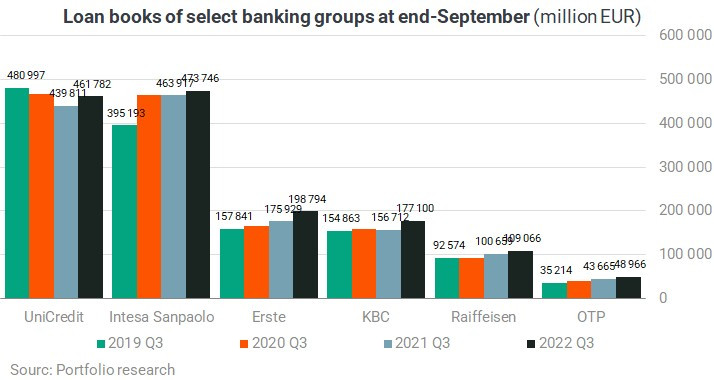
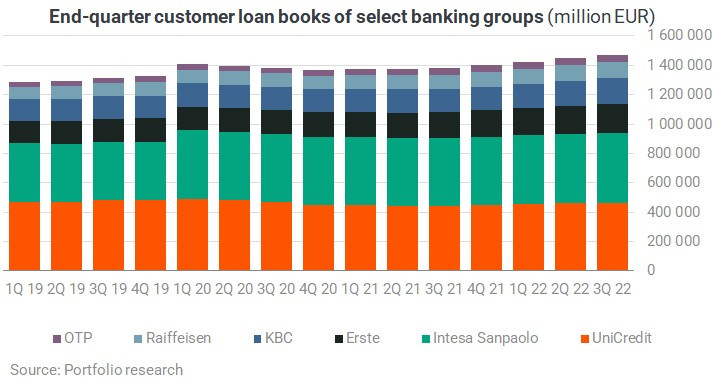
With OTP publishing its Q3 figures last Thursday, the last of the major regional banks operating in Hungary has released its earnings report for July-September. Below we are presenting the key figures in euro terms of six banking groups, in order of size: Italy's UniCredit and Intesa Sanpaolo, the Austrian Erste, the Belgian KBC, Austria's Raiffeisen and Hungary's OTP. Here you can see the size differences between the banks:
The fundamental developments described in the lead can be quantifiably shown as follows:
- the banking groups' aggregated net interest income rose 16% yr/yr in Jan-Sept and 21% in Q3 alone;
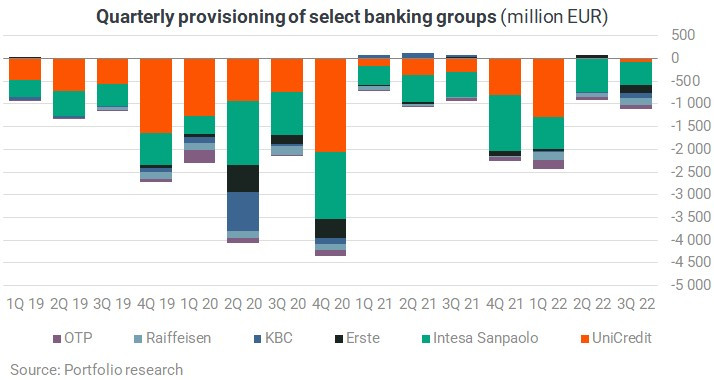
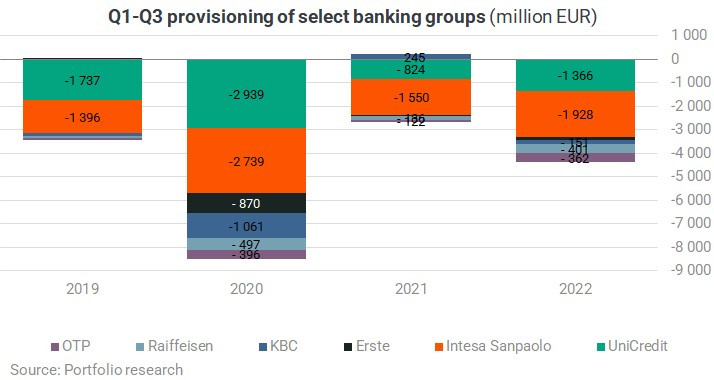
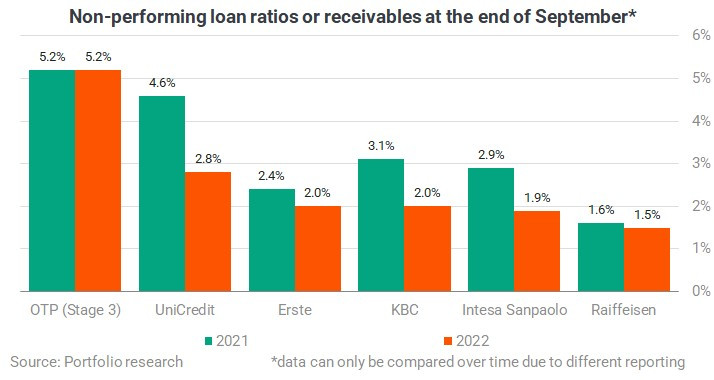
- loan impairment and other risk costs have increased by 79% year to date and by 29% in the third quarter alone compared to a year earlier. This happened despite the fact that the share of non-performing loans has continued to fall (and they were only half as risky as in the first year of the Q1 2020 crisis).
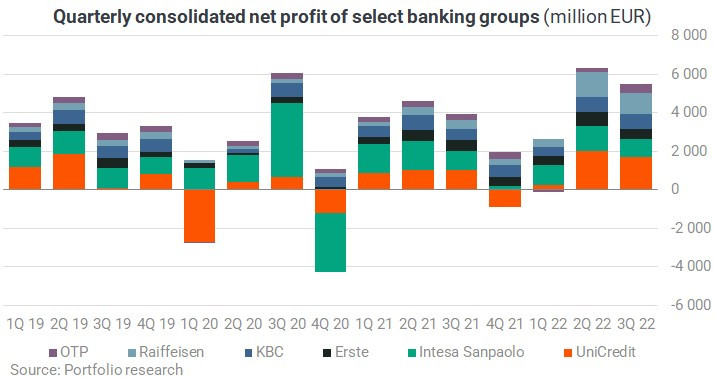
Although there are many other factors that affect the banks' after-tax profit, the regional banking "story" remains true also based on the evolution of two aforementioned items:
Compared to last year, the positive impact of the EUR 3.8 billion increase in net interest income this year was only partly offset by the negative impact of the EUR 1.9 billion increase in risk costs, while the other items were broadly neutral, resulting in a net profit growth of more than EUR 1.9 billion.
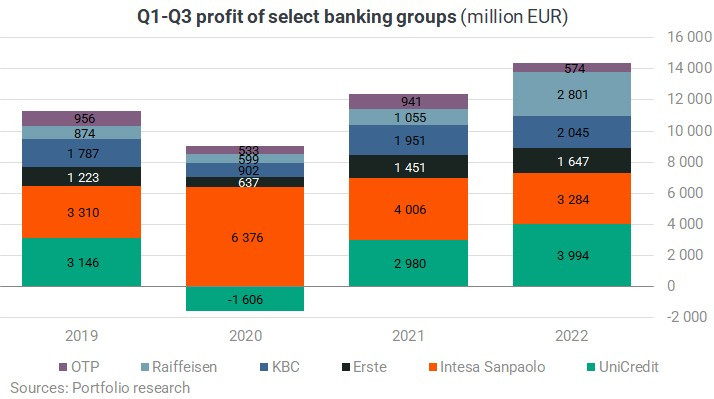
While last year the six banks made a combined profit of €12.4 billion in the first nine months, this year the figure has risen to €14.3 billion. Overall, the rise in other revenues, regulatory and tax charges (such as the Hungarian "extra profit tax" and the payments made in connection with the liquidation of Sberbank) and the steady rise in operating costs (the latter increasingly affected by galloping inflation) have largely cancelled each other out.
As mentioned above, the primary source of the increase in revenues was the rise in net interest income.
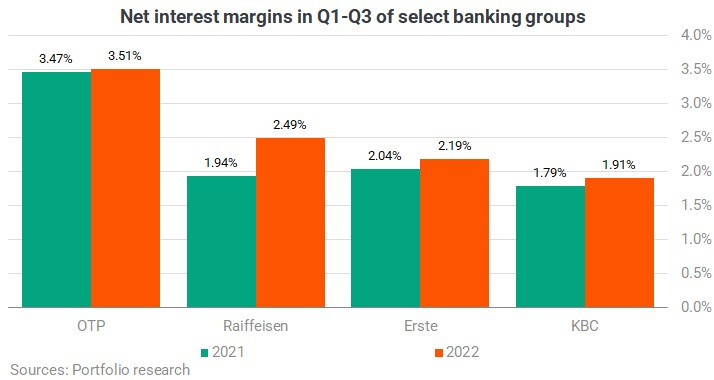
THE INCREASE IN NET INTEREST INCOME stems FROM TWO SOURCES: WE CALCULATE THAT ROUGHLY 60% OF THE INCREASE IN NII COMES FROM WIDENING NET INTEREST MARGINS AND 40% FROM credit GROWTH.
The widening of the interest margin is explained, in order of importance, by:
- in several regional markets (most notably the Czech Republic, Hungary and Romania), the interest rate paid by central banks on the liquidity deposited with them rose,
- the rise in bond market yields in the region is also pushing up the interest income available in the government securities market,
- the gradual repricing of debt stocks was also helping, but probably to a lesser extent than above (the advantage being floating-rate debt, partly except in Hungary, which has an interest rate freeze),
- meanwhile, deposit rates are 'sticky': especially at the beginning of a rising interest rate environment, the negative impact of repricing of deposits is small, especially with a very high share of demand deposits (above 80% for retail deposits in Hungary, for example).
A special case is Raiffeisen, which has a significant exposure to Russia, where both the interest margin and interest income increased the most. Almost half of the 53% (!) increase in net interest income this year at the Austrian banking group is linked to Russia, largely as a result of the strengthening of the rouble and the high margin of the repo business in Russia. In simple terms, this is the biggest "secret" of this year's soaring Raiffeisen profits.
(Note for the graphs below: where one or two banks are missing from the graph, the banks concerned have not provided their exact figures.)
In addition to the widening of the interest margin, the expansion of portfolios, especially the credit stock, continues to play an important role: lending has not stopped anywhere, but has slowed down. In euro terms, over the year, KBC and Erste (both +13%) and OTP (also +12% in euro) saw the largest increases in their loan portfolios, while Intesa saw the smallest (+2%).
Risk costs have increased by €1.9 billion this year compared to last year, but as we have pointed out, this is not because more loans are defaulting at the banks, but because last year was partly driven by the post-Covid impairment reversals, and this year this process has slowed. On the other hand, the worsening economic outlook due to the inflationary environment and the energy crisis has prompted banks to apply prudence in terms of impairment.
The chart below shows how the increase in non-performing loans did not generate the trend: the share of loans in the portfolio that could be considered problematic by some definition has remained stable at OTP, fallen significantly at UniCredit, KBC and Intesa Sanpaolo, and decreased to a lesser extent at Erste and Raiffeisen. Overall, NPL ratios are at or near historic lows.
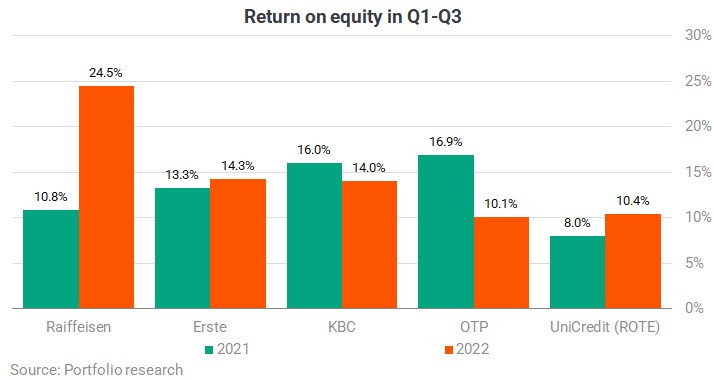
Four out of six banks have seen their profits increase this year, with Raiffeisen (+165%) and UniCredit (+34%) showing the biggest increases. Accordingly, these two had the most spectacular rises in return on equity. The average unweighted ROE rose by almost 2 percentage points to close to 15% for all banks.
The second quarter of this year brought multi-year record profits for banks in the region, and although the third quarter was a little worse, they could not complain about these three months either. However, it is unlikely that the performance of the last six months will be sustained or repeated in the coming quarters, with a slowdown in lending, deterioration in loan portfolio quality, rising risk costs and an overall decline in bank returns in the region. Most banks are expecting this, but management's forecasts for the preliminary reports generally give the impression that banks' outlook for the coming quarters is more uncertain than gloomy.
This uncertainty is reflected in what market looks like now: after the first big shock of the Russia-Ukraine war, investors are generally happy with the rise in the interest rate environment, as it is good for earnings generation, especially in the early days, while the negative consequences (slackening lending, poorer portfolio quality and high risk costs) are yet to be realised.
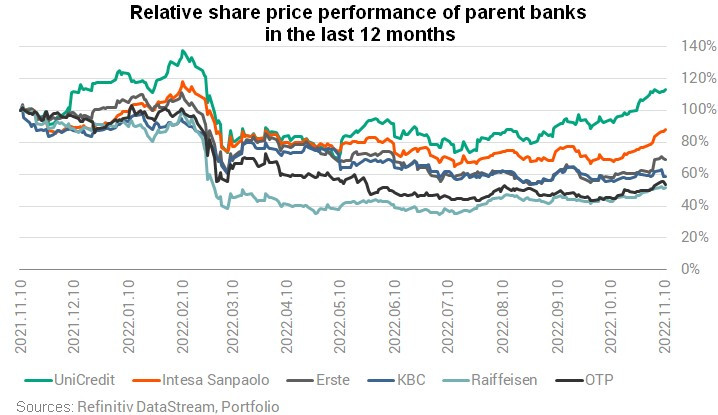
The positive performance of banks over the past six months is also reflected in share prices, which have tended to rise in recent months, but still
ALL BANKS' SHARE PRICES ARE STILL BELOW THEIR LEVELS OF A YEAR AGO, WITH THE EXCEPTION OF UNICREDIT.
The share price of OTP and Raiffeisen are the most below the levels they were a year ago, as the Austrian bank has significant and uncertain exposure to Russia, while Hungary's largest lender is overtaxed and burdened by regulatory costs (e.g. interest rate freeze).
Cover photo: Getty Images