Half of the branches gone - What's the deal with banks in Hungary?


Quality changes in the physical infrastructure of banks
Before presenting the numerical data, it is worth highlighting the main trends in the physical infrastructure of banks in recent years:
- in an unprecedented way, the pandemic has accelerated a long-standing trend of declining branch traffic and increasing the role of digital channels, but
- nowadays, banks are no longer responding with mass branch closures, but by opening more modern physical units with better access for wealthy customers to rationalise their branch network, rather than closing branches with poorer returns,
- the role of branches is changing: they are increasingly becoming a place for advice rather than a place for cash handling and administration,
- the acceleration of digitalisation and the partial disappearance of branch banking leaves more time for building quality personal customer relationships,
- more and more branches are becoming cashless, or primarily or exclusively advisory branches,
- digitalisation and robotisation are not making banks' workforce needs redundant, but rather reshaping them in terms of function and quality,
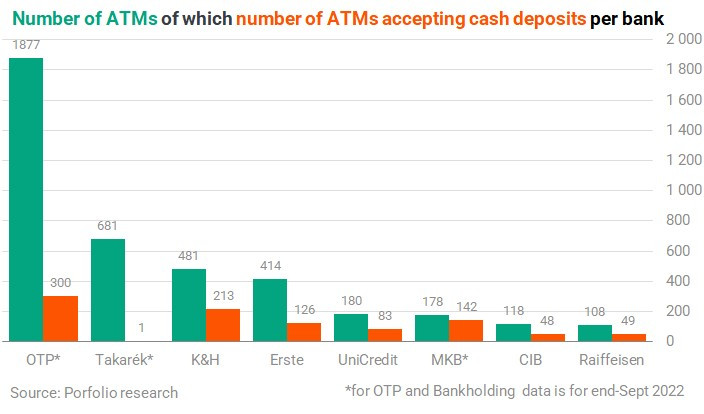
- although cash is becoming less important (card purchases now outnumber cash withdrawals) in customer transactions, banks are not phasing out ATMs but adding new functions to them,
- such as the fact that more and more banks are allowing cash deposits at an increasing number of their ATMs, which is typically the most popular feature among self-employed individuals and small businesses that generate a higher proportion of cash income.
Let's see those numbers!
The MNB's figures show that
SINCE 2013, THE NUMBER OF BRANCHES IN THE CREDIT institution SECTOR HAS HALVED TO 1,600, AND THE NUMBER OF EMPLOYEES HAS FLUCTUATED BUT IS ON A DOWNWARD TREND, CURRENTLY BELOW 39,000.

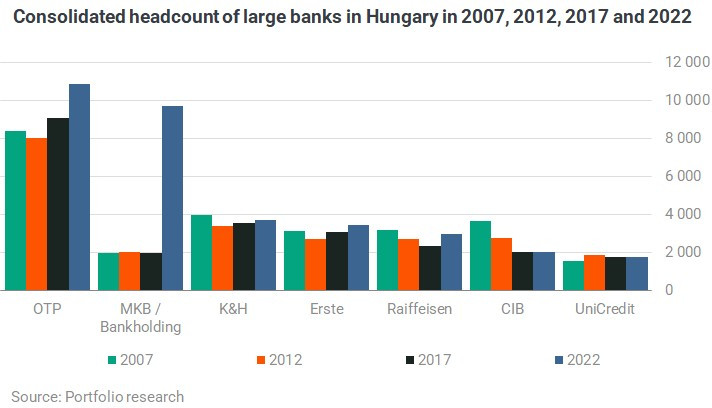
We also surveyed the largest banks, and the aggregated data for the seven largest groups of credit institutions are shown in the chart below. As you can see, there is a slight divergence from the trend for the banking sector as a whole in terms of staff numbers.

The statistical headcount of the big banks is around 34 500, the peak before the coronavirus pandemic, and the banking sector's workforce is increasingly concentrated in the larger banks, partly presumably due to the consolidation of the sector: just think of the transfer of Sberbank's loan portfolio to Bankholding and Commerzbank's portfolio to Erste Bank. In terms of headcount, OTP is the leader of the board, with almost three times as many employees in Hungary as K&H and Erste, which are ranked third and fourth, respectively.

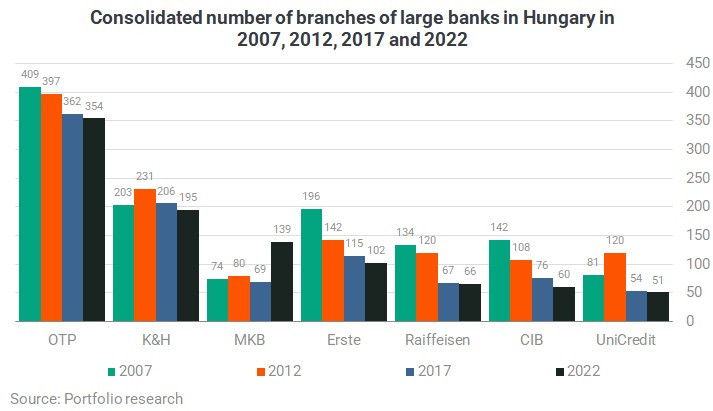
However, the long-term decline in the number of branches can also be seen in the large banks, but in most places the big waves of branch closures have already taken place 8-10 years ago and the decline is now slow.
Last year, the number of branches of the seven largest banks still fell to 1,479 from 1,704, but in net terms more than 200 of the 225 closures were attributable to a single player, Takarékbank.
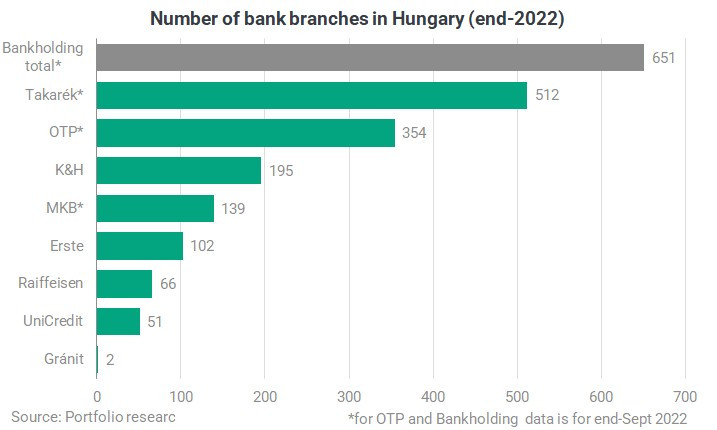
The Hungarian Bankholding, formed by Takarékbank and MKB Bank, still operates the largest branch network in Hungary with 651 units (OTP has 354 branches), according to data at the end of September 2022, and as they told us, 98% of their customers are still closest to a Hungarian Bankholding branch.
In the two graphs below we show how the number of branches and the number of employees in banks have changed compared to 5, 10 and 15 years ago. Compared to the situation before the financial crisis, K&H, CIB and Raiffeisen have seen a decrease in the number of branches, while the others have seen an increase.
The reasons behind the decline in headcount at a single location may vary: in addition to the loss of market share, it may be due to a combination of efforts to reduce the role of staff-intensive activities and to increase efficiency, the latter of course being driven by the role of digitalisation.
The proliferation of digital channels is also the main driver behind the closure of branches, which has meant a significant contraction of the branch network everywhere except MKB Bank, which absorbed Budapest Bank last April.
Recently, the reduction of the branch network at most banks has been gradual, as has the increase in the number of digitally active customers. As digitalisation progresses, some branches in less exposed locations and with lower traffic are being dropped from the networks.
We have also heard of cases where it was not a drop in customer traffic or a fall in branch-level returns, but a shortage of staff that led to branch closures: there was a large bank that closed two or three branches last year simply because it could not find the right number of staff to maintain them.
One of the biggest banking stories of 2023 could be the expansion of ATM networks, which will be required by a new MNB regulation for some banks. Although we do not know the exact number of customers or card numbers per bank (most banks did not answer our questions in this regard), OTP, Bankholding, K&H and Erste certainly have more than 600,000 customers and will be subject to strict rules under the new legislation.

In addition to the above table, some specific rules are also set out:
- if the credit institution operates a number of cash dispensers above the expected number in any of the two territorial categories of the table, it is entitled to reduce the number of cash dispensers in the third category by up to 25%,
- banks with a total of between 600,000 and 1,200,000 cards issued, as set out in the table, are obliged to operate ATMs in at least 65% of the towns other than county centres, and banks with more than that number of cards in at least 80% of these towns.
If you need to expand your ATM network because of the above territorial rules, the banks have
- 18 months to add less than 25 ATMs
- 24 months to add 25 or more ATMs.
And if the required number of ATMs is available, but they need to move ATMs between municipalities, the bank has nine months to do so. It is also stipulated that the turnover of ATM withdrawals and deposits cannot be higher than the benchmark set by the MNB.
Banks are still evaluating the situation created by the new MNB regulation, and their current number of ATMs is shown in the graph below.
Cover photo: Getty Images