Hungarian gov't blatantly interferes in the housing insurance of millions, an entire industry in revolt


What's the deal with home insurance?
To understand the government's efforts, we need to be aware of the critiques regarding the housing insurance market. The most prominent of these are the following:
- Hungary is not doing too badly in Europe in terms of the number of home insurance policies and penetration rates of around 75-80%, but the number of policy switches per year is very low (we only found accurate data on new policies, but in most of these there are no policy switches),
- a significant proportion of domestic home insurance policies are outdated, with one-off annual premium changes (indexation) at most in line with inflation, not necessarily taking into account the much higher increase in property values and the need for increased recovery costs,
- home insurance is generally a peripheral issue in the minds of customers, who do not pay enough attention to the value of the insurance, or even to the premium statements sent out by insurers once a year,
- this phenomenon leads to substantial underinsurance, especially with such high inflation: if the premium and the sum insured increase by less than the cost of repairing any damage to the property, i.e. the property becomes less and less covered, the insurer is obliged to pay only a smaller part of the amount of the damage, proportional to the coverage, which is less than 100%,
- the real "masters" of home insurance are insurance salesmen and intermediaries, but most of them are not interested in actively managing their own portfolios, nor in presenting the full range of home insurance products to their customers during the sales process,
- competition is also low according to the statistics: among the major non-life insurance categories (see our graph below), personal property insurance has one of the lowest claims ratios, at just 34% according to 2020 data from the National Bank Of Hungary (MNB), meaning that only one third of premiums paid are used by insurers to pay claims, and it is also the most concentrated market, with the five largest operators accounting for nearly 90% of the market,
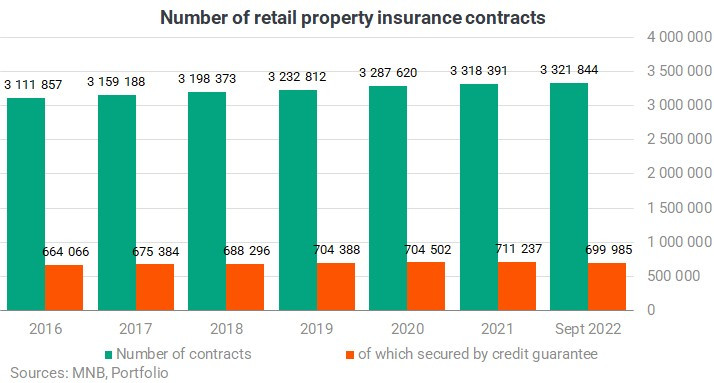
- although the introduction of the MNB's e Certified Consumer-Friendly Home Insurance (CCHI) t in 2019 has improved the position of customers, the 25-30,000 CCHI contracts signed so far are still negligible compared to the total portfolio of 3.3 million home insurance policies and the 270,000 home purchase and home construction loans taken out between mid-2019 and mid-2022, meaning that the product has not yet made a real breakthrough. The low incentive effect of CCHI and the insurance interest in its introduction is reflected in the fact that the largest provider in the housing insurance market, Aegon, with a market share of around one third, only achieved the certification by Christmas 2022.
It seems as if home insurance has become the most lacklustre activity in a sluggishly competitive financial sector.

What is going to change this year?
A government decree published on Wednesday evening, with effect from 30 April 2023, states:
- when taking out a mortgage loan, it is usually obligatory to take out home insurance with the bank as the beneficiary, in which case the borrower must be shown which home insurance policies to choose from, based on the MNB's e Certified Consumer-Friendly Home Insurance (CCHI) calculator,
- when determining the APR ceiling (which could be as high as 52% this year), the premium for the property insurance covering the mortgage loan must be included in the APR,
- for home insurance policies for an indefinite period on residential property, insurers may pay a maximum of 20% of the intermediary's remuneration,
- for a full month in March each year, in addition to the insurance anniversary, customers will be given the opportunity to cancel their home insurance policy free of charge under the normal cancellation rules, and all customers will be notified of this opportunity by 15 February.
As we understand it, this is not yet the final package, some legislative corrections and/or interpretative guidelines are being prepared by the MNB:
the new call for tender for qualified consumer-friendly home insurance products, which will also apply to existing products, could be ready by the time the regulation enters into force on 30 April. Minister of Economic Development Márton Nagy and Ministerial Commissioner Zsolt Kovács have promised that after the re-regulation of home insurance, the self-care market, including life insurance, agricultural and health insurance, could be on the agenda.
What does it all mean?
1. Mandatory use of the CCHI calculator: there are 3.3 million residential property insurance policies in Hungary (the majority of which may be home insurance), of which 700,000 have credit insurance according to MNB data. This means that the share of home insurance policies taken out by borrowers directly after taking out a mortgage loan is 21%. It is common practice for credit providers or intermediaries not to present the full range of home insurance policies to the customer, including the most favourable offer, but only the one offered by the insurance partner "most favourable" to the bank or intermediary. The borrower usually tends to take insurance lightly, as it no longer seems a major task after the costs and administration of a mortgage. This is still a practice that creates an "asymmetry" that does not allow competition between insurers to prevail, so the government's desire to change it is understandable. It is debatable, however, whether the mandatory use of the MNB's calculator is the most appropriate solution, because although it shows the full range of Certified Consumer-Friendly Home Insurance (CCHI) (11 out of 14 home insurance institutions already have one), its use may impose a burden on administrators that many consider unviable and disproportionate. Portfolio had one market source calling the mandatory use of the calculator a mere formality that has little real impact on competition, while another said that "they might as well put the Netrisk calculator" in the hands of administrators. In any case, it remains to be seen in practice whether it will have a real stimulating role for competition, in which the regulator may still have a major say.
2. APR ceiling: we ourselves were incredulous about this change, but digging into the exact wording of the regulation, we found that the government had indeed included the property insurance premium in the maximum APR regulation. However, the APR ceiling is relevant not for mortgages secured on real estate but for unsecured consumer loans. Personal loans can be granted with a maximum APR of 37.0% and credit card, current account, pledge and commodity loans with a maximum APR of 52.0% in the first half of 2023 due to the increase in the base rate, levels from which the total APR for mortgages is fortunately very far. Our banking sources have confirmed that this could be a legislative error: it is not the APR ceiling in the Consumer Credit Act, but the APR regulation, or more precisely the definition of the annual percentage, that would be the legislative place where a change would make sense for mortgage loans, but for the time being there are more questions than answers from banks on the application of the law. We understand that the Hungarian Banking Association would also like to clarify this discrepancy, as well as which mortgage insurance policy (or policies) should indicate the APR in their commercial communications. It is therefore expected that the changes to housing insurance will also affect the definition of APR, and the market is likely to be subject to further legislative changes in this area. The extent to which such a change would stimulate competition is debatable, as the low level of customer awareness may well mean that the IT and administrative burden on financial institutions will be greater than the actual customer benefits it would bring.
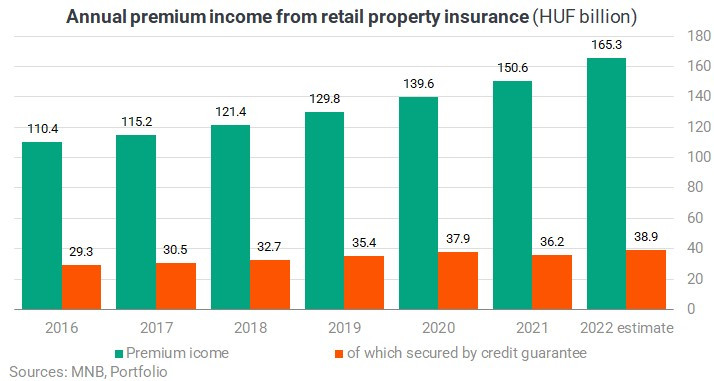
3. Commission cap: it would be more appropriate to talk about a remuneration cap, as the wording of the Regulation would suggest that this is what is meant. We understand that the actual broker commission rate for home insurance is no higher than 20% for roughly 80% of market sales, and only 20% falls into the higher category. However, we have had sources suggesting that this may be true only for CCHI products, which already have a very depressed commission rate because of the limits built into the central bank rating. Commission structures tend to be more complex than what would allow for a uniform application of a remuneration cap subject to the letter of the law. Under a wide variety of names (e.g. management fees, marketing fees, etc.), insurers may give remuneration to intermediaries (especially their own dependent agents) that will not be related to home insurance in any detectable way, but will be worthwhile for intermediaries to actively engage in the product. While the purpose of the regulation would obviously be to drive down the cost of more expensive home insurance, thereby stimulating competition from a pricing perspective, it could also have a negative impact on the intermediary market, with the above-mentioned negative effects outweighing the benefits at the end of the day.
4. March cancellation option: until now, insurers have had to inform their customers about the premiums expected for the following year once a year, at least 60 days before the policy anniversary, and remind them that they have the option to cancel their existing insurance at least 30 days before the anniversary. The possibility to cancel in March, or more precisely by 31 March, extends this once-a-year opportunity by one more time. This would not be as radical a solution as we have seen for compulsory motor insurance before 2010 (and used to be the case for home insurance), i.e. a whole mass of policies would expire on a specific day of the year, but it would partly move the market in this direction, as the anniversary date for new home insurance policies taken out under the new option would all be in March. Its real significance, however, would be to "unleash" those "hungry insurers" and "even hungrier intermediaries" who hope to gain new business from housing insurance switching. We understand that the Association of Hungarian Insurance Companies (MABISZ) has strongly objected to the second cancellation option in March each year, but this could indeed stimulate competition in the market, which could be in the interest of some insurers who may be pricing aggressively. This could be particularly important if this 'campaign period' is subject to intense media and intermediary attention. A source with experience in the insurance industry said that the government could take away "the extra profit of a market that has gone stale" with such a move, even if the insurance surtax introduced last year and increased at Christmas, which diverted up to HUF 80 billion, already has a similar purpose at the level of government communication, albeit not specifically tailored to home insurance. Importantly, the regulation will only enter into force on 30 April, meaning that the "housing insurance campaign" will not happen this year, but only next year. However, insurers, banks and intermediaries should be prepared for the mandatory use of the central bank's CCHI calculator, the change in the APR and the new intermediary remuneration cap in the next three months.
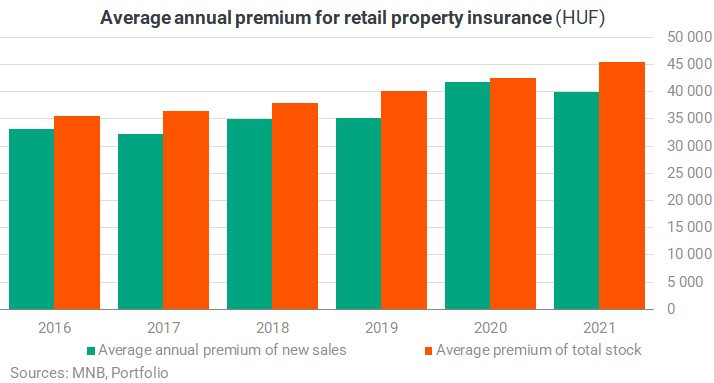
As Aegon Hungary is the largest and probably the most profitable player in the housing insurance market in absolute terms, it seems that
Aegon has the most to lose from the changes. At the very least, it is interesting that the government is doing such damage to the large insurer, which it recently acquired a 45% stake in.
In our understanding, some of the insurance market players have reacted with frustration, while others have interpreted the changes as a business opportunity. Intermediaries, including banks, were mainly angered by the expectations regarding the remuneration cap and the CCHI calculator, while the somewhat clumsy first change to the APR has caused some good laughs too. The insurers were adamantly opposed to the introduction of the March notice period in negotiations with the government, but nevertheless included it in the legislation, as we understand that the market has not come up with a better proposal. Accordingly, the insurance executives who spoke to us anonymously were not happy about the change, generally seeing it as unnecessary and harmful given the current tax and regulatory burdens, but of course promising to behave in a law-abiding and cooperative manner with the regulator.
Cover photo: Getty Images



