Hungarian arm of Raiffeisen Bank doubles annual profit in 2022

Similarly to other banks, the rise in the interest rate environment and the persistence of lending activity despite this played a large role in the rise in profits.
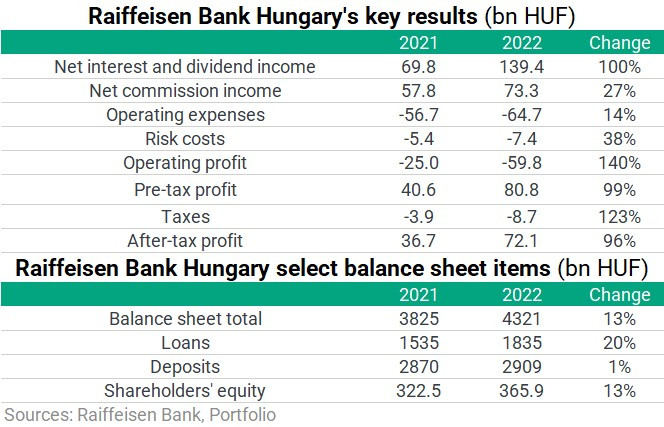
Raiffeisen Bank Hungary reported HUF 139 billion net interest and dividend income, up 100% from the base period's print, just like at the after-tax profit. Net commission income also increased significantly at the bank, going up 27% yr/yr.
Operationg expenses amounted to HUF 65 billion, which marks a 14% annual increase, well below the rate of income growth. Risk costs remained moderate at HUF 7.4 bn, but this corresponds to a 38% yr/yr increase.
The windfall tax implemented last year cost the bank HUF 17.6 bn, and the interest rate freeze caused a HUF 6.5 billion "modification loss" for Raiffeisen, according to the earnigns report.
The bank's loan portfolio grew by 20% and its deposits edged up 1% from 2021, while its balance sheet total expanded by about 13%.
The parent company, Raiffeisen Bank International, the Western European bank with the largest exposure to Russia, reported in early February that its fourth-quarter profit more than doubled from a year earlier to €826 million from €317 million, overshooting analysts' expectations of €657 million. Of the €826 million, €637 million were generated in Russia, but the bank cannot withdraw this from the country or use it to pay dividends due to capital restrictions.
RBI posted €982 million consolidated profit (up 35% yr/yr), excluding Russia and Belarus as well as gain on sale of the Bulgarian units (€453 million). Risk costs reached €949 million, of which €490 million booked in Russia and Belarus, and build-up of risk overlays (provisioning ratio of 0.73%); NPE ratio remained unchanged from 2021 at 1.6%. The bank's CET1 ratio stood at 16.0% (transitional) at the end of last year, driven by strong consolidated profit and RWA optimization; and it was 14.0% excluding Russia.



