Magyar Telekom holding its ground amid transformation of Hungarian telecoms market


A pleasant surprise in revenue
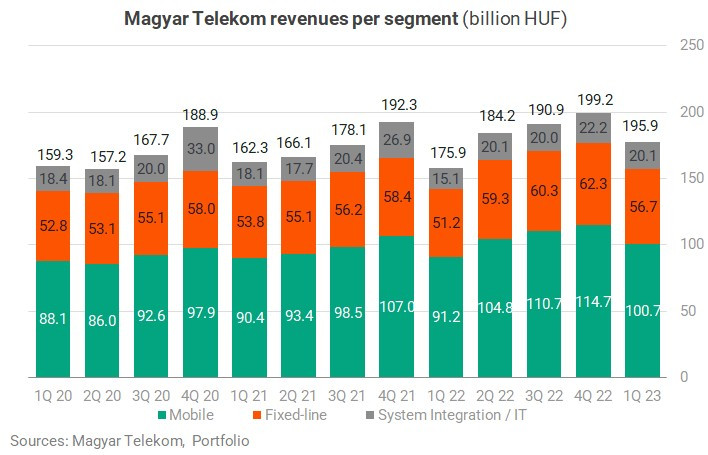
Magyar Telekom's revenue growth in the first quarter of 2023 exceeded analysts' expectations, closing the period with HUF 195.9 billion, which is HUF 6 billion above consensus. EBITDA and operating result also surprised on a moderately positive note, while profit after tax, less watched by investors, came in at HUF 10.5 billion, nearly HUF 2 billion below market expectations.

Key figures for the quarter
Quarterly revenue increased by 12.5% year-on-year, driven by continued strong demand for mobile data, growth in broadband revenues and higher systems integration and IT revenues. Magyar Telekom introduced inflation-based tariff adjustments from this year, which also contributed to the double-digit revenue growth.

- Mobile revenues increased by 10.6% year-on-year, driven by growth in mobile data and voice retail revenues. The latter reflects the positive impact of further customer base expansion in Hungary and North Macedonia, as well as the tariff correction in Hungary, which offset the decrease due to lower usage levels. Data revenues, meanwhile, jumped by more than 23%, driven by a continued increase in subscriber numbers and usage levels in both countries. Wholesale voice revenues declined, mainly due to lower revenues from lower incoming traffic in Hungary. SMS revenues stagnated as lower revenues from bulk messaging in Hungary were offset by an increased subscriber base and higher subscription fees. Mobile handset sales revenues increased slightly. Although revenue from customer sales transactions continued to increase due to higher average handset prices in both countries, this was offset by a strong increase in present value discount related to instalment sales and a decrease in export revenues from third party customers in the Hungarian operations.

- Fixed line revenues increased by 10.9% compared to the first quarter last year, mainly driven by growth in fixed broadband and TV revenues, driven by customer base expansion and inflation-linked adjustments to Hungarian subscription prices. Retail broadband revenues jumped by almost 21%, driven by the positive impact of continued customer base growth and further ARPU growth. Retail voice revenues were stable, while TV revenues increased by more than 10%, driven by further growth in the IPTV subscriber base in both countries, as well as the positive impact of targeted price increases and the Hungarian tariff correction. Fixed line equipment sales revenues decreased by 14%, reflecting lower sales volumes in Hungary. Retail data revenues increased due to a higher contribution from leased line fixed internet services. Wholesale revenues also increased by single digits, as higher international transit and TV resale revenues in North Macedonia offset a modest decline in Hungarian wholesale IP and data revenues.
- System integration and IT revenues grew by more than 31%, reflecting the more favourable annual project distribution experienced in Hungary.
GROSS MARGIN IMPROVED BY 13.1% YEAR-ON-YEAR TO HUF 114.1 BILLION IN Q1 2023, MAINLY DUE TO A HIGHER CONTRIBUTION FROM TELECOMS SERVICES.
The increase in direct costs reflects revenue-driven growth in system integration and IT services, as well as other direct costs. Among indirect costs, personnel expenses increased by 6.9% year-on-year as a result of the wage increase introduced at the beginning of the year. Utility tax increased by 6.8%, while Magyar Telekom recorded a charge of HUF 7.2 billion in the first quarter related to the additional telecoms tax introduced last year. Other operating expenses increased significantly as a result of higher energy costs in Hungarian operations, particularly electricity costs, and additional cost pressure from high general inflation.
besides a double-digit growth in revenue, magyar telekom reported a decrease in profits, owing to rising operating expenses and the supplementary telecommunications tax, and also a one-off positive item in the base period.
In the first quarter of last year, Magyar Telekom sold one of its IT subsidiaries, Pan-Inform, and the transaction resulted in a one-off gain of HUF 3.3 billion on EBITDA level.

EBITDA declined by 6.6% year-on-year to HUF 58.0 billion in Q1, as the improvement in gross profit was offset by higher indirect costs, including the supplementary telecommunication tax. EBITDA AL was down by 8.9% year-on-year to HUF 50.8 billion in Q1 2023, due to aforementioned drivers coupled with higher IFRS 16 lease liability related depreciation and interest expenses, in line with the increasing volume of the related lease liabilities.
mtel's EBITDA margin hit is lowest since q1 2020.
Depreciation and amortisation (‘D&A’) expenses declined by 5.1% year-on-year to HUF 33.6 billion in Q1 2023. In Hungary the decline was driven by lower software related depreciation expenses thanks to the optimization of the IT infrastructure and the proportionally lower amortization of the spectrum licenses that expired in April 2022 and were since reacquired. In North Macedonia, the lower D&A was reflecting the absence of one-off increases related to shortened useful life and accelerated depreciation in relation to RAN modernization in Q1 2022.
Net financial result deteriorated to a loss of HUF 8.7 billion in Q1 2023 from a loss of HUF 3.0 billion in the base period. Interest expense increased driven by higher interest related to lease liabilities, instalment sales and higher average interest costs. The unfavourable change in other finance expense reflects less favourable results on measurement of derivatives at fair value reflecting the different shifts in the relevant yield curves resulting in a year-on-year deterioration and which offset FX gains related to the strengthening of the forint during the period.
Net income was 43.0% lower year-on-year, at HUF 10.5 billion in Q1 2023, primarily driven by lower EBITDA and deteriorating net financial result.

Management comment
Following the first quarter flash report, Magyar Telekom has not changed the 2023 and 2024 public targets set in February, and expects to achieve 5-10% growth in revenue and EBITDA AL this year.

Magyar Telekom CEO Tibor Rékasi highlighted the continued expansion of MTel's subscriber base in the face of an extremely uncertain economic and operating environment and the evolving competitive environment. He added that the group's profitability has been negatively impacted by the current macro environment and significant cost pressures.
In Hungary, our indirect costs, excluding the supplementary telecommunications tax, increased by 28%, primarily due to the sharp increase in our energy prices, in particular the four times higher electricity cost year-on-year. Given the increasing subcontractor costs, unfavourable yield environment and weaker forint, we continue to take proactive steps to address changes in our external environment and leverage our strong position in the market to drive positive momentum in our operating performance,
said Rékasi.
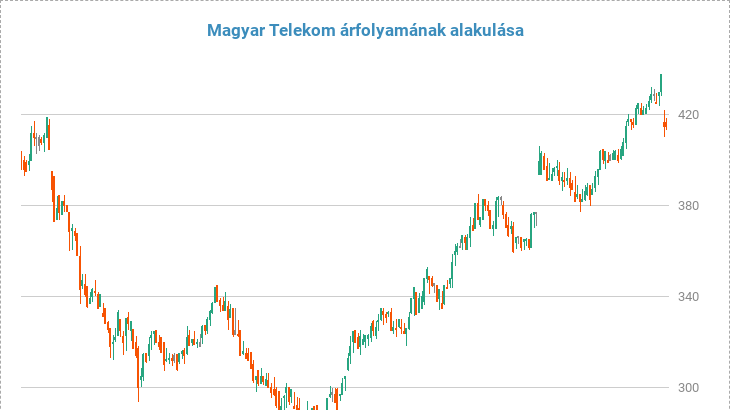
Magyar Telekom's shares have risen sharply since the turnaround in October, and this year alone gained 22%, outperforming the Hungarian market, while the BUX index has risen 6%.