Owners of banks in Hungary show surprisingly stellar performance


The Hungarian banking sector achieved a non-consolidated profit of HUF 485 billion last year, the details of which are summarised here, and the central bank (MNB) is expected to publish the Q1 figures on 6 June. However, the flash reports have already been published, and we take this in this article to look at the performance of six international banking groups - parent banks, if you like - in the first three months of the year: OTP Bank, Austria's Erste and Raiffeisen, Belgium's KBC and Italy's Intesa Sanpaolo and UniCredit are in the spotlight.
The six banking groups achieved a combined after-tax profit of €6.65 billion, which is not only a record profit, but
2.5 TIMES larger what the banks had a year ago in the shadow of the breakout of the Russia-Ukraine war.
According to Intesa Sanpaolo, the bank has not had such a good quarter since 2007, with several banks achieving absolute records or close to it.

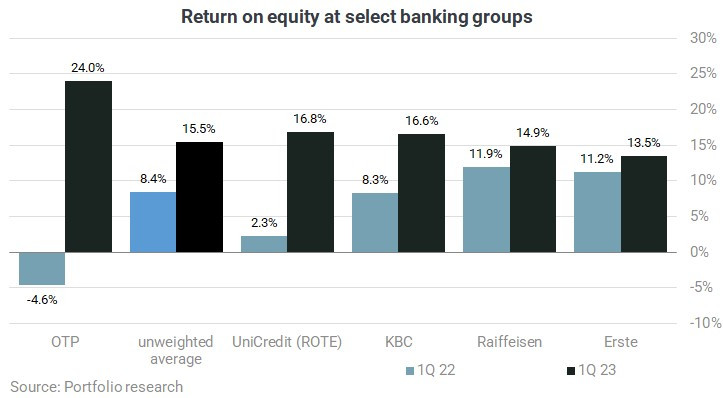
All banks saw an increase in their return on equity, with OTP Bank achieving the highest return of 24%, helped by a €230 million badwill. The badwill impact of the acquisition of Nova KBM d.d. comprised HUF 103 billion, OTP said.
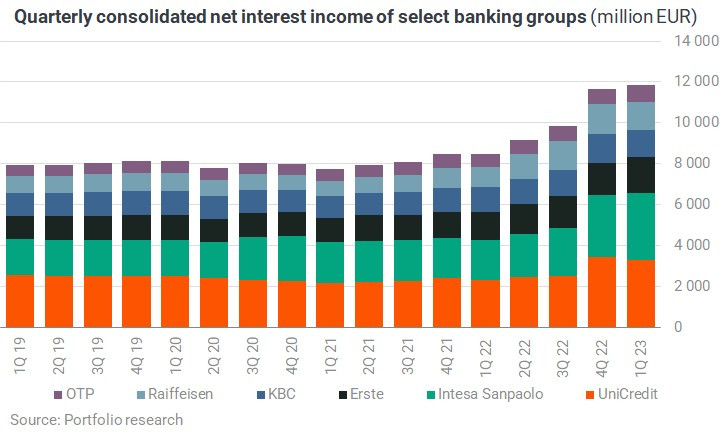
The chart below is the best explanation for the record profits of the parent banks: a rarely seen surge in net interest income. On this line, the banking groups had a 39% surplus of €3.3 billion compared to a year earlier, which
contributed some 80% of their net profit growth of €4.1 BILLION last year.
In particular, interest rates soared in the fourth quarter of last year, but they have continued to rise even in the first quarter of this year. Intesa's (+66%) and UniCredit's (+44%) net interest income increased the most compared to a year ago, while KBC's (+10%) grew the least.
As the stock of interest-bearing assets grew much less than this, for example, banks' aggregate loans grew by only 1.6% in a year, so
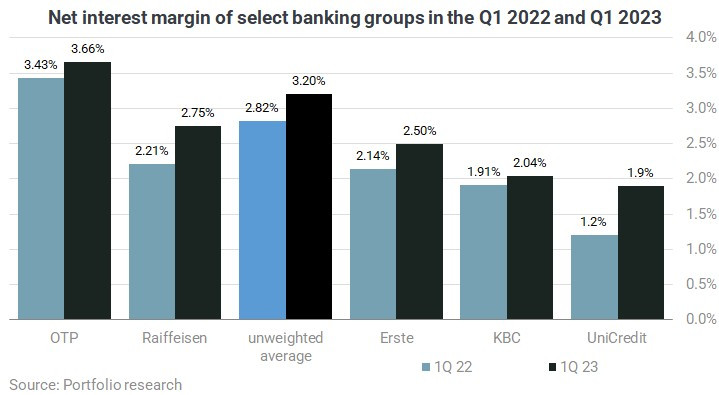
THE WIDENING OF INTEREST MARGINS IS THE MAIN REASON FOR THIS INCREASE IN NET INTEREST INCOME.
Five of the six banks provided a specific figure, all of which saw their interest margins rise, with the average up to 3.2% from 2.8%.
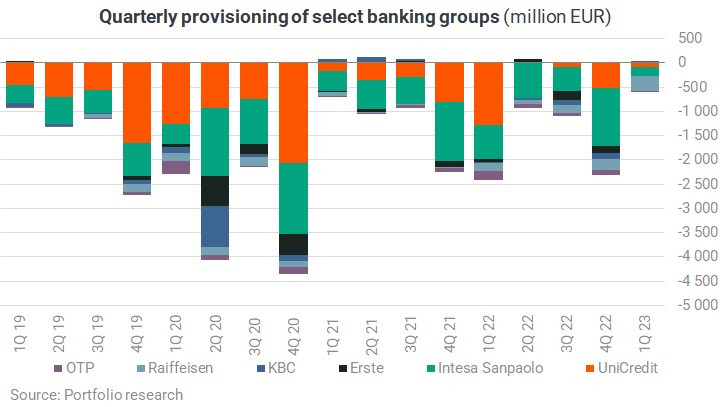
While revenues grew, expenses increased to a lesser extent across the banking groups, so their cost/income ratio, which is an indicator of efficiency, typically improved. Compared to last year's first quarter base, which saw war and a gloomy energy outlook, the banks' total risk costs declined significantly by 77%, with Erste and KBC releasing more provisions than they generated.
on the risk costs line, banking groups saved almost €1.9 billion compared to a year earlier.
Regardless of the war, the energy crisis and high inflation, the share of non-performing loans (NPL) and exposures (NPE) has fallen for all banks over the past year. Since each bank uses a different definition in its reports, the graph below is more suitable for comparisons over time, less so for comparisons between banks.
One of the big questions for this year will be how long and to what extent the excellent portfolio quality can be sustained, but for the time being it seems that
the BANKING SECTOR IS STILL FARING WELL IN THIS AREA, despite the tight labour market and economic performance close to stagnation.

Another interesting question this year will be where the erosion in loan demand will stop and what kind of lending activity we can expect from individual banks by the end of the year, as this is more important for longer-term revenue generation than the temporary rise in interest rates.
Over the past year, the six banking groups' aggregate loan growth in euro terms was only 1.6%, compared with 3.6% in the previous four quarters.
OTP, which is also active in acquisitions, saw the largest increase (+19%) in its euro-denominated loan portfolio over a year, while the two Italian banking groups even saw theirs fall.
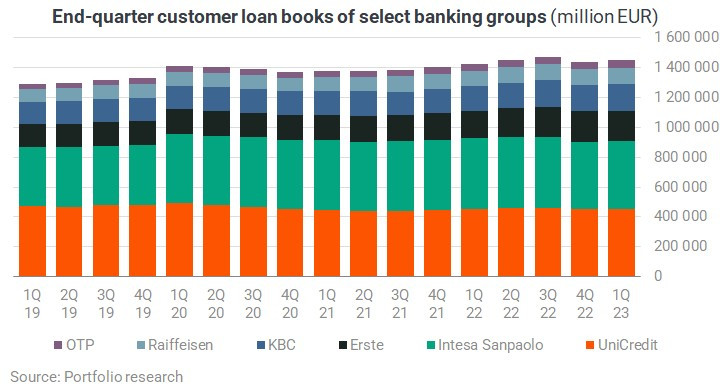
Our graph below shows how much bigger Italian banks are than others, even compared to Austrian banks.

Cover photo: Getty Images