New passenger car registrations up for 12th month in a row in EU


New car registrations reached 851,156 units, up 15.2% year on year, as the bloc recovers from last year’s component shortages. The growth in June was greater at 17.8%.
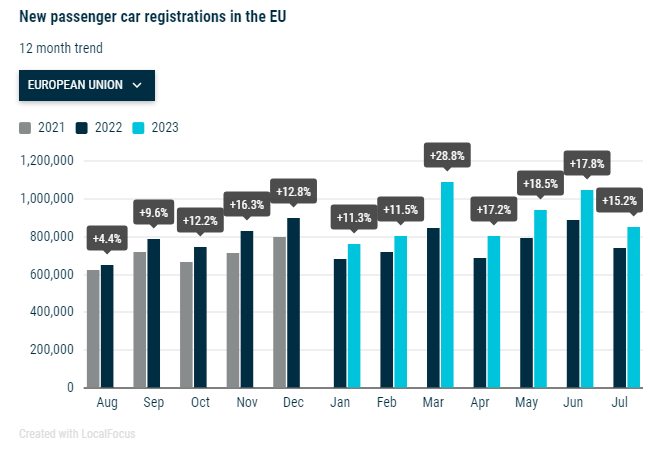
From January to July 2023, new EU car registrations grew significantly (+17.6%), totalling 6.3 million units.
Despite indications of the European automotive industry’s recovery from pandemic-related supply disruptions, year-to-date volumes are still 22% lower than in 2019.
There were double-digit percentage gains in most markets during this seven-month period, including the four largest: Spain (+21.9%), Italy (+20.9%), France (+15.8%), and Germany (+13.6%).
New passenger car registrations declined in Hungary by 2.2% yr/yr in the first seven months, with Sweden being the only other country with a decline. In July, Hungary recorded a 6.8% decrease, the same as Malta and greater than Sweden (-3.0%).
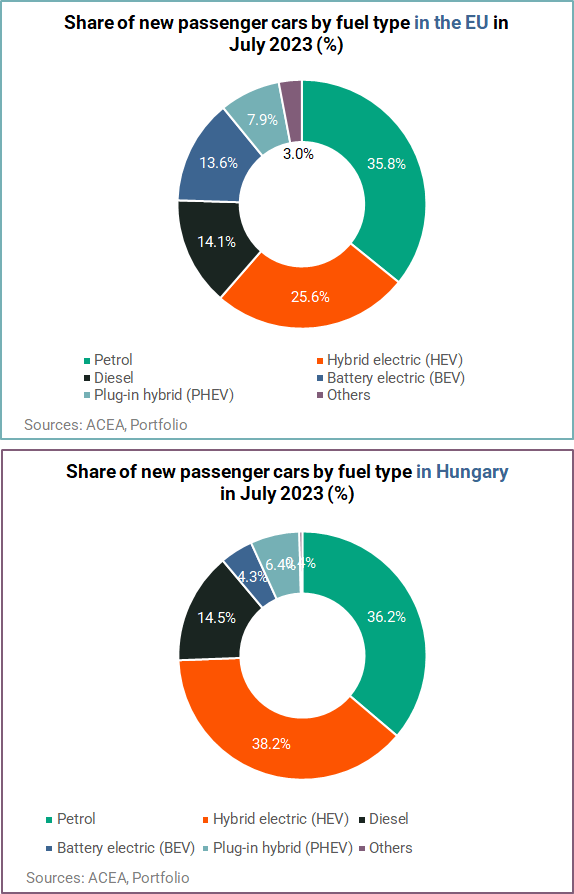
In July alone, new EU battery-electric car registrations substantially increased by 60.6%, reaching 115,971 units while accounting for 13.6% of the market.
The number of hybrid-electric vehicles (HEVs) registered last month was 217,530, an annual increase of 31.6%, while the number of plug-in hybrid electric vehicles (PHEVs) increased by 14.5% to 67,060.
In July, the number of new petrol cars registered increased by 5% year-on-year to 304,903, while their market share fell to 35.8% from 39.3% a year earlier. The number of new diesel cars fell by 9.1% to 120,016, with their market share shrinking to 14.1% from 17.9%.


The share of petrol-fuelled vehicles remains the highest in the EU (35.8%), while the share of hybrid electric vehicles (HEVs) is already higher in Hungary (38.2% vs. 36.2% petrol). However, the share of battery electric (BEV) and plug-in hybrid (PHEV) vehicles remains higher in the EU: BEVs 13.6% vs. 4.3%, PHEVs 7.9% vs. 6.4%.
According to ACEA data, 64,907 new passenger cars were registered in Hungary in January-July, which corresponds to a 2.2% decline over the same period of 2022.
While the registration of new petrol and diesel cars dropped 9.2% and 6.3%, respectively, there was a growth of 25.3% to 3,274 units at BEVs, a 18.3% increase to 3,298 units at PHEVs, and a growth of 2.5% to 25,298 units of HEVs.

In July alone, 8,340 passenger cars were registered in Hungary, down 6.8% in annual terms.
The registration of new petrol and diesel cars dropped 28.2% and 6.9%, respectively, there was a growth of 2.3% to 356 units at BEVs, a sharp 53% increase to 537 units at PHEVs, and a growth of 19.4% to 3,187 units of HEVs.

Cover photo: Shutterstock