A record number of Hungarian companies go under, economic crisis deepens


The number of companies in liquidation increased significantly in September, with 2,256 companies coming close to liquidation in last month. Although the unfavourable figure is partly explained by a seasonal effect - July and August are traditionally the months of the year when the holidays mean that the courts have fewer cases to deal with, which may have been put off to September - last month's figure is just below the records set in May and June, when liquidation proceedings were launched against 2,356 and 2,514 companies, respectively.
This year, up to the first week of October, 16,876 proceedings have been launched, which is double the total number of procedures launched last year, but 3.2 times more than the total number of procedures (5,256) launched in 2019.
And for proceedings already completed, a record 1,110 liquidations were closed last month. For the year as a whole, 6,536 such closures have been recorded.
The two figures also show a diverging trend: the number of businesses closed in this way rose steadily until July, from 400 in January to 880, while the number of new proceedings launched showed a deceleration in the monthly figures, and by September the number was below the annual peak.
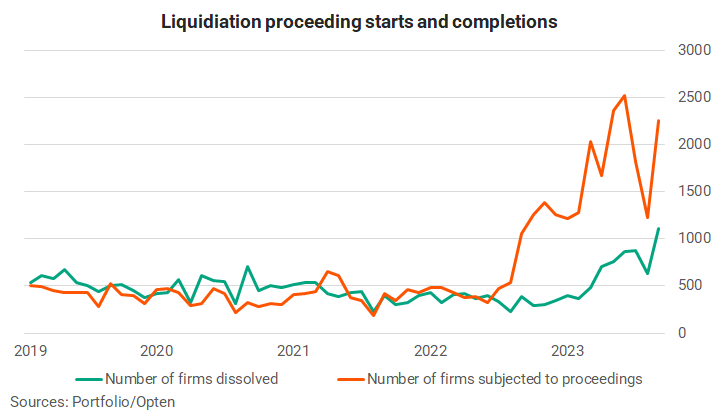
In addition to the difference between the two types of data, several factors point to the possibility that a new wave of business closures may now have started.
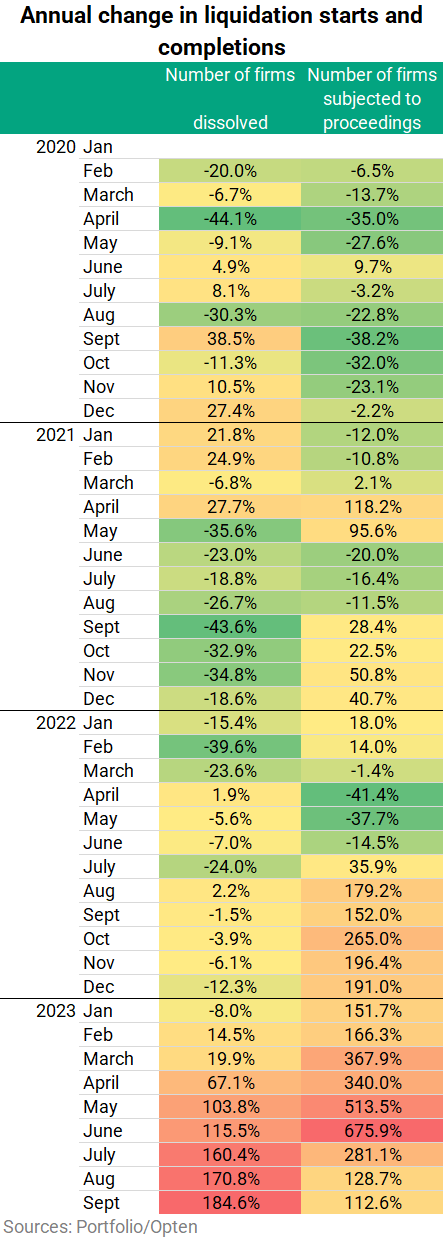
Pure crisis, without KATA and Covid impact?
In the past, there were two main reasons that led to a significant increase in the number of liquidation proceedings in the first quarter, and in the number of closures following their conclusion, as we reported at the time.
Firstly, last summer, the government suddenly tightened the rules of small business tax KATA, which caused many small and medium-sized enterprises to throw in the towel. Secondly, during the coronavirus pandemic, the government decided to ease the situation by introducing a moratorium on company court proceedings, which led to a backlog of cases during the crisis, which were slowly processed on the administration side.
By now, however, the KATA effect has virtually disappeared from the data, with such procedures probably getting done in the first months of the year and the courts have largely worked off the Covid-related extra workload.
There is a rising trend in the number of proceedings launched without a precedent or those that were not affected by the moratorium, which suggests that the economic difficulties of last year have hit these businesses just now,
explained Csaba Alföldi, a business information expert at Opten, to Portfolio. He said the share of proceedings initiated in less than 150 days was already 16%, while 15% were launched in less than 60 days, up from around 10% at the beginning of the year.

The hardest part is yet to come
What's more, we can draw a parallel between the sectors concerned and key macroeconomic data. According to the latest figures, retail sales volumes in the first eight months of the year were almost 10% down on the same period last year.
And the poor retail consumption data is also reflected in the liquidation figures for commercial firms: the lack of turnover and high operating costs led to 682 firms in the sector being placed under liquidation in September, five times the average of around 170 in the last five years. On an annual basis, the trade and repair of motor vehicles sub-sector has already seen 4,958 liquidations and 1,707 closures.
According to Csaba Alföldi, a clear picture will emerge in the coming months as to whether this is a temporary surge or whether many businesses have indeed been hit by the adverse effects of the recession.
Among the possible reasons behind the closures, he cited high inflation, soaring energy costs and lagging household consumption. But the level of interest rates on loans available to businesses, at around 20%, could also make operations unaffordable.
The difficult economic conditions may also be reflected in the drop in the number of new business start-ups, with only 19,152 new businesses registered by the end of September this year. This is down from 22,716 in the first nine months of last year, but well below the 21,471 in the last 'normal' year before Covid in 2019. Meanwhile, the curtain was brought down on 30,457 companies in January-September, more than 30,219 in the whole of 2020.
Cover photo: Getty Images



