EU car market continues to grow, but still well below pre-Covid levels


In the first three quarters of 2023, the EU car market grew substantially (+16.9%), totalling eight million registered units.

Despite the year-to-date increase, the market remains 20% below the pre-COVID pandemic level of 10 million units in 2019,
the European Automobile Manufacturers' Association (ACEA) reported on Friday.
Except for Hungary (-3.2%), all of the region’s markets recorded gains during these nine months,
including the four largest: Italy (+20.5%), Spain (+18.5%), France (+15.9%), and Germany (+14.5%).
New passenger car registrations declined in Hungary by 3.2% yr/yr in the first nine months, becoming the only country with a decline.
In September, Hungary recorded a 3.1% decrease, with a drop reported in Romania (-11.6%), Ireland (-10.5%), Latvia (-8.6%), Estonia (-4.3%), Austria (-4.3%), and Germany (-0.1%).
Electric cars
In September 2023, EU battery-electric car (BEV) registrations increased by 14.3%, reaching 127,149 units, or 14.8% of the market (up from 14.1% in Sept22). This was the third time this year that battery-electric cars surpassed diesel, making them the third-most-popular choice for new car buyers.
Germany, the largest market, declined by a significant 28.6%, which may be linked to incentives for private buyers being reduced from September. However, notably positive performances in three other EU markets – the Netherlands (+70.8%), Sweden (+60.7%), and France (+34.2%) – offset Germany’s decline.
Hybrid-electric cars (HEVs) retained their position as the second most-preferred option, accounting for a significant 27.3% of the market. In September, new EU HEV registrations increased by 30.5% to 235,348 units, primarily driven by robust growth in the bloc’s three largest markets: Germany (+44.1%), Italy (+34.8%), and France (+30.2%). This resulted in a cumulative 28.8% increase, with nearly 2 million units sold in the first three-quarters of the year – around a quarter of the market.
Last month, new EU plug-in hybrid car (PHEV) registrations were relatively stable (+0.4%), totalling 70,578 units. Strong performance in major markets such as France (+35.1%) and Belgium (+71.4%) helped offset Germany’s decline (-45.7%), the largest market for this power source. Overall, the market share of plug-in hybrid cars decreased from 8.9% to 8.2% in September this year.
Petrol and diesel cars
In September 2023, the EU petrol car market increased by 5.5% to 293,884 units, although its market share decreased from 35.3% to 34.1% compared to September last year. Sales growth in the largest bloc’s markets – Italy (+32.2 %), Germany (+9.1%), Spain (+3.2%), and France (+1.4%) – largely contributed to this result.
The EU’s diesel car market continued to decline in September (-12.5% to 109,680 units), despite growth in Germany (+4.6%), as sales in most of the bloc’s other markets retracted. Diesel cars now have a market share of 12.7%, down from 15.9% in September of the previous year.


The share of petrol-fuelled vehicles remains the highest in the EU (34.1%), while the share of hybrid electric vehicles (HEVs) is already higher in Hungary (45.9% vs. 33.1% petrol). However, the share of battery electric (BEV) and plug-in hybrid (PHEV) vehicles remains higher in the EU: BEVs 14.8% vs. 4.9%, PHEVs 8.2% vs. 4.9%.
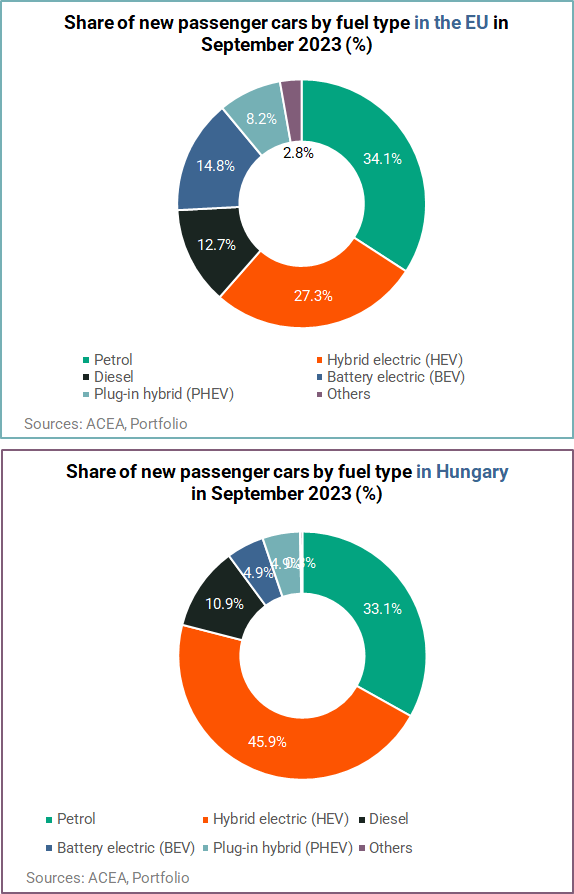
According to ACEA data, 83,009 new passenger cars were registered in Hungary in January-September, which corresponds to a 3.2% decline over the same period of 2022.
While the registration of new petrol and diesel cars dropped 8.9% and 14.2%, respectively, there was a growth of 22.2% to 4,199 units at BEVs, a 19.3% increase to 4,261 units at PHEVs, and a growth of 6.7% to 33,302 units of HEVs.

In September alone, 9,123 passenger cars were registered in Hungary, down 3.1% in annual terms.
The registration of new petrol and diesel cars dropped 22.3% and 23.8%, respectively, there was a growth of 9.8% to 448 units at BEVs, a 13.1% increase to 449 units at PHEVs, and a growth of 23.7% to 4,185 units of HEVs.

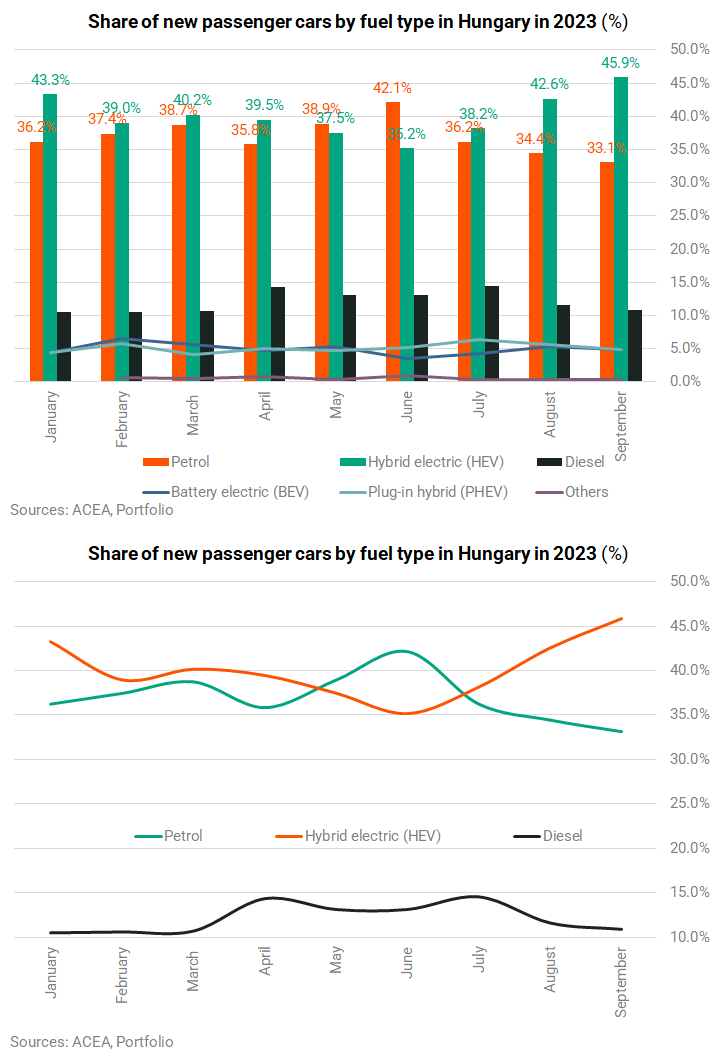
Finally, here's the evolution of the share of new passenger cars by fuel type in Hungary up to September 2023. As you can see hybrid electric vehicles and petrol-fuelled cars have been more or less neck and neck throughout the year, but a sharp divergence started after July (bottom chart) and the share of HEVs started to climb at the expense of petrol cars. The share of diesel-fuelled vehicles was between 10.5% and 14.5% in January-September, averaging 12.1%.
Cover photo: Getty Images



