New passenger car registrations drop only in Hungary in EU in 2023


16-month streak broken
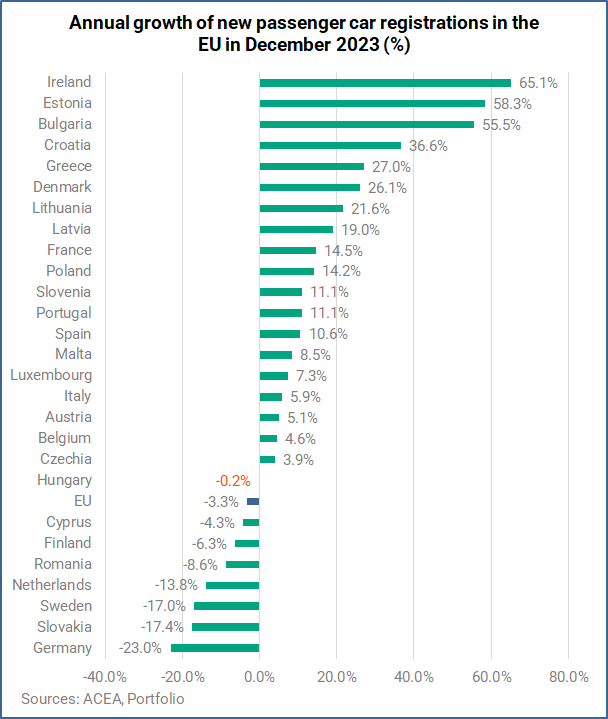
In December 2023, the EU car market experienced a 3.3% decline, recording 867,052 units in sales. The drop came on the back of a high base.
December also marked the first month of contraction after 16 consecutive months of growth.

Notable increases were observed in top markets such as France (+14.5%) and Spain (+10.6%). In contrast, the German car market declined by a significant 23% in December.
New car sales down only in Hungary
In 2023, the EU car market concluded with a solid 13.9% expansion compared to 2022, reaching a full-year volume of 10.5 million units.
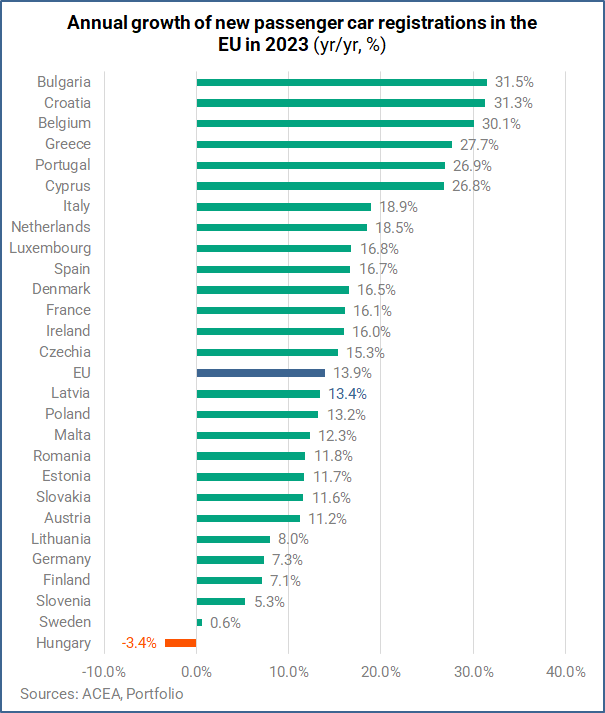
All EU markets grew in the past year except for Hungary (-3.4%).
Double-digit gains were recorded in most markets, including three of the largest: Italy (+18.9%), Spain (+16.7%), and France (+16.1%). Conversely, Germany, with 2.84 million cars sold versus 1.77 mn in France, recorded a more modest 7.3% year-on-year increase, influenced by its weaker December performance.
In December, new passenger car sales in Hungary dropped 0.2% yr/yr, which comes as a great improvement after the November print which showed a 12.6% yr/yr decline, the largest in the EU. A total of 7,986 new passenger cars were sold in Hungary in Dec23, almost as many as a year earlier (8,001).
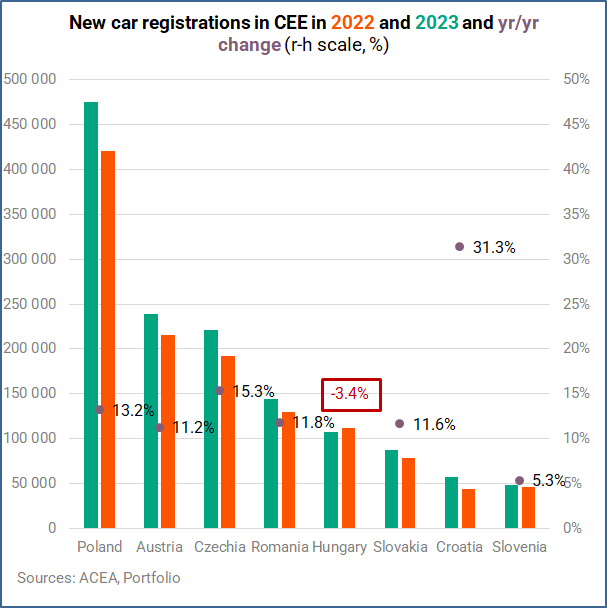
The chart below shows the number of new passenger car registrations in Central and Eastern Europe in 2022 and 2023, as well as their yr/yr change.
New EU cars by power source
Battery-electric cars (BEVs) established themselves as the third-most-popular choice for buyers in 2023. In December, market share surged to 18.5%, contributing to a 14.6% share for the full year, surpassing diesel, which remained steady at 13.6%. Petrol cars retained their lead at 35.3%, while hybrid-electric cars (HEVs) claimed second spot, commanding a 25.8% market share.
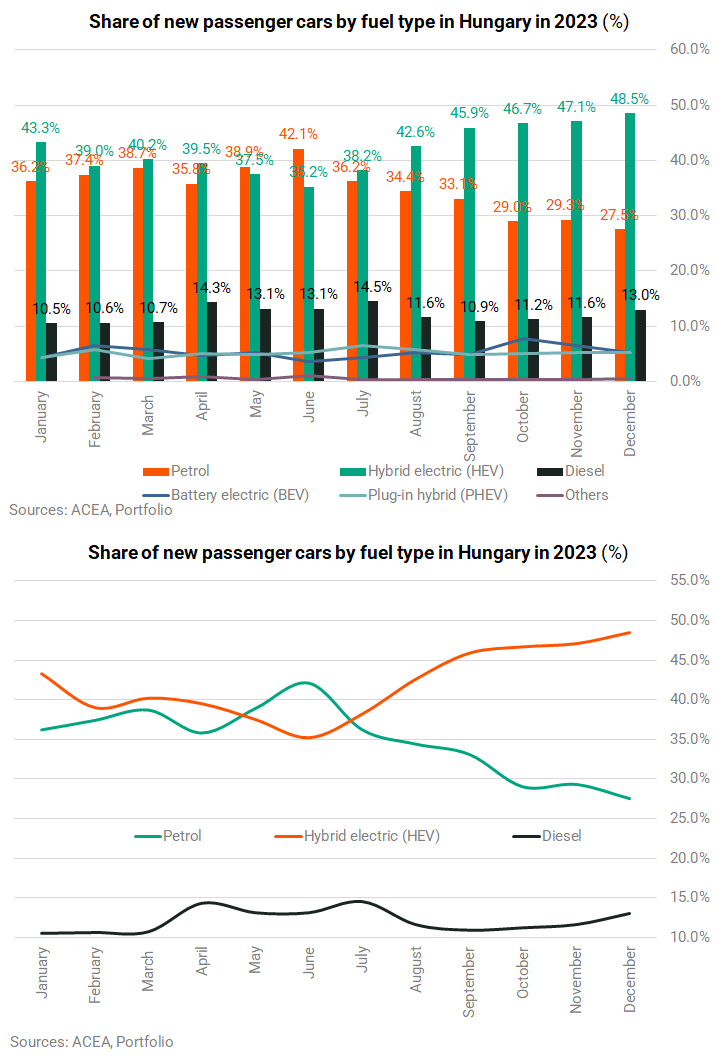
In Hungary, the share of HEVs (41.8%) was much greater than in the EU, while the share of petrol cars was similar and the share of diesel cars was lower.


In December 2023, new battery-electric car (BEV) sales declined for the first time since April 2020 (during the COVID-19 pandemic’s peak), dropping by 16.9% to 160,700 units. This decrease can be attributed to a comparatively robust performance in December 2022 and a significant downturn in Germany (-47.6%), the largest market for this power source. Despite this, the overall volume for the full year of 2023 surpassed 1.5 million units, reflecting a substantial 37% increase compared to 2022. The battery-electric car market share reached 14.6% in 2023.
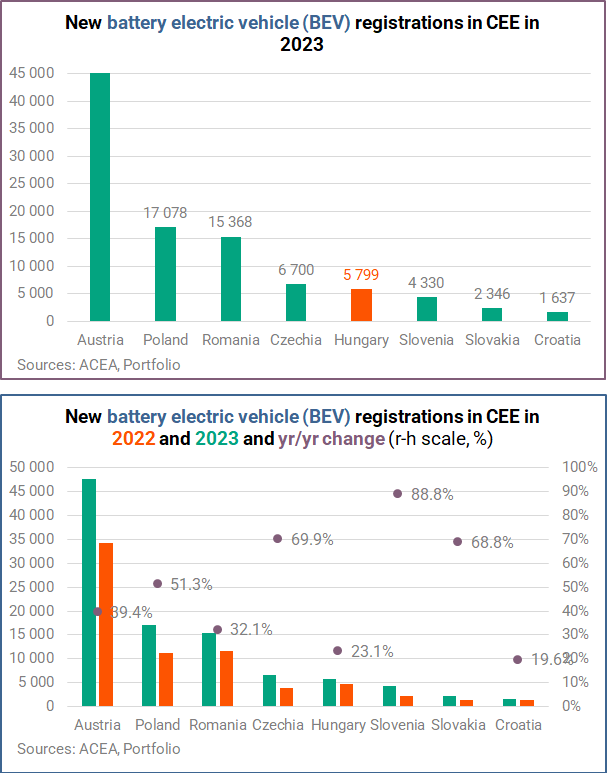
BEV registrations in Hungary rose 12.2% yr/yr in December - a humble growth compared to the majority -, but jumped by 23.1% in the whole of 2023. While the latter figure may seem favourable, in EU terms it marked the fourth-smallest growth after Croatia (19.6%), Sweden (18.1%), and Germany (11.4)%) and compares with a +37% EU average.
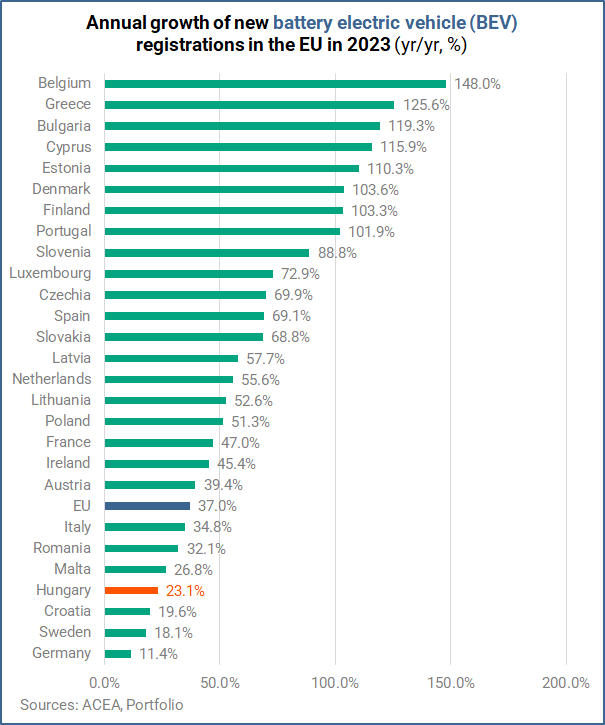
The first of the following two graphs put Hungary's BEV sales into regional perspective. The first shows the actual sales figures for last year, while the second also compares the 2023 figures to the 2022 performance, including the annual changes as a percentage.
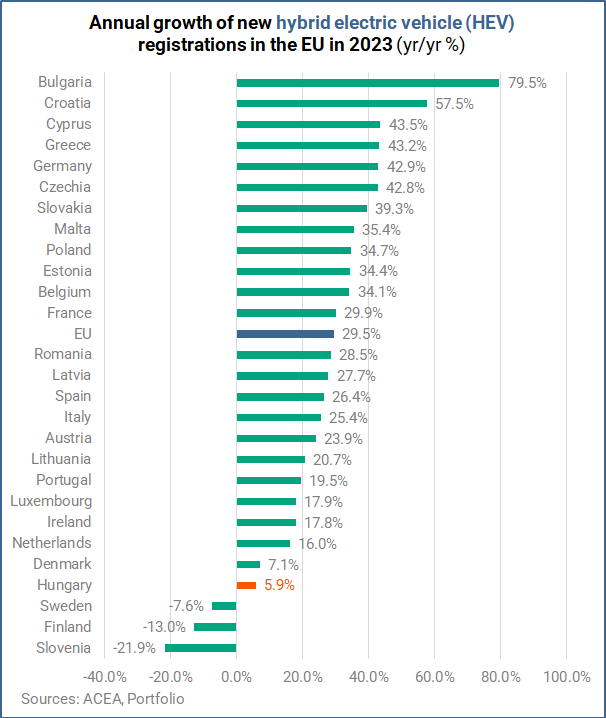
In December, new EU registrations of hybrid-electric cars (HEVs) surged by 26%, driven by impressive gains in three of the four largest markets: Germany (+38%), France (+32.6%), and Spain (+24.3%). This contributed to a cumulative 29.5% increase in 2023, resulting in over 2.7 million units sold in 2023 – a quarter of the EU market share.
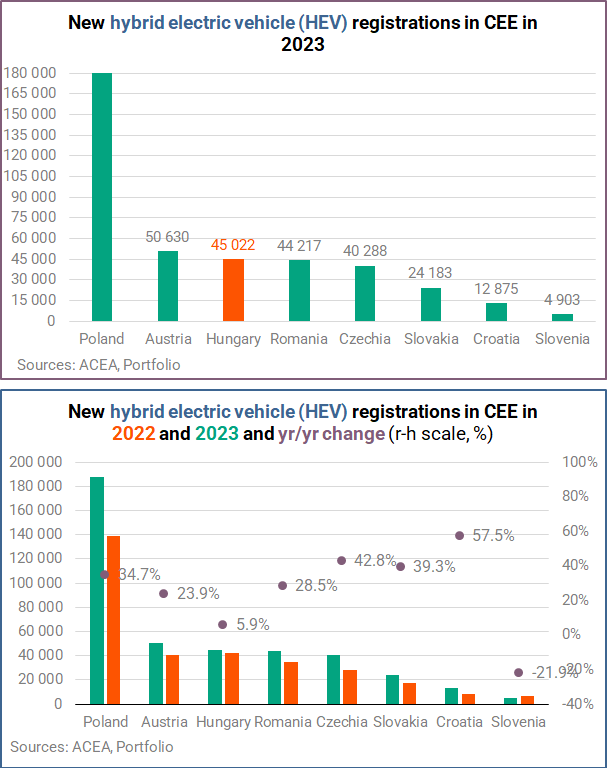
HEV registrations in Hungary declined 3.1% yr/yr to 3,874 units in December, which was the only negative change besides Finland's (-27.3%). In 2023, HEV sales edged up 5.9% to over 45,000 units. There were only three member states behind Hungary, but all with annual decreases.
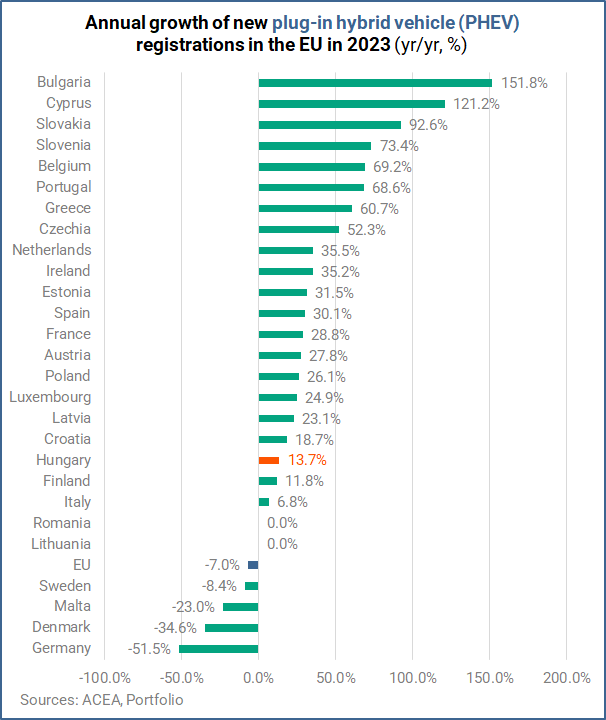
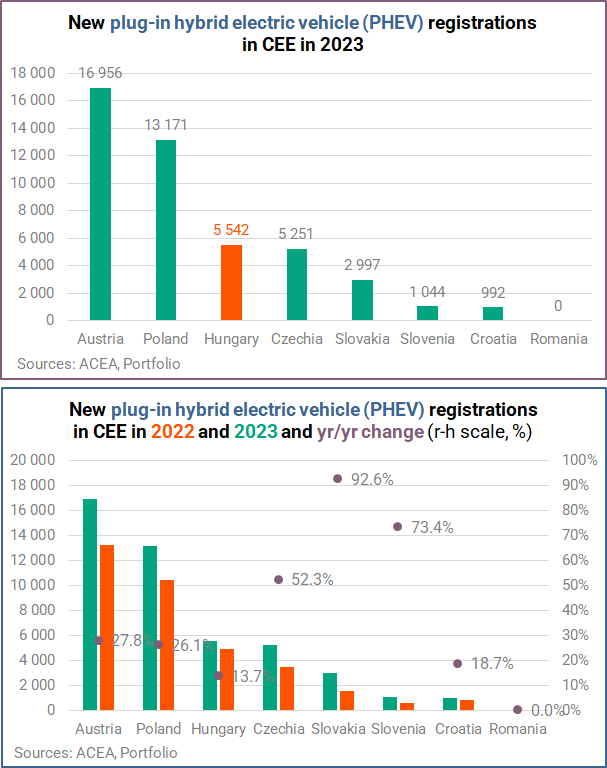
In contrast, sales of plug-in hybrid electric cars (PHEVs) ended the year on a downward trend, declining by a significant 40.2% to 71,546 units in December 2023. Increases in key markets, Belgium (+19.7%) and France (+17.3%), were insufficient to offset the substantial downturn in Germany (-74.4%), the largest market for this power source. As a result, the EU plug-in hybrid electric car market decreased by 7% compared to 2022 and now represents a 7.7% market share.
PHEV registrations in Hungary edged up 5.5% in December to 420 cars, the smallest growth figure in the EU after no change in Romania and Lithuania and contractions in 7 member states and in the EU (-40.2%). In 2023, PHEV registrations on Hungary rose 13.7% to over 5,542 unites, also among the lowest growth figure if we discount stagnation in Romania and Lithuania and contraction in the EU (-7.0%) and four member states.
Petrol and diesel cars
In December 2023, the EU petrol car market grew by 5.1%, driven by significant contributions from key markets like Italy (+24.9%) and Germany (+16.1%). This led to a total of 3.7 million units sold, a 10.6% increase compared to the previous year. Despite maintaining the lead with a 35.3% market share throughout 2023, petrol cars experienced a slight decline from 36.4% in 2022.
The EU diesel car market continued its downward trajectory in December, contracting 9.1%. This decline was evident in several key markets, including three of the largest: Spain (-26.5%), France (-22.2%), and Italy (-19.7%). However, Germany diverged from this trend with 10.3% growth.
In 2023, diesel car sales reached 1.4 million units, accounting for a market share of 13.6%, declining from 16.4% in 2022.
In Hungary, the sale of petrol cars dropped by 0.9% yr/yr in December (2,195 cars), while diesel car registrations rose 13.3% to 1,036 units.
In 2023, petrol car registrations fell 14.7% to 37,752 cars, while diesel car registrations went down 8.6% to 13,043 units.
Cover photo: Getty Images



