Hungary MVM plans to quintuple renewable capacity, new nuclear power plant


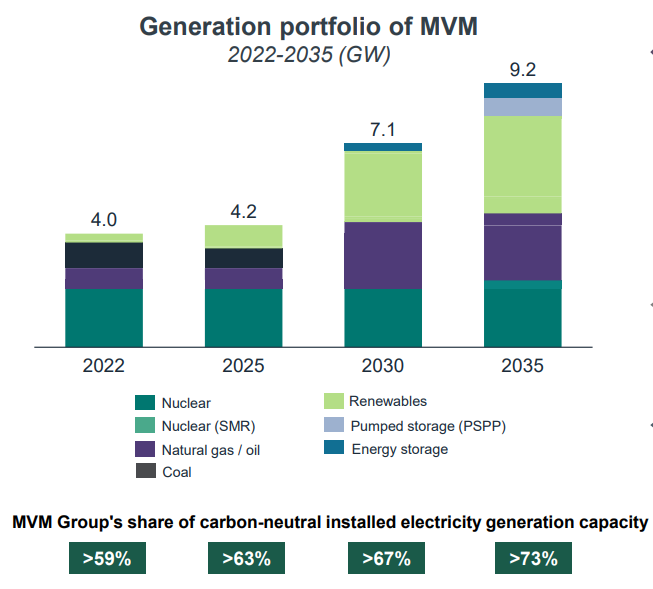
The investor presentation revealed, for example, that an additional 3,000 megawatts of renewable energy capacity is planned to be added to the current 629 MW by 2035, a five-fold increase from the current level.
Also, in addition to the extension of the operating life of Paks I (Hungary's sole nuclear power plant) and better use of synergies with Paks II (two new blocks being built by Russia's Rosatom), the group is also planning a small modular reactor (SMR) with a capacity of 300 MW by 2035.
Of the 3,000 MW additional renewable energy portfolio, 2,450 MW should be solar, 500 MW wind, 100 MW geothermal and 15 MW biomass.
In addition to the dramatic increase in renewable energy capacity, the group also plans to add a massive 2,700 MW of flexible capacities to increase balancing capacities in the energy market. A total of 1,500 to 1,680 MW of flexible gas-fired power plant (combined cycle power plant, CCGT) capacity could be created by the construction of the three new plants, the financing of which will be one of the main challenges.
One power plant would be built on the territory of the Mátra Power Plant, and once it is completed, lignite-based production would be stopped there in line with the government's decision. The other two power plants would be built on the territory of the Tisza Power Plant. MVM also plans to build 500 MW of energy storage capacity and 650 MW of pumped-storage (PSPP) capacity.
These major investments are the first green pillar of the four-pillar strategy, which could increase MVM's power generation capacity to 9.2 GW by 2035, 73% of which would be carbon neutral.
The second pillar of the strategy is portfolio diversification which covers the development of MVM's existing infrastructure, the development of wholesale and retail activities, and regional expansion. One of the main objectives is to have at least 25% of the group's annual EBITDA come from foreign markets.
The third pillar aims to strengthen customer services, reinforce the brand and enhance the attractiveness of the workplace, while the fourth pillar sets financial excellence targets. The goals in the latter are: (i) maintaining MVM's investment grade (IG) credit ratings; (ii) >30% net operating income/debt (FFO / Debt) and <2.5 (Net Debt / EBITDA) leverage ratios; (iii) well-defined capital allocation priorities and investment criteria; (iv) continuous improvement of ESGrating(s).
- In addition to the above objectives, it is also important to know how the MVM Group closed the financial year 2023 according to the preliminary consolidated but not yet audited figures, as summarised in the graphs below.
- MVM reached an all-time high EBITDA (earnings before interest, taxes, depreciation and amortisation) of HUF 911 billion, up from HUF 453 bn in FY2022;
- After-tax profit soared to HUF 372 bn from HUF 73 bn, a five-fold growth;
- CAPEX grew to HUF 345 bn from HUF 337 bn;
- Net debt increased to HUF 1,437 bn from HUF 1,048 bn;
- Net debt/EBITDA dropped to 1.6x last year from 2.3x in 2022;
- MVM's net cash and cash equivalents amounted to HUF 226 bn last year.

Cover photo: MVM Zrt.