Erste Hungary profit leaps in Q1 2024


Radován Jelasity, Chairman-CEO of Erste Bank Hungary shared the key figures of his bank's first-quarter performance:
- Operating income grew by 32% in Q1, driven mainly by a 22% yr/yr increase in fee and commission income compared.
- Operating expenses were 16% higher than in the first quarter of last year. The main reason for this was an increase in staff-related expenses.
- The cost/income ratio continued to decline, reaching 32% by end-March.
- In Q1, the bank had to book risk costs unlike in the same period of 2023. A significant part of the other comprehensive income is accounted for by the booking of annual liabilities, such as the extra profit tax.
- In the period from January to March 2024, Erste's profit grew significantly compared to the same period last year, thanks to a decrease in the windfall tax, and amounted to HUF 28.655 billion.

Within lending, a spectacular upturn could be seen in the retail market, while corporate loan demand was characterised by a wait-and-see attitude, said László Harmati, the financial institution's Deputy CEO for retail.
The stock of loans and bonds was broadly flat compared with a year earlier, while new lending increased by 38%.
Retail lending has picked up, with 2.5 times more home loan disbursements compared to the first quarter of 2023. Personal loans have continued to grow from a high level (with higher real wages contributing to this), and baby loans have also performed better than expected (due to an increase in market share). The good performance of retail lending was largely driven by the family housing subsidy scheme CSOK Plus, he added.
The stock of corporate loans and bonds decreased by 5%, mainly due to a decline in large corporate and local government holdings, said Róbert Cselovszki, President and CEO of Erste Investment and head of the corporate and financial markets business.
The crisis has not yet caught up with businesses, but growth has stalled, and firms are waiting for subsidised loans to be made available, he added. It is not a coincidence that new lending to firms fell in the first quarter in the SME and large corporate and municipal segments.
László Harmati explained that Erste Group's retail assets under management exceeded HUF 5,800 billion, while the securities portfolio continued to grow. Customers continue to look for good yield opportunities, and the bank's position has improved as yields on government bonds have declined. 71% of retail client assets are held in securities, which is an outstanding figure. The private banking business had HUF 1,100 billion of assets under management at the end of March, he added.
Róbert Cselovszki pointed out that there is still room to increase savings for retirement, and looking at clients' investments, it seems that there would be savings buffers for this purpose as well. Today, more than 621,000 retail and 51,000 micro clients can be considered digitally active.
The parent bank's performance
Erste Group reported a profit of EUR 783 million, beating the EUR 736 million consensus estimate of analysts polled by Reuters. The Austrian banking group outperformed market expectations mainly in terms of net interest income, while the group's loan book was stagnant at the beginning of the year.
We are talking about the third largest quarterly profit in euro in the history of the banking group, and the €783 million profit is also relatively respectable: annualised, it corresponds to a return on equity (ROE) of 16%. The market should welcome the better-than-expected figures, mainly due to the continued 4.7% increase in net interest income.
As for the specific incomes:
- Net interest income increased to EUR 1,852 million (+4.7%; EUR 1,769 million), most strongly in Austria, on the back of higher market interest rates and larger loan volume.
- Net fee and commission income rose to EUR 712 million (+10.8%; EUR 643 million). Growth was registered across all core markets, most notably in asset management and payment services.
- Net trading result declined to EUR 106 million (EUR 117 million); and
- the line item gains/losses from financial instruments measured at fair value through profit or loss increased to EUR 33 million (EUR -81 million).
Operating income increased to EUR 2,788 million (+11.6%; EUR 2,499 million).

As for the expenses,
- General administrative expenses were up at EUR 1,283 million (+3.3%; EUR 1,242 million).
- Personnel expenses rose to EUR 746 million (+7.0%; EUR 698 million) driven by salary increases.
- Other administrative expenses declined to EUR 402 million (-1.6%; EUR 409 million) as contributions to deposit insurance schemes – mostly already posted upfront for the full year of 2024 – declined to EUR 76 million (EUR 113 million), most notably in Austria;.
Overall, the operating result increased markedly to EUR 1,505 million (+19.8%; EUR 1,257 million), the cost/income ratio improved to 46.0% (49.7%).
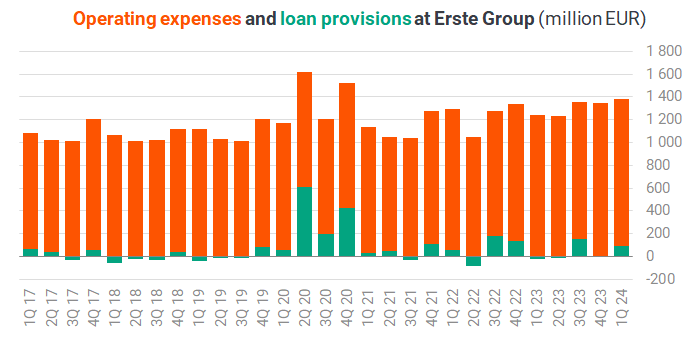
The impairment result from financial instruments amounted to EUR -95 million or 18 basis points of average gross customers loans (EUR 21 million or 4 basis points). The NPL ratio based on gross customer loans was stable at 2.3% (2.3%). The NPL coverage ratio (excluding collateral) declined slightly to 83.7% (85.1%).
Banking levies are currently payable in four core markets. EUR 86 million (EUR 99 million) are reflected in other operating result: Thereof, EUR 67 million (EUR 89 million) were charged in Hungary. The decline is presumably due to the reduction in the 'extra profit tax' burden, which the bank was able to make avail of for the restructuring its government bond portfolio.
Total assets increased to EUR 342.7 billion (+1.6%; EUR 337.2 billion). Loans and advances to customers were largely unchanged versus year-end 2023 at EUR 208.1 billion (+0.1%; EUR 207.8 billion). On the liability side, deposits from banks declined to EUR 19.7 billion (EUR 22.9 billion). Customer deposits rose – most strongly in the Czech Republic and Romania – to EUR 235.3 billion (+1.1%; EUR 232.8 billion). The loan-to-deposit ratio stood at 88.4% (89.3%).

Of the individual markets, Hungary was the biggest contributor to the group's performance after Austria, the Czech Republic and Romania, with profits rising from €10 million to €64 million, partly due to a reduction in the special tax burden. The Czech subsidiary's profit rose by 77%.

As for the outlook, Erste Group expects net loan growth of about 5%. It also sees risk costs remaining at a low level in 2024. "While precise forecasting is hard at current low risk cost levels, Erste Group believes that in 2024 risk costs will be below 25 basis points of average gross customer loans," the bank said.
Assuming an effective group tax rate of below 20% and lower minority charges compared to 2023, Erste Group aims to achieve a ROTE of about 15% in 2024. The CET1 ratio is expected to remain strong, providing enhanced capital return and/or M&A flexibility, despite Erste Group targeting the execution of a share buyback in the amount of EUR 500 million in 2024.

Cover photo: Portfolio



