Raiffeisen swallows Russian damage, numbers reassuring without this item


On Wednesday, Raiffeisen Bank International (RBI) published its second quarterly preliminary earnings report. At first glance, the results may seem disappointing, but the long-standing Russian litigation that has plagued the banking group is finally coming to an end in financial terms. Russian AO Raiffeisenbank has derecognised € 1,204 million of expected proceeds from enforcement of legal recourse against Rasperia in Austria, and the risks are now clearly on the upside.
The company prefers to present its results without the Russian subsidiary, which is being downsized. Encouragingly, including the €307 million second-quarter result, the first half of the year
excluding Russia saw a 5% increase in profit, bringing it to €567 million.
Looking only at the second quarter, we see that the increase is even higher, at 29%. This is mainly due to growth in other results and net fee and commission income.

Compared to a year earlier, Q2
- net interest income including Russia was up 4.1%, while excluding Russia it was down 0.6%;
- net fee and commission income including Russia was up 8.9%, while excluding Russia it rose 0.8%.
Therefore, it is clear that the driving force of the Russian market in a high interest rate environment would be significant from an income perspective.
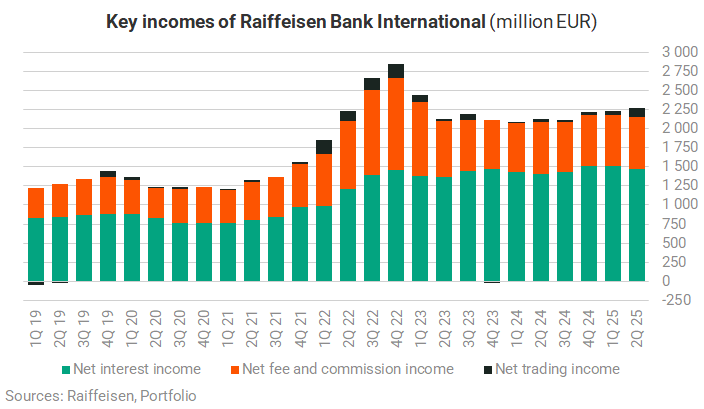
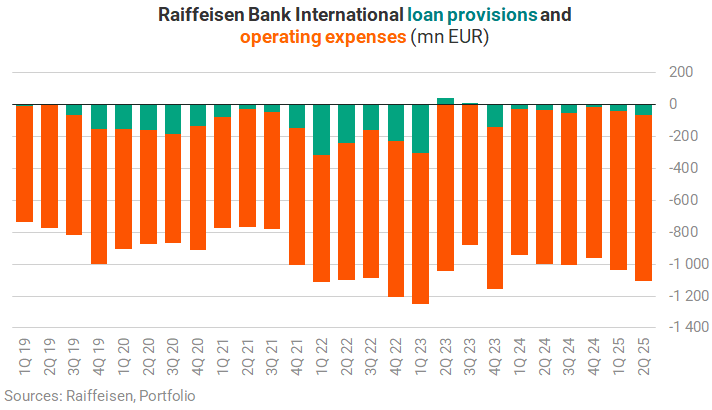
The good news is that operating costs rose by 7% both excluding and including Russia (the cost/income ratio deteriorated from 50.7% to 53.7% in the first half of the year). Meanwhile,
risk costs outside Russia fell by 21%, and are better than management expected despite increasing provision coverage.
The non-performing exposures (NPE) ratio remains at 1.8%, unchanged from a year ago but down from 2.1% at the end of 2024. "We now expect the provisioning ratio in the core group to be around 35 basis points, whereas we had originally assumed up to 50 basis points," said RBI Chief Risk Officer Hannes Mösenbacher.
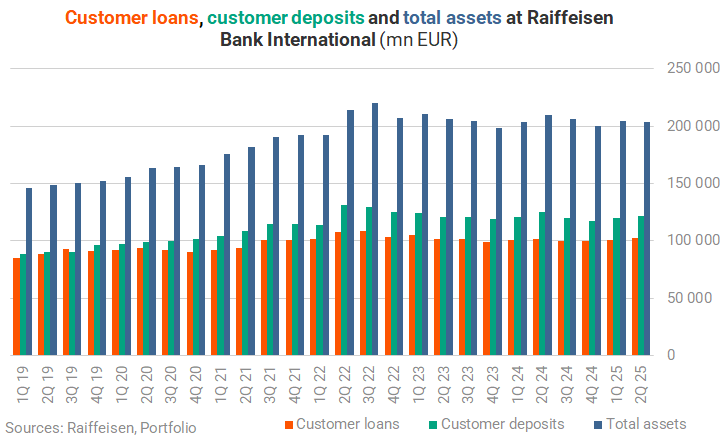
In euro terms, the stock of loans to customers increased by 0.3% year on year, or by 2.2% if Russia is excluded. Meanwhile, deposits fell by 3.1%, but increased by 2.4% when Russia was excluded.
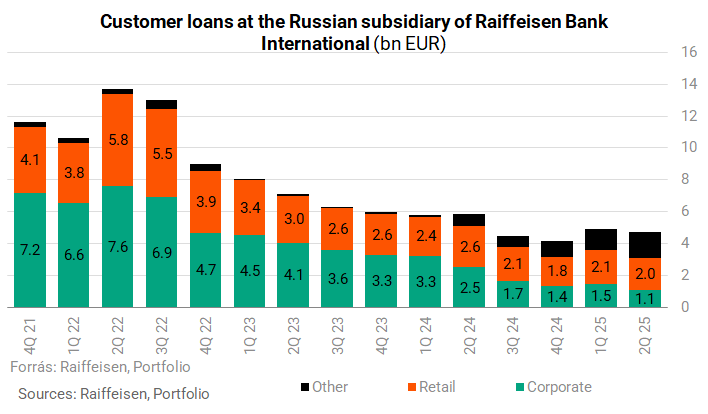
At the start of the war between Russia and Ukraine, RBI had a loan portfolio of €10.6 billion in Russia, which has shrunk to €4.7 billion by the end of June. While exposure to Russian companies has clearly declined over the past year, it has otherwise stagnated, mainly due to the appreciation of the Russian rouble. Without this, the deleveraging picture would be more favourable.
The CET 1 ratio, including the period result and excluding Russian operations under the assumption of full loss of the net asset value at the deconsolidation, would amount to 15.7% compared to 18.2% including Russian operations.
"I am satisfied with the semi-annual results in view of the interest rate cuts in the eurozone and our most important market, the Czech Republic. RBI has once again demonstrated its earnings strength,
said RBI CEO Johann Strobl.
The result for the first half of the year corresponds to an annualised return on equity of 8.1%, but the group's targets are 10% for this year and 13% for the medium term.
Raiffeisen's share price has risen 29% this year and 35% last year on the Vienna Stock Exchange.

Cover photo: Shutterstock