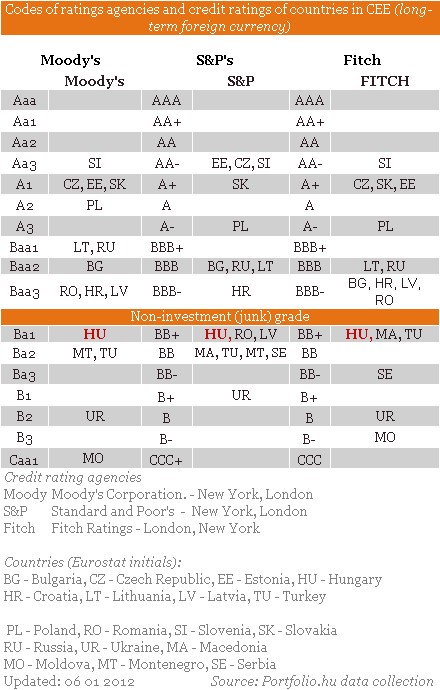
Fitch Ratings has on Friday downgraded Hungary's Long-term foreign and local currency Issuer Default Ratings (IDR) by one notch to 'BB+' and 'BBB-', from 'BBB-' and 'BBB' respectively. The Outlook on the long-term IDRs is Negative. The agency has also downgraded Hungary's Short-term IDR to 'B' from 'F3', and its Country Ceiling by two notches, to 'BBB' from 'A-'.
Fitch was the only major agency still with Hungary at investment grade.
Fitch said that while the importance of securing a timely new IMF agreement has increased, "the prospects of reaching it have become more uncertain."
More importantly, the rating agency expects that a "Stand-By Arrangement is the only type of deal that Hungary can realistically expect," saying that "even if an agreement were to be reached, doubts would remain over whether the Hungarian government could submit to its strict conditionality, given its track record of policy unpredictability and the premature end in July 2010 of the previous IMF programme."
The downgrade comes after Prime Minister Viktor Orbán has announced in the morning that the government aims to secure an IMF/EU credit line as soon as possible.
Fitch's move is not a huge surprise, as several government officials, among others János Lázár, head of the parliamentary group of the ruling Fidesz party, has forecast the other day that this could be expected. Some analysts noted that a two-notch downgrade was also possible.
In a research note issued earlier this week, Michal Dybula, analyst at BNP Paribas in Warsaw, said he would not rule out a one-notch downgrade in the first quarter of 2012 by both Moody’s and S&P and possibly a two-notch downgrade by Fitch (which has up until now been the only major agency still with Hungary at investment grade).
"Assuming that the historical relationship holds, such actions would raise long-end yields by 200bp from current levels - although the move could be larger, given that past rating up/downgrades were within the investment grade area. In addition, the forint would continue to weaken sharply, even if NBH reserves were to be used for external debt repayments. Further yield and spread widening by 200bp would suggest EUR/HUF rising to the 340 levels," Dybula forecasted.
The ratings agency issues the following statement:
"The downgrade of Hungary's ratings reflects further deterioration in the country's fiscal and external financing environment and growth outlook, caused in part by further unorthodox economic policies which are undermining investor confidence and complicating the agreement of a new IMF/EU deal," says Matteo Napolitano, Director in Fitch's Sovereign Group.
When Fitch put Hungary's ratings on Negative Outlook on 11 November 2011, it cited negative rating drivers as a worse than anticipated economic slowdown, and a rise in the risk premium and fiscal financing pressure. In the agency's view these risks have materialised.
The Hungarian growth outlook is continuing to deteriorate. In December, Fitch halved its forecast for 2012 eurozone GDP growth to 0.4%. Given Hungary's high degree of trade openness and strong economic and financial linkages to the eurozone, as well as tightening domestic financial conditions, the agency in January cut its forecast for Hungary's GDP growth to -0.5% from 0.5% previously.
Fiscal and external financing risks have increased significantly since early November, owing to a deterioration in investor sentiment. Hungary's high stock of government, external and private sector foreign currency debt and large associated financing requirements leave it vulnerable to adverse swings in investor confidence. The government faces external debt repayments of EUR 4.6 bn in 2012 (and larger ones in 2013-14), as well as large non-resident holdings of domestic debt to roll-over.
An auction for three-year, five-year and 10-year bonds on December 29 failed partially after investors demanded higher yields than the government was prepared to pay (although the holiday period may have been a partial mitigating factor).
On January 5 the government sold less than its targeted amount of 12-month bills, and only at a yield of nearly 10%. Yields on 10-year government securities are currently near 11%, up from 8% in early November. The Hungarian forint (HUF) lost another 2% against the euro (EUR) over the same period, reaching an all-time low of nearly 320 in early January.
Adverse moves in market sentiment towards Hungary have been greater than in central European peers such as Poland and Romania, highlighting its domestic problems as well as contagion from the eurozone debt crisis.
Additional unorthodox policy measures have further undermined confidence in policy making. In mid-December, preliminary official talks with a view to securing a new deal with the IMF and EU broke down after the government failed to provide assurances that it would alter legislation (including a new Central Bank Act) viewed as contravening EU law. During the parliamentary passage the ruling majority incorporated most suggestions from the European Central Bank (ECB), but left in place provisions that Fitch perceives to reduce the independence of the National Bank of Hungary (NBH). Furthermore, the new constitution, which went into force on January 1 2012, subordinates changes to key tenets of economic policy (such as taxation) to a two-thirds parliamentary majority, thus reducing the scope for fiscal adjustment of future governments.
As a result, the importance of securing a timely new IMF agreement has increased, while the prospects of reaching it have become more uncertain. Fitch expects that a Stand-By Arrangement is the only type of deal that Hungary can realistically expect.
Furthermore, even if an agreement were to be reached, doubts would remain over whether the Hungarian government could submit to its strict conditionality, given its track record of policy unpredictability and the premature end in July 2010 of the previous IMF programme.
Hungary remains self-financing on a flow basis: Fitch estimates that in the year to Q311 the sum of the current and capital account surpluses was 3% of GDP. However, the current-account surplus is as much a reflection of domestic demand weakness as of export resilience.
Also, the surplus on the financial balance (around 4% of GDP in Q3, Q4 rolling basis) was driven exclusively by portfolio inflows, whereas the foreign direct investment (FDI) and 'other investment' balances recorded net outflows.
The two notch downgrade of Hungary's country ceiling to 'BBB', thus reducing the uplift of the Country Ceiling above the Foreign-Currency IDR to two from three notches, reflects Fitch's concerns about the government's track record of unorthodox policies, including with respect to the banking sector. The country ceiling uplift is two or three notches in the case of non-eurozone EU member states, depending on governance and policy records. Nevertheless, the agency believes the imposition of capital controls (which is not permitted under the EU treaty except under exceptional circumstances) is a low risk.
The Outlook on Hungary's ratings remains negative, indicating a probability greater than 50% of another downgrade within the next two years.
A further increase in fiscal and external financing risks and the failure to secure a timely and appropriate IMF agreement could lead to a downgrade. A deeper contraction in economic activity than currently expected; evidence of an increase in private sector capital outflows; a material weakening in the government's commitment to fiscal consolidation or destabilising unorthodox policy measures could also lead to a downgrade.
Conversely, an easing in fiscal and external financing pressures, the government meeting its budget deficit targets and a return to healthy growth, particularly in the context of significant structural reforms and declining external debt ratios, could stabilise Hungary's ratings.
Charting is displayed using TradingView's technology, a platform, where you can build advanced charts,
spot upcoming trends in the stock screener, and find inspiration in multiple trading ideas