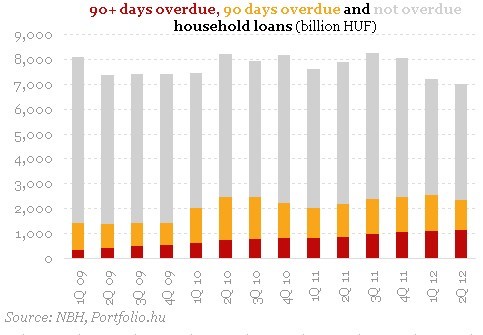
Although the early mortgage payoff scheme was already over, Q2 2012 saw a continued increase of the ratio of non-performing loans in Hungary's banking sector. At the end of June, 16.3% of retail loans were past 90 days in arrears, as opposed to 11% a year earlier, according to a National Bank of Hungary report. Although the opportunity to convert foreign currency mortgages into local currency was available to the majority of defaulting borrowers, the present state of affairs suggest no more than 5% of loans will be converted by the 31st August deadline. That is, banks continue to have a snowballing problem. The silver lining of the cloud is a decreased ratio of debt payments only 1 to 2 months overdue, which projects a slowdown in the increase of the NPL ratio. What could bring a final turning point in the situation for once and all is the fixed exchange rate scheme available to foreign currency mortgage holders.
The aggregate volume of non-performing loans over 90 days in arrears continued to swell in Q2, up 5.4% from HUF 1,080 billion at the end of March to HUF 1,138 billion at the end of June. This unwelcome trend remained prevalent despite the weakening of the Swiss franc (from 245.3 to 239.9 forints) as well as the euro (from 295.5 to 288.2 forints) between the beginning and the end of the quarter. The firming of the forint could have helped reduce both the size of overdue debt and the monthly mortgage payments of foreign currency borrowers. Nevetheless, the trend of rising overdue debt in retail banking continues.
The NPL ratio of residential loans has increased from 15% to 16.3% quarter-on-quarter in Q2, 5.3 percentage points higher than a year earlier. The early mortgage payoff scheme paid a key role in the deterioration of the loan portfolio quality. It reduced banks' aggregate foreign currency mortgage portfolio by HUF 712 billion in Q1 2012 (or HUF 1,354 billion including the early payoffs that were completed in late 2011), and the vast majority of clients who opted for repayment were good debtors with no overdue liabilities. This automatically boosted the ratio of non-performing loans. On the other hand, the decline in the ratio of well-performing debt with no overdue liabilities came to a halt during Q2; currently two-thirds (more exactly, 66.9%) of residential loans are duly paid according to plan, which is higher than the bottom reached at the end of March. (Statistically, well-performing loans include modified contracts.)
NPL ratios vary greatly across different types of residential loans. The impact of the mortgage payoff scheme is clearly demonstrated by the fact that the default rate is currently the highest for foreign currency home equity loans where the NPL ratio has climbed as high as 24.2%. This is however a completely different issue that has nothing to do with the problems associated with foreign currency borrowing, as indicated by the fact that the second and third highest NPL ratio is found among personal forint loans (21.4%) and forint home equity loans (20.2%). Subsidized forint mortgage loans have remained a positive exception, with a default rate as low as 3.5%; in this category the extent of government subsidies, wage hikes since the time of borrowing (typically early 2000s), and fixed installments have all had a favorable impact on portfolio quality.
There are two categories in which portfolio quality was positively affected by the mortgage payoff scheme: non-subsidized forint mortgages and forint home equity loans (the latter is not shown in the chart below due to distortions of earlier data). The reason for the improvement is that preferential payoff scheme was not offered to forint mortgage holders; and furthermore, the forint mortgage portfolio increased by about HUF 313 billion in new loans clients have taken out in order to use them for paying off foreign currency mortgages. In Q2, when the mortgage payoff scheme was already over and had no direct impact on the statistics, the NPL ratio of non-subsidized forint mortgages remained stable at 12.1%. The reason for this is that the newly approved loans increased the total portfolio size (while at the same time there was some increase in non-performing loans as well). However, the same cannot be said of unrestricted-use forint home equity loans. Despite the fact that this part of the portfolio is composed of relatively new loans (a large part of them was approved after the crisis), the NPL rose from 18.3% in Q1 to 20% three months later.
After the completion of the early mortgage payoff scheme, there was no acceleration in the growth rate of the overall NLP ratio in Hungary's banking sector, however it was still considerably higher than the rate witnessed during the quarters immediately preceding the payoffs. As defaults are often the result of high Swiss franc rates, the government's fixed exchange rate scheme that started in April could bring a relief to struggling clients who are not yet more than 90 days behind the payment schedule (i.e. less than 90 days in arrears or promptly paying debtors). Meanwhile, writing 25% off of some non-performing FX mortgages and converting the remainder into forints, the deadline for which is 31st August, will improve future statistics. According to data provided by commercial banks, of the debt affected by the new legislation, EUR 438 million worth of foreign currency loans (HUF 126 billion at late June exchange rates) were over 90 days in arrears at the end of Q2, of which clients intend to convert EUR 132 million (HUF 38 billion) into forint loans, based on clients' statements of intent given to banks. This amount is equivalent to 5% of mortgage loans more than 90 days in arrears. Based on banks' legal obligation to provide data to the NBH, only 8 non-performing FX mortgage contracts worth a total of HUF 42 million were actually converted by the end of Q2.
The statistics above include already restructured loans categorized according to the extent of delayed payment. Since early last year NBH reports have included a detailed breakdown of these, which shows that 13.7% of the current total residential loan portfolio (worth HUF 958 billion) have been restructured, as opposed to 12.2% in the Q2 2011 report (restructuring was not a typical procedure in the past 6 months, probably due to the work overload banks are facing). Without restructuring, banks would most probably have considerably higher NPL ratios. On the other hand, in certain cases restructuring does not solve the problem; today, 32.5% of restructured loans are once again over 90 days in arrears, with another 28.5% also in arrears but not past 90 days.
As shown in the charts below, there has been some improvement in structure of debt in arrears, broken down by the length of delay, with a lower percentage of debtors who have fallen recently behind the payment schedule. Meanwhile, numerous but low-value consumer loans in arrears have shrunk as a percentage of the total, while the percentage of fewer but high-value mortgage loans in arrears increased.
The reasons for debtors falling behind with payments were analyzed by the National Bank of Hungary in the April 2012 Stability Report. Having employed a stress test based on a Cox proportional hazards model, the NBH found the volume of non-performing loans would be less than half the actual amount if there had been no financial crisis, bringing with it a weakened currency, a slump in employment and increased loan interest rates. The more relaxed lending conditions typical of the pre-crisis years alone would have resulted in a significant rise in the NPL ratio without any additional negative factor; the situation was further aggravated by the onset of the crisis.
The increase in default as a result of job losses was mainly typical of the initial stage of the crisis; in contrast, the effects of higher interest rates and worsened exchange rate conditions have been gradually spreading its way throughout the retail loan portfolio. Higher interest rates carry a permanently higher probability of default; as for interest rates, the pattern is different: each repeated period of currency weakening leaves a negative impact. The interaction component shown in the chart above resulted mostly from the interaction of exchange rate weakening and rising interest rates; that is, this component is also linked primarily to rising monthly installments. All in all, NBH analysis of date up to December 2012 found that the increase in the instalments due each month had a significantly greater impact on debtors' ability to keep up with payments than rising unemployment did.
Charting is displayed using TradingView's technology, a platform, where you can build advanced charts,
spot upcoming trends in the stock screener, and find inspiration in multiple trading ideas