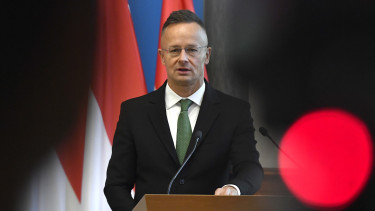
Hungary has repaid ahead of schedule a EUR 607 million tranche of the IMF credit taken out in 2008, Economy Minister György Matolcsy has announced on Friday. His ministry said in a statement that redemption was due by 12 February. Matolcsy said the early repayment "is a measure that shows financial stability, investors' safety and the strength of the country." Payment was made today in Japanese yen, local newswire MTI cited the minister as saying.
Matolcsy added that the early repayment was made possible by the fact that the Premium Euro Hungarian Government Bond (P€MÁK) was scooped up. The State Treasury sold a total of 1.325 bn worth of this instrument. Another EUR 5.5 bn worth of IMF credit is to be repaid by 28 October 2014.
“This [repayment ahead of schedule] took place without us going to international money markets, so without taking out new credit from anyone," Matolcsy said.
What facilitated the early repayment of this tranche of IMF credit was the issuance of the Premium Euro Hungarian Government Bond, which is also credit. So the state repaid its previous debt from debt, which is not surprising.
While Matolcsy said payment was made in JPY, local news portal index.hu said some of it was in euros. (This was possible by a EUR/JPY conversion which naturally had no impact on the forint market.) We need to note that the currency in which the credit is repaid is always picked by the IMF.
Today’s announcement indicates that if the success of the P€MÁK continues, the refinancing of FX debt would not face a shortage of foreign currency funds even if the FX bond issuances failed or faced difficulties.
The announcement most likely serves only communication purposes, as the repayment of debt ahead of schedule sounds like success, while in this case it carries no financial benefits. The state always had the funds even before two to repay its maturing FX debt three weeks ahead of schedule.
In view of the forint depreciation over the past few weeks, it seems to be the most likely explanation that the state’s main intention was to stress for the markets that debt financing remains solid and problem-free.
While Matolcsy said a total of 1.325 bn worth of P€MÁK were sold, the Economy Ministry’s statement says “only" 1.275 bn. According to our information, Matolcsy's figure is the correct one. As you can see on the chart below an over EUR 600 m redemption was due in February. This is what the state repaid ahead of schedule, according to today’s announcement.
As we have recently reported, the state’s FX deposits kept at the central bank (NBH) were flat at EUR 3.2 bn at the end of last year, while its forint deposits dropped to a two-year low and the state’s financial reserves fell to a 1.5-yr low by the end of December 2012.
The success of the P€MÁK considerably reduces Hungary’s need to raise foreign currency funds via Eurobond issuance(s) in order to repay the outstanding EUR 5.1 bn FX debt.
How to proceed?
Hungary needs to repay EUR 5.5 bn IMF credit by 28 October 2014. The Fund signed a SDR 10.5 bn Stand-By Arrangement (SBA) with Hungary on 6 November 2008, of which SDR 7.6 bn were actually drawn (EUR 8.8 bn) by September 2009. A two-year, EUR 6.5 bn balance of payments assistance for Hungary was granted by the EU in parallel with the IMF deal. Of this facility EUR 5.5 bn were drawn.
Charting is displayed using TradingView's technology, a platform, where you can build advanced charts,
spot upcoming trends in the stock screener, and find inspiration in multiple trading ideas