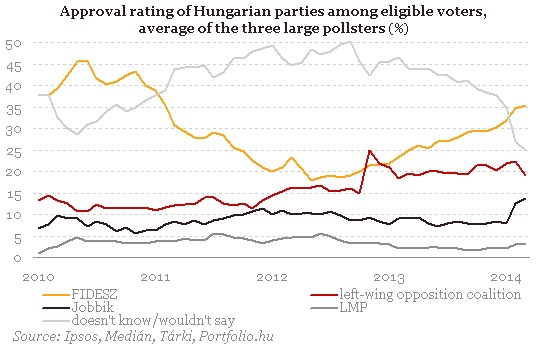
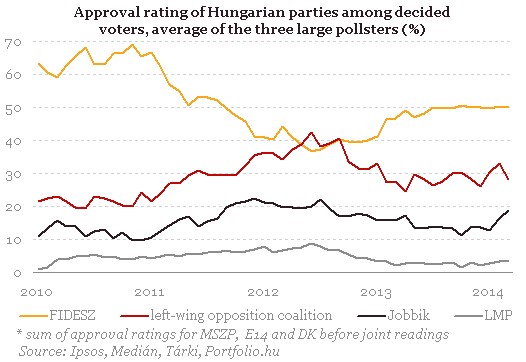
Pollster Medián has published the results of its last pre-election political survey, which opened the possibility to examine the three large local pollster’s findings together.
The findings of the three large local pollsters show that among eligible voters the popularity of the ruling Fidesz-KDNP coalition has been persistently rising even as we are approaching election day (6 April, this Sunday). Their average approval rating in this group is 35%. Meanwhile, over the past few months the left-wing opposition coalition managed to capitalise only marginally from the ever smaller number of undecided voters, and the latest poll shows a clear decline in this group. The leap in the popularity of far-right extremist party Jobbik in February was not a fluke, though. The March prints came out somewhat higher therefore the average approval rating of the party also rose.
Although Fidesz did not garner larger support among decided voters over the past few months, its approval rating still stagnated high, around 50%. In the meantime, the popularity of the left-wing coalition parties fell to below 25% and the popularity reading of Jobbik is close to 20%. Interestingly enough, green party LMP now has better approval rating figures then before, none of the three large pollsters believe it will reach parliamentary threshold (5%). Note, however, that these statistics tended to undershoot the actual popularity of small parties over the past few years therefore, in view of the margin of error, LMP is not in a hopeless situation.
Medián’s survey results have been published today by weekly HVG. The findings confirm that among inactive voters the willingness to change the government is nowhere to be seen, which reduces chances of a surprise outcome. It also deserves some attention that 7% of eligible voters said they would pick a newly established (minor) party, which landed Együtt 2014 Party a 2% approval rating, despite the fact that this formation has absolutely nothing to do with former Prime Minister Gordon Bajnai’s team and alliance.
This indicates that the government’s idea worked and - as Mujtaba Rahman, Practice Head & Director for Europe at Eurasia Group pointed out yesterday - the "generous financial resources" given to newly established parties confused voters and drew some votes away from the opposition. He also pointed out that this ballot will contain as many as 18 party names.
"Moreover, Fidesz has gerrymandered several individual districts," Rahman said, adding that "most importantly, the center-left opposition failed to present an alternative to Fidesz."
Medián concurred, saying that the sudden and surprise appearance of small parties on the national list could in fact take away a lot of votes from the ‘government changers’ (Kormányváltás).
Charting is displayed using TradingView's technology, a platform, where you can build advanced charts,
spot upcoming trends in the stock screener, and find inspiration in multiple trading ideas