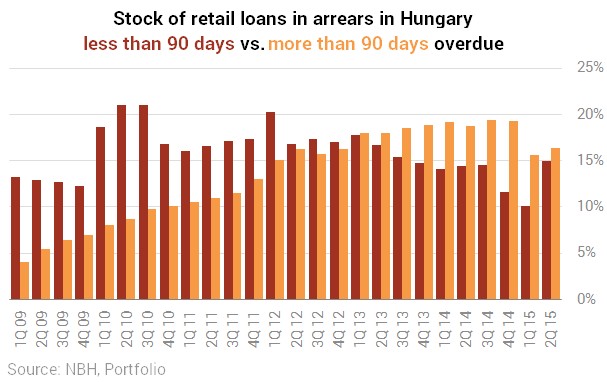
The number of non-performing morgage loans in Hungary is close to 144,000, two-thirds of which have been permanently in arrears, according to a report by the National Bank of Hungary (NBH) released on Thursday. Over-indebtedness is the greatest issue: together with the amount in arrears, it can be stated that about half of debtors owe more than the current value of their homes. As the majority of non-performing loans were taken out for inexpensive homes, downsizing is hardly a viable solution. According to the National Bank of Hungary, about 70,000 to 80,000 non-performing mortgages could be "remediable", which suggests that the NBH might soon come up with ideas reagarding the what's and how's. Portfolio.hu's conclusion is that another debt relief scheme is probably in the making, to complement the solutions offered by the National Asset Management Agency and the hitherto unpopular personal bankruptcy.
A throrough 87-page descriptive report on non-performing retail mortgage loans has been published by the National Bank of Hungary (NBH), including the following major findings (the charts below are based on the NBH's banking statistics and might therefore diverge from the information below):
Over-indebtedness is the greatest obstacle to reducing the stock of non-performing retail mortgage loans. Over-indebtedness is the reason for 43% of non-performing loans, whereas lack of income is to blame for 38% of non-performance.
Although banks have been active in debt restructuring, they could do even more, as restructuring could still a long way towards restoring liquidity in the NBH's view. The greater part of debtors is willing to cooperate with their bank in finding a solution, although about half of them are distrustful of their banks.
Debtors also need to show greater willingness to cooperate; about 15% of those surveyed categorically rejected each of the potential solutions offered.
Banks have limited room for the sale of the mortgage collateral, repossession is costly and lengthy.
Administrative obstacles make effective solution of the problem difficult, especially in the case of already defaulted loans. The majority of debt relief packages offered in the past were too complex for debtors to understand.
Some interesting data on non-performing retail mortgages:
NBH records show 144,000 non-performing mortgage loans; the total amount of debt is HUF 1,100 billion. Some 70% of the non-performing debtors live in small towns or rural communities, 12.6% in Budapest.
82% of these clients have higher debt now than the amount borrowed (partly as a result of increased debt principal, and partly of the amount in arrears).
55% of the non-performing loan contracts have defaulted. The majority of defaults occurred between 2010 and 2014, with the single highest number in 2013.
Of the non-defaulted, non-performing loan contracts, two-thirds have been permanently in arrears.
The average monthly payment is HUF 48,000 to HUF 52,000, the interest rates (after banks' obligatory remedial action) average 5.4% to 6.2%, the remaining time to maturity is 12 to 13 years. However, the actual parameters are widely spread.
In addition to the mortgages, there are almost 100,000 personal loan contracts.
About half of the non-performing debtors are above 45 years of age, the majority will be above retirement age when the loan matures.
Can debts be paid off by selling the home? Typically not, for the following reasons:
Although two-thirds of debtors have less debt principal than the actual market value of the property, more than half of the properties are worth less than the combined amount of the debt principal and the amount in arrears.
The majority of the properties are worth less than HUF 10 million, therefore, downsizing is hardly a viable solution for settling debt. Considering the properties affected by non-performing loans, the share of homes worth less than HUF 10 million is almost 50% even in Budapest where market prices are higher.
Saleability is limited as well. For instance, in the Észak-Magyarország (Northern Hungary) region, even mid-size cities have more homes collateralized in a mortgage loan more than 90 days in arrears than the number of market transactions each year; and the trend is even more pronounced in smaller towns or villages.
Debtors typically reject solutions involving the loss of their homes. The majority of debtors are aware that they could lose their homes, but nearly half do not perceive it as a realistic threat.
Taking the existing solutions (e.g. National Asset Management Agency, personal bankruptcy - the latter could resolve about 15,000 such cases) into consideration, about 120,000 to 140,000 cases remain unresolved. Of these, about 70,000 or 80,000 are "remediable" according to the NBH, which is currently working on a solution.
Charting is displayed using TradingView's technology, a platform, where you can build advanced charts,
spot upcoming trends in the stock screener, and find inspiration in multiple trading ideas