Hungary to remain without EU funding for a long time, economists say


We are seeing several difficulties in the global economy, with the most prominent ones being inflation and high energy prices. Moderator Tamás Moró, lead strategist at Concorde Securities, asked panel participants about these at Portfolio’s Budapest Economic Forum conference.
Looking at rising energy prices, there are both short-term problems and structural problems involved, Dan Bucsa, chief CEE economist at UniCredit Bank, said. Cyclical difficulties include the upcoming cold wnter and certain production outages (e.g. the partial ones in the Netherlands).
These transient problems will not be solved in the next 6 to 9 months,
Bucsa said.
As for inflation, the problem is on the supply side. Demand is stable, so higher prices are primarily caused by supply problems. These appear to be re-occurring and we have to prepare for similar problems
Marek Drimal, EMEA Strategist at Societe Generale Corporate and Investment Banking, expects high inflation to persist through 2022. Meanwhile, there is positive news as well, as the economic outlook of the euro area has improved significantly through fiscal stimulus and the Next Generation EU.
There is, however, a significant risk the magnitude of which we do not know at present, and that is China,
Drimal said. While there are also political risks concerning China, he highlighted economic ones, including the high debt ratio of the property sector, the decreasing openness of Chinas trade and the restructuring of supply chains.
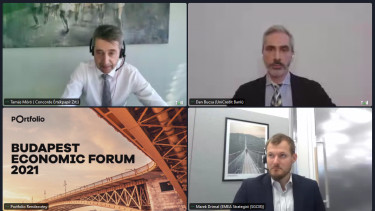
Móró’s next question concerned monetary policy. In his view, CEE central banks are rather aggressive, but the question is what changes can be expected in monetary policy.
According to Dan Bucsa, the Hungarian central bank cannot be considered overly aggressive and the current monetary policy could be more resolute.
In his view, the rate hike cycle could have begun as early as March and the MNB may have to do more in the future as well. In the short term, there are risks involved due to market reactions, as the lower-than-expected rate hike in September led to the devaluation of the forint and similar things could happen in the future as well.
We can also expect households to make some savings on energy compared to other countries as energy prices are regulated in Hungary. As a result, we may see increased household spending in coming months. Also, even though the Hungarian inflation target is higher than those of other CEE countries, interest rate hikes will be required next year as well, Bucsa said, adding that while the forint should have firmed due to the tightening cycle of the MNB, this has not happened.
Drimal concurred, recalling that while the Hungarian central bank used to be among the loosest, this has changed completely: the MNB now upholds orthodox monetary policy and maintains its forecast of continued tightening.
Drimal expects the MNB to keep up orthodox monetary policy through higher than expected rate hikes.
Both Bucsa and Drimal highlighted that the rate of earnings growth in Hungary is among the highest, and this could continue into the future. Hungary has one of the tightest labour markets in Europe, which also points towards further rate hikes. Móró also agreed.
What will happen in Central and Eastern Europe once the Fed begins tapering? According to Drimal, the Fed’s tightening is, and always has been, among the most important factors for emerging markets. As a result of the tapering, the dollar could firm against the euro, which in turn could devalue the forint. Drimal expects the fed to make a rate hike in the first quarter of 2023, while Bucsa anticipates a move as early as in 2022, while we are already seeing capital outflow from the CEE region. This could lead to higher than expected increase in long rates in the region, including Hungary, panel participants agreed.
The two economists were also asked about Hungary’s row with the EU. Acording to Bucsa, this is more a social issue than a political one as it contributed relatively little to growth. In his view, the disagreement could be prolonged after the rule of law mechanism was invoked, and
he does not expect EU funds to arrive in Hungary in the second half of 2022.
This means Hungary will have to take out further loans early next year. (While not saying so expressly, Bucsa probably meant FX bond issues). Drimal also does not expect the problem to be resolved in the short term, but added this should not have a significant impact on economic recovery.
Cover photo: Getty Images





