Spillovers from Russia-Ukraine war to hit CEE economies hard


According to Capital Economics, CEE will be affected through two main channels.
First, industry will be hit by weaker export demand, supply chain disruptions and higher energy prices. Total goods and services exports to Russia and Ukraine amounted to 3% of GDP in Central Europe before the war.
While much smaller than the region’s exports to Western Europe, they are still significant and will be more or less lost this year.
According to Capital Economics, the overall hit to net trade might knock 1.0-1.3%-pts off GDP growth in Hungary, Czechia and Poland this year.
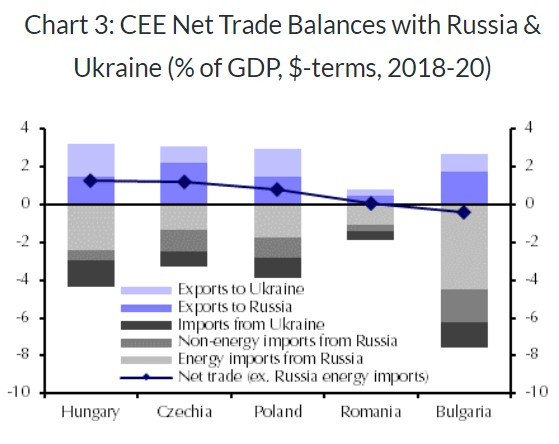
Second, economies will face headwinds from higher oil and food prices.
"With the price of oil at $120pb and likely to remain above $100pb this year, fuel inflation will keep headline inflation well above central banks’ targets (the impact will be offset slightly by reduced VAT in Poland and fuel price caps in Hungary)," CE said.
High oil prices will also cause current account balances to deteriorate – if oil falls to $100pb by year-end, the energy import bill in CEE will be $20bn higher this year than in 2021, equivalent to 1.0-1.5% of GDP. (The report does not say whether the increase in the price of energy sources other than crude oil, such as gas, has been taken into account in the forecast.)
This will push current accounts into a larger deficit in Poland and Hungary (5% of GDP), and to even more alarming levels in Romania (8% of GDP). This will keep exchange rates under pressure.
The economists at CE expect the war in Ukraine to add 2%-pts to CEE inflation this year.
"The dampening effect of higher inflation on households’ real incomes and consumer spending will be reinforced by tighter monetary conditions," they said.
Central banks have stepped up tightening cycles this month and CE expects interest rates to rise towards 6% in Poland and 8% in Hungary this year, which is more hawkish than investors.
CE's assessment is that
these two channels will knock 2.5 percentage points off CEE GDP growth this year,
but the analysts think that "looser fiscal policy and a potential boost from Ukrainian refugees will provide some offsetting support", so they have lowered their GDP growth forecasts by 1.0-1.5%-pts in total.
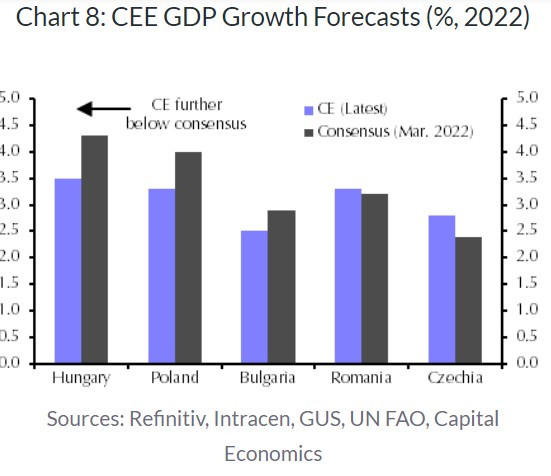
In view of this, CE projects growth to be around 3.5% in Hungary, Romania, and Poland, and around 3.0% in Czechia this year, acknowledging that its forecasts are generally below the consensus, particularly for Poland and Hungary.
The forecast is not such a surprise: it is exactly the mid-point of the Hungarian central bank's (MNB) 2.5-4.5% growth forecast, so it cannot be labelled as particularly pessimistic.
Other major London-based analyst firms project a severe recession in the Russian economy, above all because of unprecedented international sanctions. In its latest global forecast, international credit rating agency Fitch Ratings predicted an 8% contraction in Russia's gross domestic product for this year and a 0.2% decline for 2023. Global financial services group Bank of America's London-based research arm, BofA Global Research, has forecast a 13% plummet in GDP in Russia this year, accompanied by accelerating average annual inflation to 20%.
Cover photo: Getty Images





