IMF projects over 10% annual inflation for Hungary for 2022


The IMF has updated its global macroeconomic forecast for the first time since Russia started the invasion of Ukraine on 24 February. The WEO includes new estimates for Hungary, as well. The IMF's prognoses confirm earlier assessments that the war will have two important negative consequences for the Hungarian economy:
- growth will slow significantly compared to last year;
- inflation could remain with us for longer than expected and peak higher as commodity prices soar.
More precisely, the Fund's economists forecast Hungary's GDP to grow by 3.7% on annual average in 2022, down from 7.1% in 2021. Also, they expect no spectacular rebound even in 2023, forecasting growth to reach only 3.6%. The IMF's updated estimates are largely in line with current market forecasts. The Hungarian central bank (MNB) last projected 2.5 to 4.5% growth for this year, while analysts believe GDP will most likely be up by 3 to 4%. The central bank is a lot more upbeat than the IMF in terms of the 2023 growth, forecasting output to be 4 to 5% larger than this year.
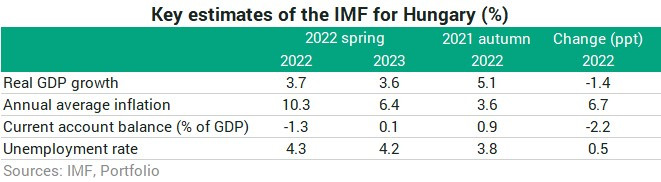
The IMF's latest forecast for 2022 also shows double-digit inflation at 10.3% on annual average, slightly above the consensus estimate. The MNB expects inflation between 7.5 and 9.8% this year, and analysts are also rarely forecasting above 10%, with 8-9% being the general consensus.
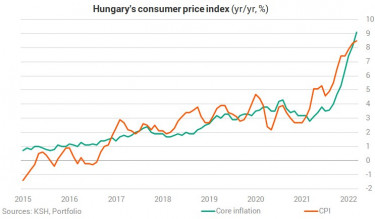
The WEO does not include a textual explanation for the Fund's forecasts for Hungary therefore we do not know what the IMF staff think think about, for example, the maintenance of price freezes. However, their inflation forecast may suggest that they think these price caps could be lifted soon. An annual average of 10.3% would also imply that
cpi could certainly PEAK WELL ABOVE 10%, AROUND 12-13% later this year.
According to the IMF staff, inflation could fall in 2023, but the 3% target of the MNB still seems a long way off. They now expect an average price increase of 6.4% next year, above the central bank's estimate of 3.3-5%.
A further consequence of the war could be a deterioration in Hungary's current account balance, although the IMF does not expect the scale of this to be as significant as many fear. Last year's C/A deficit of 0.9% of GDP is expected to widen to 1.3% in 2022. Nor do economists expect a significant change in the unemployment rate, which could rise from 4.1% in 2021 to 4.3% this year and remain around that level next year.
Cover photo: Getty Images





