Hungary posts mammoth budget deficit again


No sign of improvement, quite the contrary
Hungary's general government posted a shortfall of HUF 326 billion in the fourth month of the year. According to Portfolio's data base, this is the largest deficit ever incurred in April.
This means the deterioration of fiscal processes has not stopped even in the fourth month of 2022.
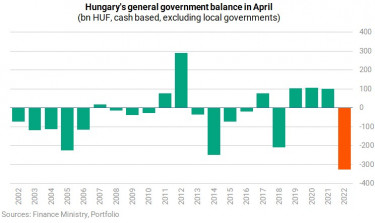
The deficit in the first four months of the year amounted to HUF 2,635.6 billion. The January-April gap is the largest ever. According to the Ministry of Finance's preliminary report, the central budget recorded a deficit of HUF 2,669.7 billion, while extra-budgetary funds recorded a surplus of HUF 52.8 billion and the social security funds a deficit of HUF 18.7 billion.
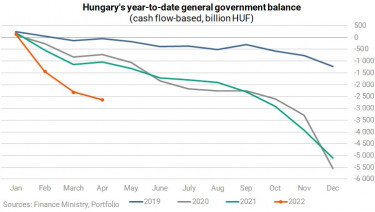
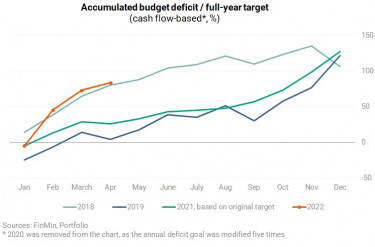
Deficit reaches 83% of full-year target
"In respect of expenditures, it is worth noting that the amounts spent on pensions and curative-preventive medical care exceeded the payments made a year earlier. The government had paid out HUF 1,679.6 billion for pension benefits and HUF 709.1 billion for curative-preventive medical care by the end of April," the Finance Ministry listed in a brief statement the major expenditure items between January and April.
This is apparently linked to higher pension expenditure, linked to the pension hike at the beginning of the year and the full payment of the 13th-month pension in February. The impact of the additional pension increase decided by the government a few weeks ago is not even reflected in this.
This means that by the end of April, 83.6% of the annual cash deficit target had already been met. This is also an extremely high ratio compared to previous years.
Gov't faces a difficult task
The preliminary release by the FinMin turned out to be more concise than usual, but the ministry found it crucial to emphasise at the beginning of its statement that "the stability of Hungary must be maintained in an unpredictable world economic environment created by the war therefore the government is committed to improving balance indicators."
This short sentence can be interpreted in two ways.
- On the one hand, the ministry has written it in general terms to reassure market participants that the budget balance is fine and there is nothing to worry about.
- On the other hand, it could also be seen as a sign that the government is committed to improving the deficit, which could also suggest that the government is preparing for further rebalancing and adjustment and this remark is a harbinger of that.
The PM also notes in the statement that "according to its calculations, economic growth of 4.3%, public debt improving to 76.1% of GDP and a budget deficit of 4.9% are expected for this year. Over the next four years, the government expects continued high economic growth and a steady reduction in public debt and the budget deficit".
If the government were to take additional fiscal measures to balance this year's budget, it would not be an unexpected and surprising turn of events, and this is virtually the consensus in analyst circles. For a number of reasons, the government will have to act if it does not want the budget deficit to get very out of hand (although higher-than-planned inflation and GDP growth expected at 4.3% this year still give the government a significant manoeuvring room).
It is worth pointing out, however, that the new government is now expected to be in place by the end of May, so the earliest it could take measures to improve the balance is June, consequently the earliest they could come into force is July. While the additional fiscal adjustment requirement is HUF 1,200-1,500 billion per year, this would have to be met in half a year, which suggests that the government will have an extremely difficult task in this area.
Cover photo. Péter Szijjártó, Minister of Foreign Affairs and Trade, Tibor Benkő, Minister of Defence, and Mihály Varga, Minister of Finance (right to left), in the front row of the 'horseshoe' at the inaugural session of Parliament on 2 May 2022. Source.: MTI/Szilárd Koszticsák





