Here's the first warning: Hungary is entering a dangerous spiral


According to the statistical office's Tuesday report, the average gross salary in Hungary (for the national economy as a whole) increased to HUF 496,000 in March, which represents a 17% year-on-year growth. Regular earnings are also growing fast, with average regular gross earnings at HUF 459,700, up 15.5% yr/yr in March. This means that wages are growing particularly fast in Hungary, for several general reasons:
- at the beginning of the year, the minimum wage and the guaranteed wage minimum were hiked sharply by 20%, well above the raise of the previous years;
- this drastic hike entailed the requirement of massive wage increases in lower wage categories, as well, to avoid wage congestion (which occurs when starting employees would be paid the same as people working at the given firm for a long time);
- the increasing labour shortage is itself leading to wage hikes.

We are also witnessing stronger wage pressures in this month even compared to January and February. In other words, the March figure is the first sign that Hungary is at the brink of a price-wage spiral. With inflation soaring in recent months and now at a 20-year high, companies are forced to implement larger than planned wage increases, especially in labour-scarce sectors. (Inflation is partly the result of international developments [energy prices] and partly the result of domestic developments, with companies passing on the higher wage costs to customers.) Rising inflation could lead to more and more firms doing things they shouldn't: in many places, wages could rise not once but several times this year.
The strong wage pressure is clearly attested by the fact that in the corporate sector (companies with at least five employees) the average gross wage increased by more than 16% to HUF 526,000.
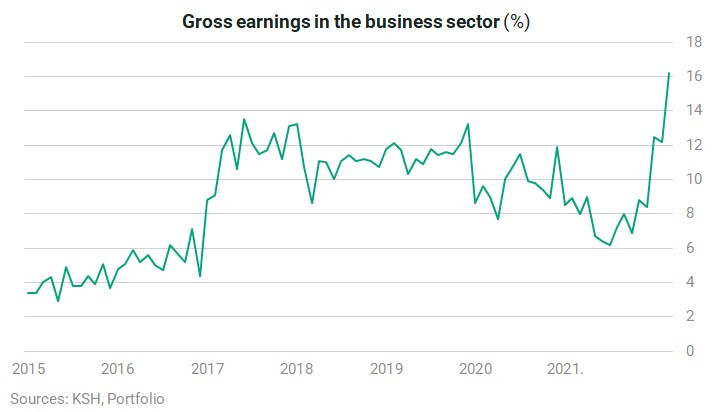
In the budget sector, average gross earnings rose to HUF 467,000, an increase of over 17% in annual terms. (In February, a statistical anomaly caused average earnings to double in the budget sector, but the effect has already "popped".)

- According to the KSH's report, full-time employees’ average gross earnings at corporations employing at least five persons, at budgetary institutions and significant non-profit organisations in respect of employment, amounted to HUF 511,400. Excluding those in public works, the figure comes to HUF 522,300.
- Average net earnings were HUF 340,100 excluding tax benefits and HUF 352,200 including them.
- Both average gross earnings and average net earnings excluding tax benefits grew by 17.5%. The growth of average net earnings including tax benefits was 18,1%, compared to the same period of the previous year.
- Average gross regular earnings (gross earnings without premiums and one-month bonuses) are estimated at HUF 459,700, being 15.5% higher than a year before.
The previously scheduled wage increases, the high nonregular payments (including bonuses and premiums) as well as the significant minimum wage and minimum wage for skilled workers growth contributed in the first place to the increase in average earnings,
the KSH commented.
In today's report, the stats office has provided more details on median wages than in previous flash reports, which greatly improves the transparency of earnings statistics. Median gross earnings reached HUF 394,500, up 15% yr/yr. Median net average earnings, taking into account discounts, were HUF 274,000, 16.5% higher than in March of the previous year. (Median earnings are the total of what half the people earn more and half earn less.)
How much wages rise in Hungary?
In recent years, there has been a major debate about whether wages really grow as fast as the monthly reports of the Hungarian Central Statistical Office (KSH) show. The starting point of the wage dispute is a striking contradiction. In Hungary, the two sets of KSH wage statistics show markedly different trends in terms of wage growth. The statistics based on the national accounts show that wage growth in 2020 was much lower than the labour (earnings) statistics reported in the KSH's monthly flash reports. Economist István Dedák pointed out that the difference in the purchasing power of earnings growth over the last ten years between the different statistics is staggeringly large - almost threefold - with 19% shown by the national accounts and 58% by the monthly labour statistics. In an article responding to the debate, experts at the KSH revealed that the increase in the wage bill according to the ILS (institution-based labour statistics) is well above the rate measured by the national accounts (NA), which tries to filter out the effect of 'whitening' of the economy. Gábor Oblath, an economist, has discussed the problem in several articles and concluded that wages at the national economy level could not have risen at the rate indicated by labour statistics. However, the reasons for the discrepancy and the exact impact of each reason are still unclear. Because of the accounting of the whitening effect as a wage increase, ILS-based wage growth may overestimate the actual increase in the economy, while others argue that earnings calculated on the basis of the NA underestimate it because the national accounts, estimated on the income side, do not give a true picture. This suggests that the truth about the growth of Hungarian earnings could be somewhere in between, but only the KSH could tell us exactly where, and the stats office has been owing us this answer for years.
Cover photo: Getty Images





