Hungary makes four concessions to Commission


10-hour government meeting, forint also on the menu
The government held a 10-hour meeting on Wednesday, said Gergely Gulyás, the minister leading the Prime Minister's Office.
The first point of discussion was the economy and it was concluded that
despite all the tensions, the fundamentals of the Hungarian economy are strong
Gergely Gulyás began his briefing.
Budget revenues are growing, and most budget revenues pencilled in for this year will prove to be underestimated. We have done our best to stabilise the budget. We are doing our best to keep the deficit targets, he said, but did not announce anything new.
Today, exchange rates are being driven by gas prices, which a concomitant weakening of the forint. The root cause is the war,
he said.
He recalled that the dollar had not been so strong against the euro in the last 20 years. Inflation has hit the entire European economy, he said.
Later Gulyás stressed that the government has no intention to weaken the forint, and it is "not happy about what's going on," referring to HUF easing.
"There's no need for any kind of haste because the fundamentals of the Hungarian economy are stable, and the deficit target will also be met. If everyone acts responsibly, this will be enough to stop the forint from depreciating, and then to strengthen the forint," he added.
A stronger forint would be better,
he later replied to a question.
He also said that the worst thing is for the exchange rate to change abruptly.
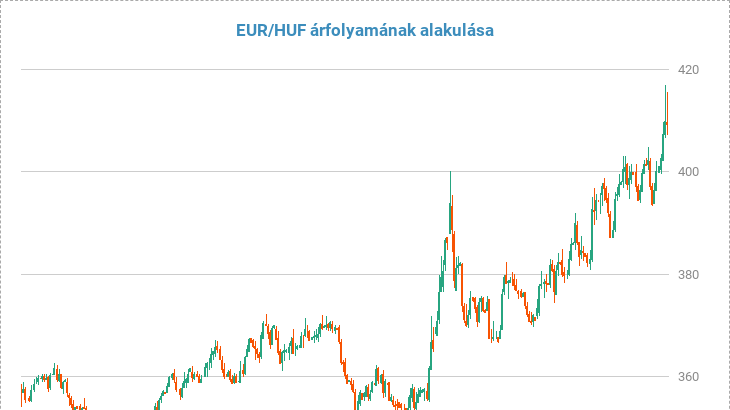
It is worth mentioning here that the forint has weakened at an extraordinary pace in the past day, rising 15 units in two days.
Dispute with the EU
Since the last cabinet meeting, progress has been made in the negotiations with the European Commission on recovery funds, said Gulyás.
The government responded in detail to the Commission's request last week:
- Hungary is reducing the share of single-bid tenders not only in EU procurement but also in public procurement.
- In criminal corruption cases, there should be judicial remedies against prosecutors.
- There will also be time for public consultation before the government-initiated legislation. The government will reduce the rate of special fast-track legislation. The government has also promised to do this.
- The government has also accepted the Commission's proposal that Hungary should devote a significant part of its resources to achieving a significant reduction in energy dependence.
The funds that we could receive as a loan would be used entirely to increase energy independence, Hungary has also promised the Commission, said Gulyás.
The minister then spoke about the investments Hungary is planning to carry out with EU funding to reduce energy dependence.
- The government plans to build a gas turbine power plant,
- The government is also taking the initiative to extend the operating life of Paks I,
- Hungarian gas production to be increased to two billion cubic metres. The country's gas demand is between eight and nine billion cubic metres, he noted. Exploration has not been worth it so far, but at the current gas price it is worth it, he said.
- The government is also accelerating the addition of solar power capacity. The target is six gigawatts of capacity in 1.5 years, he added.
Our aim is to reach an agreement with the European Commission as quickly as possible, and the government is ready to conclude the negotiations,
he stressed.
Gulyás then spoke about migration pressures and the setting up of a 'border-hunter' unit, for which the government will provide funds from the Defence Fund.
What's behind the forint weakening?
There is always the suspicion and danger of speculation. There is no reasonable suspicion, but the danger is always there. The central bank has the tools to prevent speculative attacks on the forint, said Gulyás in response to a question.
Hungary's energy exposure is significant, but we will mitigate this with the new plans, he underlined.
Hungary's very high public debt has been reduced, but it is still higher than in neighbouring countries that have not joined the euro area, he acknowledged as another risk factor.
These factors are contributing to the weakening of the forint, he noted.
Asked about the tools the government has to strengthen the forint, Gulyás said that "we have determined the reason for the weakening of the forint, and it's mainly the gas price. That is why we need to act on this and then we will have a calming effect on the markets," he said.
The government cannot solve the problem of war-induced inflation on its own, but it is trying to reduce energy dependency and diversify energy supplies, he added.
Asked if an agreement with the European Commission strengthen the forint, Gulyás replied: "It will certainly not weaken it." But the country's financing is secured, he underlined.
As long as the war situation persists, and thus inflation is higher, the forint could remain weaker, he said.
An agreement could be reached in the autumn
Even if there is a technical deal with the European Commission on the recovery funds, the earliest possible agreement would be in the autumn, Gergely Gulyás said, adding that the European Parliament is the main obstacle now. He said there is no obstacle to reaching an agreement, as the government claims that all the conditions set by Brussels have been accepted.
Asked how has the Commission reacted to these concessions by Hungary, Gulyás replied that there was an informal, positive response from the European Commission to the Hungarian government's response sent last week.
Policy of sanctions
"We consider the sanctions policy to be wrong," Gulyás reiterated. 'Utility prices are out of control in Europe and even after this some people are thinking of more sanctions. But in such a situation Europe will be at a significant competitive disadvantage compared to America or Asia," he underlined.
We want to bring Europe back to common sense, he said.
That is why the Hungarian government is taking action on the ground to protect the economy, to protect employment.
We hope to make it easier to get through this difficult period with our measures, new energy investments, price controls,
he said.
Gulyás seems to have forgotten a couple of things. Energy prices have been rising BEFORE Russia attacked Ukraine in what it calls to this day a "special military operation" that has claimed thousands of lives, billions of euros in damages, and uprooted millions of people.
According to data by the UN Refugee Agency (UNHCR), one-third of Ukrainians have been forced from their homes since 24 February 2022. This is the largest human displacement crisis in the world today. Some 7 million people have been displaced internally within Ukraine and some 13 million people are estimated to be stranded in affected areas or unable to leave due to heightened security risks, destruction of bridges and roads, as well as lack of resources or information on where to find safety and accommodation. Nearly 8.8 million Ukrainians have fled the country (and cc. 3.3 million returned) until 5 July.
The minister also appears to be extremely hopeful in stressing that sanctions policy is bad and the war - he would be sent to prison if he called the conflict a war in Russia by the way - would have to be ended through negotiations. If you pay careful attention to the cabinet's rhetoric it may increasingly appear that in Hungary's eye Brussels is equally or even more to blame for the current situation than Moscow.
Forint parts ways with CEE peers
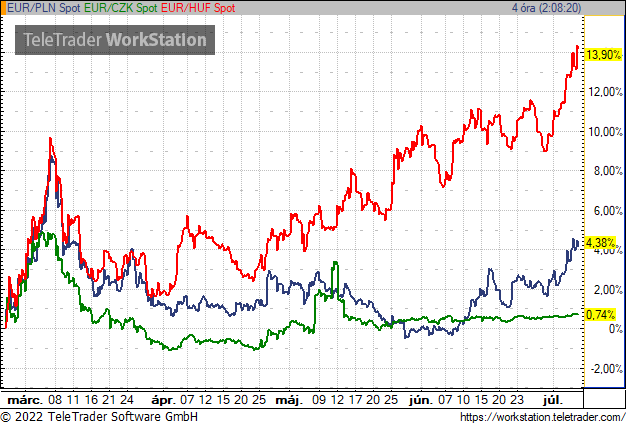
All regional currencies underperform, but the forint is the weakest performer,
the minister admitted in his reply. One reason for this, he said, is that Hungary's government debt is higher. This is the primary explanation. We inherited this from the change of regime and eight years of socialist government, he reminded.
Seriously? WTF? Are we still talking about "the past eight years"? Viktor Orbán was Prime Minister for four years between 1998 and 2002, and he has held this position, with his party having supermajority in Parliament since 2010. That's 16 years, and 12 years in a row, folks! And Gulyás still talks about inherited debt? Amazing.
The other reason is that the country's energy intensity is much higher than in two other countries, Poland and the Czech Republic, whose currencies have weakened less since the outbreak of the war, he added.
More to follow!





