Hungarian economy rides fast in Q2, but it is approaching 'Downturn Lane'


Economy shows bulging muscles in H1
Hungary's GDP grew by 6.5% year on year in April-June 2022, which can be regarded as great feat. Analysts were expecting growth to slow down from 8.2% in Q1 to around 6.0% in Q2, hence the 6.5% print is a surprise on the upside. The KSH's flash estimate shows 1.1% quarter-on-quarter growth.
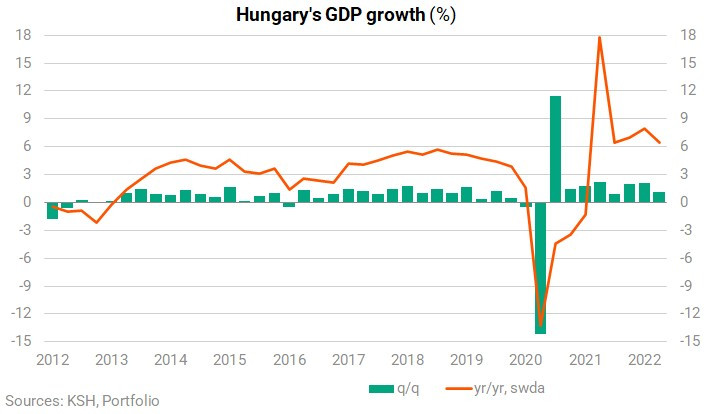
"Almost all sections contributed to the increase, but mostly industry and market services. There were significant growths especially in the manufacture of food products and beverages as well as electrical equipment within industry and mostly accommodation and food service activities as well as transportation and storage among market services. A considerable downturn in agriculture slowed the growth," the stats office commented.
Hungary's economic output expanded by 7.3% year on year in January-June.
Although detailed data have not yet been published, it is certain that the engine of growth was consumption on the demand side and services on the supply side. In addition to the rise in wages, consumption was supported by one-off benefits such as the pre-election personal income tax refund and the 13th month pension. Investment was certainly not as strong and, with energy prices rising sharply, foreign trade was particularly negative as imports became more expensive. Towards the end of the second quarter, there were already signs of a slowdown, even according to the central bank's previous assessment.
Muscle atrophy expected in H2
Annual growth is expected to decelerate further in the third quarter and contraction over April-June is also on the cards. The persistent and sharper-than-expected rise in inflation is causing ever greater pain to households, as it is reducing the real income for more and more people.
Today, even those who received a wage increase of over 10% are seeing their living standards fall, as inflation is even higher. In the coming months, rising utility costs will also drive inflation higher, while the population will be forced to cut back on consumption. The effects of one-off benefits have also run out, so that they no longer underpin GDP growth, which has already been visible in the retail sales data of recent months.
The outlook for industrial production is mixed and the construction sector has already started to slow down. The services sector is likely to hold up, but rising inflation will also have a negative impact here, as more and more services will have to be cut or abandoned by the population. On top of this, fiscal policy is also pro-cyclical, implementing large fiscal cuts of thousands of billions of forints at a time when the economy is slowing down, exacerbating the deterioration. The fiscal contribution to GDP will therefore be negative due to the adjustments, while the measures will further fuel inflation as companies pass on the special taxes to consumers.
A sharp rise in interest rates could also weigh on lending, leading to a fall in household investment. Although favourable interest rates are still available for companies, economic uncertainties are already pointing to a reduction in investment. Against this backdrop, a quarter-on-quarter contraction in the economy is becoming increasingly likely as early as the fourth quarter. The biggest risk in terms of recession is the severity of the gas crisis in Europe: if several countries are forced to restrict gas consumption in industrial facilities and the service sector, this will also have negative effects in Hungary, where industry could experience a drastic downturn.
The negative trends could be mitigated if the government were to reach an agreement with the European Commission on EU funds, which would improve the country's macroeconomic stability, reduce the need for fiscal adjustment and allow the resumption of some deferred, frozen investments. Not least, the EU deal would also stabilise the exchange rate of the forint, whose high volatility and weakening further worsens the economic outlook, and stabilisation measures would have to be accompanied by high interest rates that would freeze market lending, reinforcing fears of a recession.
Summary
GDP growth was therefore strong in the second quarter, with a large contribution from a substantial expansion in household consumption. After GDP grew by 7.3% in the first half of this year, economists expect average annual growth of around 6% even with a slowdown in H2. The rise in inflation and the slowdown in real earnings growth will certainly drag on economic performance, and the big question will be how severe the impact of the gas crisis will be on industry and services. Indeed, whether growth 'just' stops on a quarterly basis or whether a recession develops depends to a large extent on this. The deterioration in the growth outlook means that growth next year is likely to be much more modest than this year. Economists now expect GDP growth of between 2% and 3% in 2023.
Cover photo: Getty Images





