Labour shortages hit historic high in Hungary


Vacancy at a record
According to the Central Statistical Office (KSH), there were 99,000 job vacancies in the second quarter. Such a high number of workers has never been missing from the domestic labour market. Even the pre-pandemic peak was "only" at 90,000 advertised positions. In other words, the labour shortage is more severe today than it was when the problem (Covid-related lockdown measures) was a major constraint on business growth in the pre-crisis record period.

In the business sector, there are nearly 70,000 vacancies, while the public sector has 26,000 vacancies. In the public sector, there are also serious problems in education, health and public defence. The non-profit sector also lacks 4,000 workers.
The recent rapid expansion of the economy has been associated with an increase in labour shortages. In the midst of the Covid restrictions, job vacancies fell and unemployment rose, but in 2021 the Hungarian economy emerged from the doldrums and its performance exceeded pre-crisis levels. As expectations about the economic outlook improved, companies hired more and more workers and full employment has now been achieved.

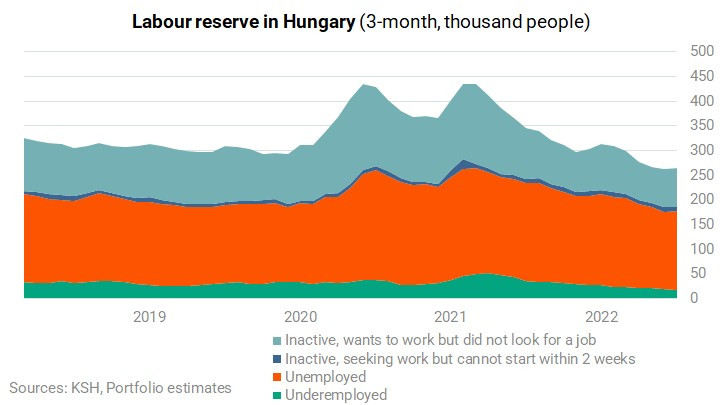
Hungary's GDP continued to grow rapidly in the second quarter of this year, with companies' orders increasing steadily, and they were keen to increase employment further. However, with the labour supply starting to run out, it is now becoming very difficult for them to do so. The labour reserve (unemployed and inactive people willing to work) is now at a lower level than it was before the coronavirus pandemic. Then the labour reserve fluctuated around 300,000, and then approached 450,000 during the COVID-19 crisis, when lockdown measures led to drastic redundancies. As the recovery took hold, the reserve has also fallen, to just over 250,000.
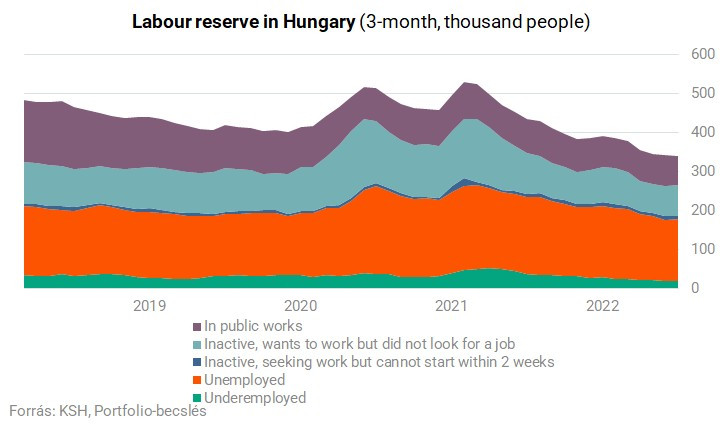
If we 'reclassify' those in public works into the labour reserve, we can see that the number of over 500,000 workers at the peak of the COVID-19 crisis has now fallen below 350,000. However, it is less and less worthwhile to include public works employees in the reserve, as it is difficult to imagine that those who are currently in the public works scheme will find a job on the market.
Companies have lowered their recruitment criteria in recent years due to labour shortages, so many of those in public works have found jobs on the primary labour market at higher wages, but now those who remain in the system either live in particularly disadvantaged settlements or are not employable in the corporate sector due to a lack of skills.
A new chapter begins?
So overall, the Hungarian economy had a record number of job vacancies in the second quarter, and companies are not really able to attract new workers because the labour reserve has fallen to a very low level. The labour shortage has thus become a serious constraint to businesses' growth.
However, the number of vacancies may fall in the coming quarters as economic growth slackens. Corporations are already more cautious about hiring, recession concerns are growing, and the surge in energy prices over the past month or two could force many companies to close either temporarily or permanently.
As the economic recession approaches, labour shortages may ease and unemployment may even rise. But in the longer term, there is no question that labour shortages will be severe. The demographic trend, with an ageing population, will lead to more people retiring while fewer people enter the labour market due to low birth rates. This could be one of the major problems to be addressed in the next decade or two, as the annual birth rate of less than 100,000 in recent years and new retirements of between 140,000 and 160,000 in the coming years will put the labour market under enormous pressure.

Cover photo: Getty Images





