Surging energy prices could put unemployment back on Hungary's map


Everything's hunky-dory on the surface
- According to the latest employment data, more than 4.5 million people work on Hungary's primary labour market, while the unemployment rate is below 3.5%. Such positive figures were last seen before the coronavirus crisis, meaning that the labour market has fully recovered from the blow delivered by the pandemic.

- In the meantime, companies are desperate to find staff: between April and June, there were almost 100,000 job vacancies in Hungary, indicating an unprecedented labour shortage. Never before have we seen such a high figure, not even when labour shortages were the main constraint on business growth before the Covid crisis. The problem is bigger now than it was then.

- Labour supply has also fallen to a low level. The pool of unemployed and inactive people who want to work is steadily shrinking. In the more developed areas of the country, there are hardly any reserves, and almost everyone who wants to work has a job. Already a significant proportion of those employed in public works have migrated onto the primary labour market.
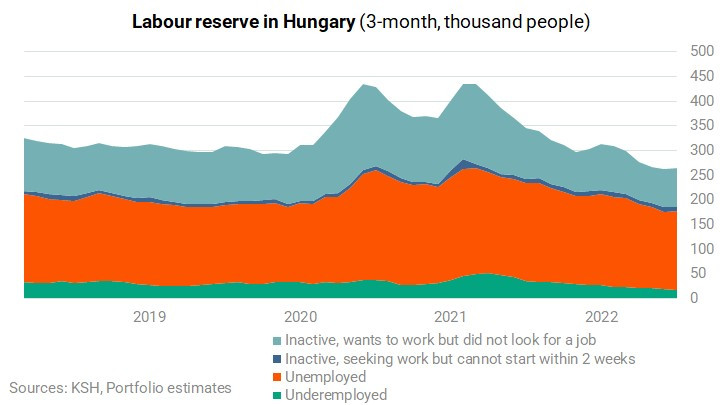
The labour shortage is so severe that companies are now competing with each other to attract and retain skilled workers, as was the case before the Covid crisis. Runaway inflation has led to the emergence of a phenomenon we have not seen for a long time: (i) wage increases in labour-scarce sectors several times a year, and (ii) one-off wage compensation. This has set off a price-wage spiral in recent months, which in itself has been a major challenge for companies.
Runaway energy prices
But now companies are facing a phenomenon that will be very difficult to manage. The price of certain products and services would now have to be raised not by 10-15-20% to avoid losses, but by much more. Indeed, energy prices, which had already risen a lot at the beginning of the year, have really gone out of control in recent months.
As a result, more and more companies are seeing their energy bills rise by a factor of 6 to 8, a challenge not seen since the Covid crisis or the global economic crisis of 2008-09.
Due to rising energy prices, many bakeries would have to sell bread for HUF 1,500 instead of the current 600 to 800 forints per kilo, restaurants would have to offer a main course for HUF 6,000 to HUF 7,000 instead of 3,000 to 4,000 forints, and a hotel room for HUF 25,000 to HUF 30,000 forints would have to be offered for more than HUF 50,000. Such a price increase would not be acceptable or affordable to consumers. As charnging that much is not an option, they are left with no choice but to try and cut costs and make efficiency investments. Or resort simply to downsizing: doing the same or more work with fewer workers. If these fail, then a temporary or permanent shutdown of production/services becomes inevitable. We are now seeing the first signs of this in restaurants and hotels, where the operations of companies with balance sheets tattered by Covid has just been restored. The closures will soon reach the retail sector, and then slowly all industries where energy price movements play a significant role.
surging gas and electricity prices could turn the labour shortage situation around in an instant.
It is easy to see that while a company could have hired 4-5 workers a month or two ago to meet demand, it now has to downsize due to multiplying energy bills and falling demand linked to high consumer prices. In the first half of the year, in addition to wage increases, households and companies have been living under the illusion of the personal income tax refund, the full-payment of a 13th-month pension and other one-off benefits. The former spread the money around and the latter raised prices after demand did not fall even at higher price levels.
Now, however, people seem to be scraping the bottom of these buffers, while inflation has risen to a level that is reducing real wages for millions of people. As a result, households have become more cautious in the last month or two, and are also preparing for higher utility bills from the autumn.

So from now on, people will have to pay more for utilities, leaving them with less money for food and other services, which are already becoming increasingly expensive very rapidly, reducing demand for them. Rising overheads deliver an even greater shock to businesses than to households, and they can hardly compensate this by raising prices, so they have to work on cutting costs.
The state is also struggling with the same problem: the energy bill of public institutions and the payment of part of the household utility bills (partial maintenance of utility bills reduction scheme) are putting considerable pressure on the budget, which is already restrictive due to the adjustments, and so GDP will be consequently shrinking.
Layoffs and closures
This is why we are hearing that more and more sectors that have been growing in recent months could suddenly collapse. With rising overheads in the accommodation services sector, industry experts project a worse situation than during COVID-19, but more cautious forecasts are also expecting a high number of closures.
We have already seen the first signs of this, with several hotels and guesthouses suspending their activities. Restaurants are also struggling to cope with the rise in raw material and energy prices, and hardly a day goes by when we don't hear or read about a restaurant or patisserie going bankrupt. Spas are not coping with the insane price rises either, so there will be some temporary closures from the autumn.
And the price businesses are getting energy for is not even close to the price that emerged on the market in the month or two. Retail companies are also now facing unbearable prices that are becoming unaffordable for more and more of them.
Industry could also be hit by a series of redundancies and bankruptcies, only a bit later. Many industrial companies are signing annual contracts, trying to fix the price for next year's energy consumption in the coming months, but this will cost a pretty penny for everyone. As a result, many will try to carry out massive price hikes, but as such attempts will fail in many cases, the next step will be shutting down production.
The first half of the year also saw a return to pre-Covid employment levels in industry, accommodation services and trade, but this could well be where the turnaround starts in the coming months.
First, labour shortages will ease (in the next few months or so), followed by a gradual decline in the number of employed people in several sectors. In other words, the sectors that are likely to be the biggest losers in the crisis now are the same sectors that suffered a lot during the pandemic.
However, the wave of closures/layoffs may be slower now, as during COVID-19 there were immediate lockdown measures that brought the economy to a sudden halt, but now the negative impact of the energy price surge is slower.
There will be some that pull the plug at once, as we are already seeing examples of. Others will face the full impact of soaring prices in a few months and close only then. Some companies will try to survive by cutting costs heavily and/or investing in efficiency enhancement but will eventually not be able to withstand the price shock as demand for their products will start to fall at a certain price level. This could lead to a wave of redundancies in the most affected sectors for many months if energy prices do not consolidate quickly.
The rebound is not expected to be as fast as it was after the Covid restrictions, when firms found themselves in a relatively favourable environment after the reopening of the economy, with low interest rates and strong demand (pent-up consumption) putting them back on a growth trajectory.
The economic situation will not recover overnight, as it did at the post-Covid reopening, with persistently high inflation making it difficult to expect real wages to grow in any meaningful way, savings to grow palpably, and skyrocketing interest rates unlikely to fall to favourable levels overnight. Hence, employment growth may also be protracted.
Of course, the best thing would be for companies not to get rid of workers, but where they are considering closure, there is no chance of that.
To avoid a host of layoffs, the government may try to provide job creation benefits through tax breaks, but the big question is whether there will be Kurzarbeit-type job retention support for sectors in crisis. The fiscal manoeuvring room is now extremely tight, but the Covid period has shown that it is much less costly to protect jobs in vulnerable sectors than to (re)create them, so it would certainly pay to reallocate significant amounts of money in the budget to job protection.
During the Covid period, nearly 60,000 full-time jobs were lost in the tourism and hospitality sector, with trade associations estimating at least double this number of redundancies (including non-full-time workers and contractors) across the sector.

In trade, 40,000 full-time jobs were lost to Covid. This year, the explosion in suppliers' prices, the weakening of the forint, rising wage costs, new special taxes and surcharges, and the price freeze measures have already put retailers in a very difficult position, and booming overheads could accelerate the wave of bankruptcies.

Tens of thousands of workers were sacked from the administrative and service support sector during Covid, and this sector is still under threat as office rents are also being hit hard by the price rises. In industry, at least 40,000 people lost their jobs during the coronavirus pandemic, where energy is also a major cost of production. In energy-intensive sectors, more and more are expecting effects similar to those witnessed during the pandemic, but delayed rather than immediate. Then the state was trying to retain workers, but now the municipal sector - which is also facing a spike in its utility bills - could well be forced to tightening measures that will lead to workers being laid off, while state-owned companies will also find it harder to operate.
In other words, there could easily be a wave of hundreds of thousands of redundancies across the economy as a whole as a result of the energy crisis if current trends do not improve.
Whether the increase in unemployment will eventually be in the tens or hundreds of thousands is too early to tell. It depends largely on how high the energy bill will eventually be for the players. To get away with a small recession and not too big a rise in unemployment, current energy prices will have to fall substantially and/or huge public subsidies will be needed, but the fiscal room for manoeuvre is limited. Extremely high energy prices could soon lead to a deep recession, and failure to protect as many jobs as possible in this situation could lead to much slower GDP growth in the years ahead.
Cover photo: Getty Images





