EIB economist points to countries at risk due to energy crisis


The EU has returned to pre-crisis levels, but has not caught up with the pre-crisis trend, and before the war, the economy was hit by another shock with the disruption of supply chains. Fiscal and monetary support have played a major role in the rapid recovery from the crisis, and the overall policy response can be considered a success.
Two factors are currently holding back the economy: monetary tightening and the Russian-Ukrainian war, said Laurent Maurin, Senior Economist in the Economics Department of the European Investment Bank, at the event.
Before the crisis, the Eastern and Central European region of the EU was characterised by strong convergence, but real GDP declined as a result of the coronavirus crisis. The depth of the Covid crisis was comparable to the 2008 crisis, but the recovery was much faster this time.
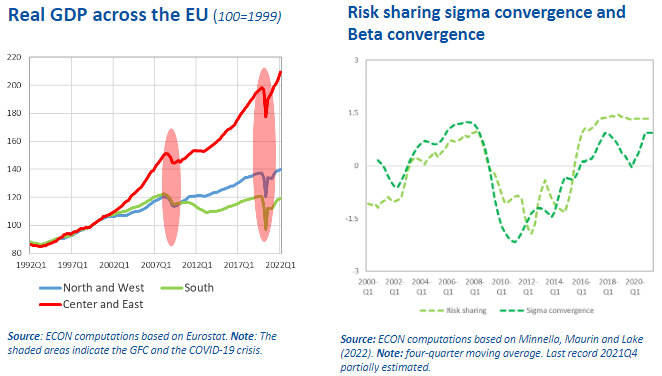
However, the effects are still being felt, with business investment still very far from the pre-crisis trend and the corporate sector not yet fully recovered from the Russian-Ukrainian war, he pointed out. At the same time, there seems to be a significant rebound in profits, with a strong correlation with fiscal support across countries.

The war has led to a significant rise in energy prices, which has also contributed to the rise in consumer price indices. However, the contribution of non-energy items to euro area inflation was also very high, so energy is not the only cause of the rise in prices for households.

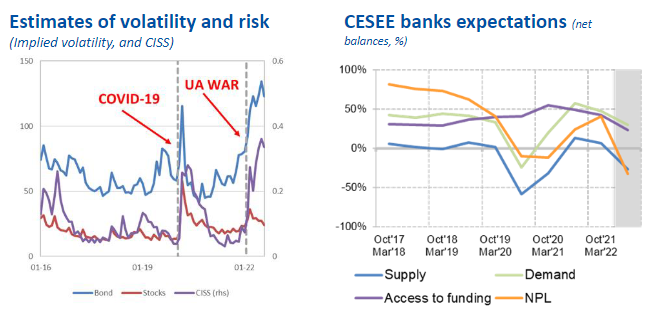
This, combined with monetary policy, has led to a rise in interest rates in the EU, with significant volatility in the pricing of government bonds, largely driven by market expectations. In addition, yield curves have flattened and spreads between countries' bonds have re-emerged.
The tightening of monetary policy has already been reflected in the pricing of corporate bonds, which are very important for investment decisions. However, a further rise is expected in the coming period as the impact of monetary tightening feeds through.

Talking about the responses given to the crisis, Maurin said that fiscal support was very significant, with 56% of European companies receiving some form of aid. Some of the fiscal support has been in the form of loans, but despite this we are not seeing a dramatic increase in corporate borrowing, while cash holdings have increased significantly. Outstanding bank loans have jumped significantly, especially in short-term maturities.
On the impact of the consequences of the war on Europe, the EIB's senior economist said that one of the channels is exports. At the European level, there is no significant export exposure, although there is significant dependence in some countries.
The greatest dependence is in energy, with the rise in energy prices having the most significant impact in Europe, which is eroding profitability. And the vulnerability of individual countries can be measured through their gas dependence: the more north-east a country is located, the greater its exposure to Russia. Greater dependence can also be found within sectors (e.g. chemicals and transport):
so the countries most at risk are those that are most exposed to Russian gas and where the weight of energy-dependent sectors is the largest, Maurin said.

Cover photo: Getty Images





