Gas prices plummet, quotes at lowest levels since June


South of EUR 100
The fall in gas prices continues in the late morning hours, after a 14.7% drop, the price broke through the psychologically important 100 euro level - currently at EUR 97.5 per megawatt-hour on the Dutch TTF gas exchange.

There are several reasons behind the fall in gas prices:
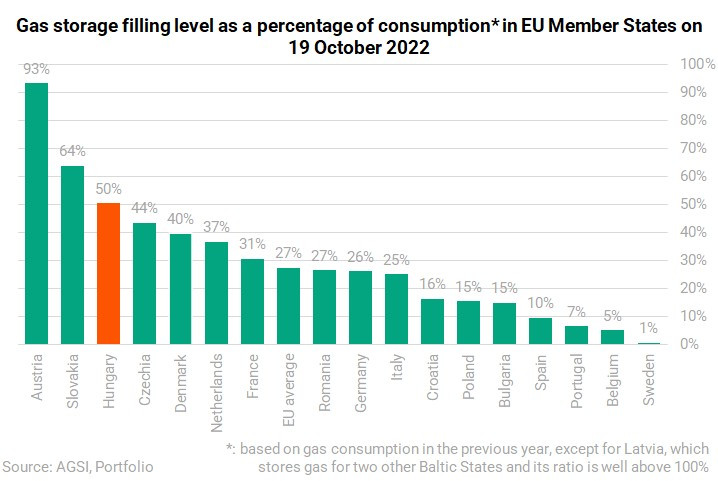
- Firstly, European gas storage facilities are already close to full capacity, so supplies to the continent are assured this winter, but frugality will be a priority as it is not always clear what the filling level will be when the storage season starts next spring. The EU is already well over the minimum target of 80% of storage capacity to be reached by 1 November, with the EU already at almost 93%, according to AGSI data, and we are seeing that:
THE GRAPH HAS UNUSUALLY NOT STARTED TO CURVE DOWNWARDS from early OCTOBER, BUT has been ON A STEADY RISE instead.
This has to do with depressed industrial and service sector consumption, the fact that people and businesses have no choice but to go try and save on energy, and the still feverish storage activity in many countries.

- Furthermore, the winter weather could be more favourable than expected for the continent, which should help make the aforementioned savings easier to achieve.
- In addition, Europe has managed to secure some of its gas supply from new sources, which is one of the reasons why the attacks on the Nord Stream pipelines have not driven up prices, and market participants were not particularly concerned about the sabotage, nor about China's announcement yesterday that it would stop its LNG shipments, after it made the preservation of domestic energy security a priority.
- Thursday's EU summit also took important decisions regarding the gas market, with the possibility of two kinds of gas price caps. Member States have also agreed on the basic rules for joint gas procurement and emergency gas bail-outs, and there is also a Portuguese-Spanish-French deal (MidCat, BarMar) that could improve gas supplies to CEE. Additionally, EU leaders opened the door in principle to new common sources of gas to help member states offset energy bills.
- Interestingly, Hungary's 50% storage load to consumption ratio is the third highest after Austria (93%) and Slovakia (64%), and unusually, the filling level has been growing rapidly even in recent weeks, driven by steady injection pace in addition to more restrained gas use.
Following Friday's fall, gas prices are now 11.5% down, the lowest since mid-June.
THE CURRENT PRICE LEVEL OF AROUND €100 ALSO MEANS THAT THE PRICE OF GAS HAS ALREADY FALLEN BY MORE THAN 70% FROM ITS PEAK OF €342 IN AUGUST.
However, the price is still higher than the €90 level of 1 year ago, when Russia tried to put pressure on European decision-makers by restricting gas supplies to obtain the Nord Stream 2 permits.

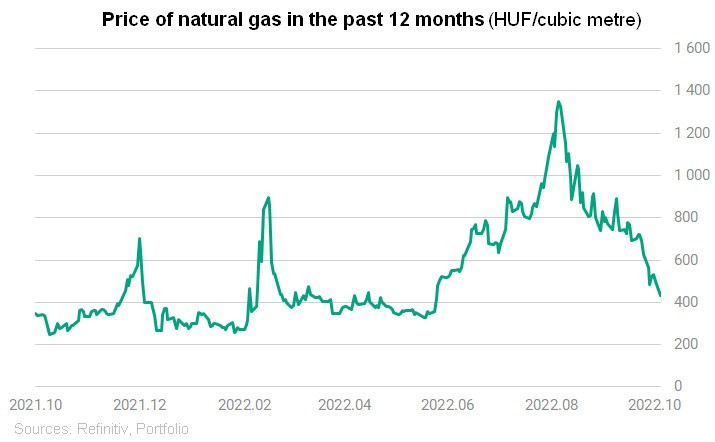
We have also prepared a graph of the gas exchange rate in HUF/m3 instead of EUR/MWh, using the current EUR/HUF exchange rate and the gas price data from the TTF gas exchange. The graph shows that the gas price in HUF peaked at the end of August, when 1 cubic metre cost more than 1300 HUF, and is currently around 431 HUF per cubic metre on the Dutch gas exchange.
The price of gas in HUF had not been this low was since early June, and it is still more than four times the price of gas in Hungary, which is subject to a rebate of 102 forints per m3.
Cover photo: Getty Images





