Majority of Hungarians would embrace heavier taxes on air travel, SUVs, reject 19° C cap on home temperature


Main findings
- 66% of people surveyed in the European Union believe that the Russian invasion of Ukraine and its consequences should accelerate the green transition (vs. 62% in the United Kingdom, 60% in China and 52% in the United States).
- 84% of EU respondents say that if we do not drastically reduce our consumption of energy and goods in the coming years, we will be heading for a global catastrophe (vs. 88% of Chinese respondents, 83% of British respondents and 72% of American respondents).
- 63% of people surveyed in the European Union want energy prices to be tied to consumption, with the biggest consumers charged more (vs. 83% in China, 63% in the United Kingdom and 57% in the United States).
Of the EU countries, only Croatia (81%) had a higher share of those who think that the post-war high energy prices should accelerate the green transition than Hungary (77%), with the same percentage of Italians respondents being of the same view. (See more results on Hungary below.)

Climate change awareness and urgency
A large majority of people surveyed in the European Union and China say they feel the effects of climate change on their daily lives (80% and 91%, respectively). Meanwhile, this perception is less pronounced among Americans (67%) and British people (65%).
84% of EU respondents say that if we do not drastically reduce our consumption of energy and goods in the coming years, we will be heading for a global catastrophe (vs. 88% of Chinese respondents, 83% of British respondents and 72% of American respondents).
Meanwhile, 87% of people surveyed in the European Union and 85% in the United Kingdom feel that their government has been too slow to act in averting climate change, an opinion that is slightly less prevalent in China (76%) and the United States (74%). Only a minority of British, EU and American respondents think that their governments will succeed in substantially reducing their carbon emissions by 2030 (30%, 36% and 45%, respectively). Chinese respondents seem much more confident, with 91% saying their government will succeed in doing so.
Most EU (66%), British (62%) and Chinese (60%) respondents believe that the war in Ukraine and its consequences on the price of oil and gas should accelerate the green transition. Americans are split: a narrow majority (52%) agrees, while 48% view the war as a reason to actually slow down the green transition.
To reduce energy consumption, 64% of EU respondents want polluting activities, such as air travel and SUVs, to be taxed more heavily to account for their environmental cost (vs. 84% in China, 66% in the United States and 52% in the United Kingdom). A majority of EU citizens surveyed (63%) also want energy prices to be tied to household consumption levels (vs. 87% in China, 62% in the United Kingdom and 56% in the United States).
Finally, on addressing high energy prices, 40% of EU respondents think that in the short term, the government should first reduce energy-related taxes (vs. 29% in the United Kingdom, 24% in China and 23% in the United States). Other measures, such as capping or regulating the price of gas, oil and coal, are more favoured by British, Chinese and American respondents (46%, 38% and 29%, respectively) than EU respondents (28%).
Three quarters of Hungarians think war should give a boost to green transition
Highlights:
- 77% believe that the Russian invasion of Ukraine and its consequences should accelerate the green transition.
- 86% say that, if we do not drastically reduce our consumption of energy and goods in the coming years, we will be heading for a global catastrophe.
- 71% want highly polluting goods and services such as air travel and sport utility vehicles (SUVs) to be taxed more heavily to account for their environmental cost.
- 65% want energy prices to be tied to consumption, with those consuming the most being charged more.
After a challenging year in which Russia’s invasion of Ukraine sparked an ongoing energy crisis and accelerated inflation all over Europe, and a summer marked by record heatwaves and droughts, Hungarians have become even more acutely aware of the impact of climate change and the need for urgent action.
Climate change awareness and urgency
While COVID-19 was considered the number one challenge for Hungarians last year, concerns over inflation now predominate, with 72% citing it as their top concern, compared with 36% across the rest of the European Union.
Meanwhile, 91% of Hungarians now say they feel the effects of climate change on their daily lives (an increase of 4 percentage points since 2021).
86% think that, if we do not drastically reduce our consumption of energy and goods in the coming years, we will be heading for a global catastrophe. At the same time, 90% feel that the government is reacting too slowly, and only 35% think that Hungary will succeed in substantially reducing its carbon emissions by 2030.
War in Ukraine and green transition
Three-quarters of Hungarians (77%) believe that the war in Ukraine and its consequences on the prices of oil and gas should accelerate the green transition (12 percentage points more than the European average of 65%).
When asked to rank their energy priorities, Hungarians expect their government to prioritise the development of renewable energies (63%) before focusing on energy supply diversification to avoid being overly reliant on a single provider (23%).
Energy savings are less of a priority, with only 14% of Hungarians agreeing that citizens and companies are not truly willing to change the way they produce and consume (5 percentage points below the EU average of 19%).
Tackling climate change and addressing high energy prices
To reduce energy consumption, most Hungarians want highly polluting goods and services such as air travel and SUVs to be taxed more heavily to account for their environmental cost (71%). They also want energy prices to be tied to consumption, with those consuming the most being charged more (65%).
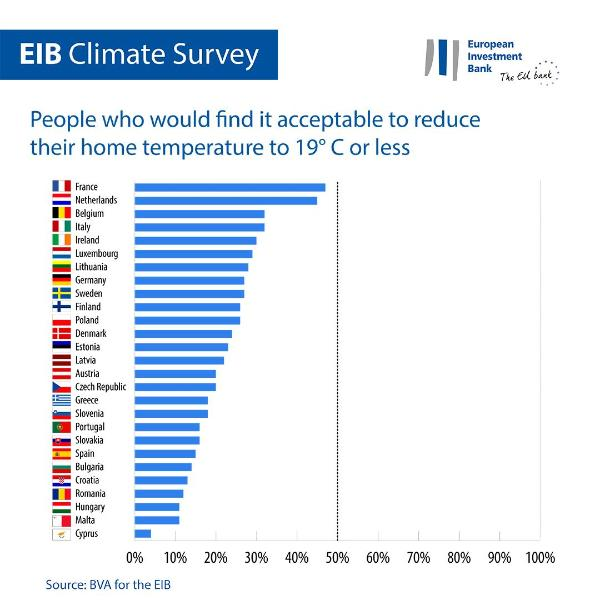
If Hungarians were to lower the temperature in their homes this winter, only 11% of them would accept capping it at 19°C,
which is the official recommendation (17 percentage points below the EU average of 28%). Meanwhile, 32% of Hungarians say that they already cannot afford to heat their homes properly.
Finally, on addressing high energy prices, 32% of Hungarians think that in the short term the government should reduce energy-related taxes (43% among far-left sympathisers). Other measures are less popular, such as encouraging energy saving through public campaigns (26%), capping or regulating the prices of gas, oil and coal (23%), or giving out energy vouchers (13%).
The EIB 2022 Climate Survey shows that most Hungarians support prioritising the transition to renewable energy generation as an effective way to fight the global energy and climate crisis. This is very welcome support ahead of the COP27 climate conference,
said EIB Vice-President Teresa Czerwińska.
"The EIB is ready to continue with hands-on support to Hungary and to make sure the country can benefit from our decades-long experience in supporting innovative clean energy investments, including modernisation of energy supply, wind farms and more energy-efficient social housing. We stand ready to use our full range of advisory and financial instruments to ensure a just green energy transition that leaves no one behind.”
Cover photo: Getty Images





