Hungary scraps Ministry of Technology and Industry, sets up new Energy Ministry


László Palkovics, Minister of Technology and Industry has bowed out of office, and his resignation was accepted by PM Orbán.
The minister's departure is unprecedented in the Orbán governments, as there have been no similar ministerial resignations (only a couple of state secretaries stepped down). So far, typically government members (such as Katalin Novák, László Trócsányi) have left the government because they took other positions.
The Ministry of Technology and Industry will be no more. Its responsibilities will be divided between:
- Ministry of Economic Development (minister: Márton Nagy) - New responsibility: industry;
- Ministry of Construction and Investment (minister: János Lázár) - New responsibility: transport;
- Ministry of Culture and Innovation (minister: János Csák) - New responsibility: vocational training.
- A new Ministry of Energy will be set up as of 1 December, to be headed by Csaba Lantos. His task will be to ensure the unified management of Hungary's energy policy.
The current responsibilities of the Energy Office that do not need to be managed by an independent body under EU rules will also be taken over by the new ministry. The key officials of the Energy Ministry will be the minister, naturally, his deputy, a state secretary for administration, a state secretary for energy and one for the environment.
Csaba Lantos started his career at the Creditanstalt Investment Bank, serving in various leadership positions between 1989 and 2000, and ultimately as the CEO of the Hungarian Investment Banking Arm (CA-IB). He was a long-time Chairman of the Supervisory Board of the Budapest Stock Exchange and the Chairman of the Board of the Central Securities Depository and Clearing House (KELER).
In August 2000, he joined OTP Bank as a Member of the Board and Deputy CEO, leading the retail banking arm. Since 2007 Mr. Lantos has been undertaking investments in the health care and life sciences sectors, and in 2010 became Board Member of Richter Gedeon Plc., the largest pharmaceutical company in Hungary. Mr. Lantos has held the position of the Chairman of the Board of MET Holding AG since 2009.
When asked why Lantos was chosen, Gulyás replied that because he is an "economist with excellent managerial skills" who has gained considerable prestige and recognition in Hungary in recent years, and with him the government will also be strengthened. He also added that Lantos had gained considerable experience in the energy sector through the MET Group.
Hungary can apply for full recovery loan for network development
Gulyás was asked about the blocking of solar grid connections, while the Factory Rescue programme is also supporting renewable energy developments. Regarding the connection, or more precisely the feed-in stop, Gulyás indicated that there is a demand for twice the current installed solar capacity (around 3,400 MW), which poses serious challenges for the stable operation of the grid.
Therefore, and this is new information, Gulyás said that the government plans to use the "loan leg of the recovery and resilience facility in its entirety" for this purpose, i.e. for grid flexibility, capacity expansion and presumably for power plant capacity expansion. The minister also indicated that it is important to install batteries for storage at the very time when companies are unable to feed into the grid.
The winds may change in wind energy policy
Asked about the tensions within the government on wind energy, which Prime Minister Viktor Orbán also spoke about in Parliament, and what can be expected after László Palkovics' departure, Gulyás said that EU regulations and the government's plans in this area coincide, because in order to be able to draw funds from the EU recovery programme, it was necessary to change the regulation of wind energy, for example.
He added that the government had prepared this work independently of the current change of ministers. He then pointed out that Csaba Lantos had indicated to the PM that he believed that "wind energy should be given priority" and that, in Gulyás' words, "the Prime Minister asked him to be minister in this context".
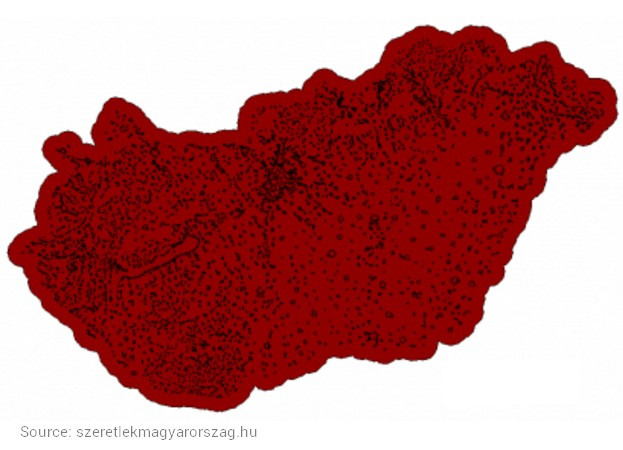
Hungarian MPs passed a law in mid-December 2016 that banned wind turbines within a 12-kilometer radius of populated areas. The legislation left no area in Hungary where new wind energy capacity could be installed.
At that time a colleague of the Faculty of Science at the Eötvös Loránd University created a map with a geoinformatics software which illustrated the areas where the law applies. Red marks the banned and white the permitted areas. Cannot see any white spots? Exactly!
More to follow!





