Job vacancies in Hungary drop for the first time in two years - Should we start worrying now?


In the three months to end-September, the number of job vacancies in Hungary has fallen by nearly 10,000, according to the latest figures from the Central Statistical Office (KSH). The 90,000 vacancies are still historically very high, meaning that labour shortages were still prevalent in Q3 of this year, but they have eased quickly as economic growth slowed. The last time the number of vacancies declined so rapidly was after the coronavirus outbreak. The statistics show 62,000 vacancies in the business sector, 25,000 in the public sector and 3,000 in the non-profit sector between July and September.

It is important to underline that, for the time being, we are essentially talking about a reduction in the labour shortage, with no sign of a substantial fall in employment and no rapid increase in unemployment. True, employment is above its previous record high and unemployment has also risen slightly since the spring, but the country as a whole continues to be characterised by a rather tight labour market. However, we may be facing major changes sector by sector, as there will be industries that are more severely affected by the slowdown and the energy price explosion.

In October, KSH counted 174,000 unemployed, slightly lower than the 178,000 seen the previous month but higher than the low of 160,000 seen in the spring. The unemployment rate was 3.6%.

It is likely that the number of vacancies will continue to fall in the final months of this year, as the economy faces increasingly severe problems and the country could well enter a technical recession. The energy crisis is hitting all sectors of the economy, with many sectors not only facing a freeze in staff numbers, but also downsizing and suspensions of activity during these months, with restaurants, swimming pools, hotels and retail outlets closing due to surging overheads.
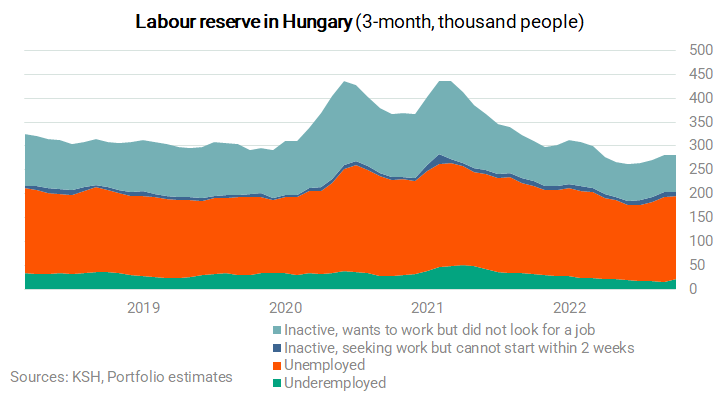
The escalation of economic problems is already reflected in the evolution of the labour supply in the period between August and October. We have already seen a slight increase in recent months, with moderate rise in both in the number of unemployed persons and those who would like to work more (the underemployed, i.e. part-time workers). However, as the graph below shows, the increase in the labour reserve is not significant, but the low point is now behind us. In the coming months, the potential labour reserve may well be back above 300,000.
Cover photo: Getty Images





